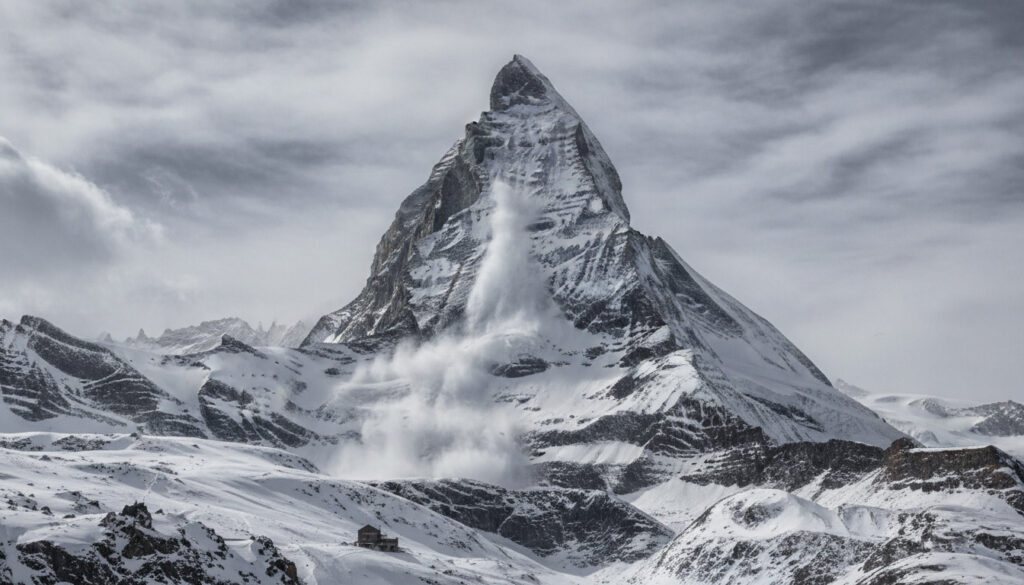
Five Skiers Found Dead Switzerland – Zermatt Avalanche Explained
Five backcountry skiers were found dead on the Adlergletscher below the Rimpfischhorn peak near Zermatt, Switzerland, following an avalanche on May 24, 2025. The victims were recovered by helicopter rescue teams after fellow climbers discovered abandoned equipment and raised the alarm.
The group had departed from the Britannia Hut early Saturday morning for a high-altitude tour of the 4,199-meter peak, which sits in the Pennine Alps between Zermatt and Saas-Fee. Authorities confirmed the recovery of all five bodies by evening, with the incident publicly reported on May 25.
Valais cantonal police have opened a formal investigation into the circumstances surrounding the deaths, while the Swiss Avalanche Institute classified the event as a dry slab avalanche. The tragedy brings Switzerland’s avalanche fatality count for the 2024-25 season to 21, exceeding the ten-year average.
What Happened to the Five Skiers Found Dead Near Zermatt?
May 24, 2025
Adlergletscher, Rimpfischhorn
5 skiers (3 Swiss identified)
Investigation ongoing
- Five backcountry skiers died in a dry slab avalanche on the Eagle Glacier beneath the 4,199-meter Rimpfischhorn peak. Ski The World
- The party departed Britannia Hut at approximately 4:30 a.m. on May 24 for a high-altitude ski tour.
- Recovery teams located three bodies in avalanche debris 500 meters below the ski site and two others on a snowfield 200 meters above. ExplorersWeb
- Three victims have been identified as Swiss nationals aged 34 to 38; identities of the remaining two remain undisclosed pending formal identification. CBS News
- The Swiss Avalanche Institute classified the slide as a dry slab avalanche despite recent warming conditions.
- The incident raises the season’s avalanche death toll to 21, surpassing the 10-year average of 18.3 fatalities.
- Valais cantonal police and the prosecutor’s office have initiated a formal investigation, though progress is slowed by the absence of direct witnesses.
| Incident Date | May 24, 2025 |
|---|---|
| Public Report | May 25, 2025 |
| Location | Adlergletscher, below Rimpfischhorn (4,199m) |
| Region | Pennine Alps, between Zermatt and Saas-Fee |
| Group Size | 5 skiers |
| Confirmed Nationalities | 3 Swiss (men aged 38, 35; woman aged 34) |
| Avalanche Type | Dry slab (per Swiss Avalanche Institute) |
| Weather Context | 10cm fresh snow followed by warming |
| Warning Level | Elevated for north-facing slopes above 3,000m |
| Recovery Method | Air Zermatt helicopters and KWRO alpine teams |
Where Exactly Were the Skiers Found in Switzerland?
The incident occurred on the Adlergletscher, commonly known as the Eagle Glacier, which lies on the northern approach to the Rimpfischhorn. This 4,199-meter peak forms part of the Pennine Alps along the border between the Zermatt and Saas-Fee valleys in the canton of Valais.
The Britannia Hut Starting Point
The group initiated their ascent from the Britannia Hut, a high-alpine refuge situated at 3,030 meters above sea level. The hut serves as the standard base camp for ski mountaineers attempting the Rimpfischhorn via the Adlergletscher route. They departed at approximately 4:30 a.m., intending to reach the summit during optimal morning snow conditions.
Discovery of Abandoned Equipment
At around 4:30 p.m. on May 24, two other climbers ascending the route noticed skis and equipment abandoned near the 4,000-meter mark, approximately 200 meters below the summit. The discovery prompted an immediate alert to rescue services, as the gear appeared deliberately placed rather than scattered by natural forces.
The Rimpfischhorn presents technical challenges including crevassed glaciers and steep ice sections. The route requires glacier travel skills and proper avalanche safety equipment. The area is particularly popular among experienced spring ski mountaineers seeking high-altitude descents.
Recovery Locations
Search teams located the victims in two distinct zones. Three bodies were recovered from avalanche debris approximately 500 meters below the ski abandonment site, positioned on an avalanche cone. Two additional bodies were found higher on a snowfield roughly 200 meters above the equipment, suggesting different trajectories or reaction times during the event.
Was an Avalanche Involved in the Zermatt Skiing Deaths?
Physical evidence at the scene confirmed an avalanche as the cause of death. The Swiss Avalanche Institute (SLF) analyzed the debris and classified the event as a dry slab avalanche, a particularly dangerous type that often occurs without warning signs despite stable appearances.
Weather Conditions and Warnings
The days preceding the incident saw approximately 10 centimeters of fresh snowfall, followed by rapid temperature increases. While new snow often bonds well with existing layers, the warming trend can destabilize persistent weak layers buried deeper in the snowpack. Elevated avalanche warnings were active for high alpine terrain, specifically cautioning against north-facing slopes above 3,000 meters—precisely the conditions present on the Rimpfischhorn’s upper faces.
Backcountry travelers monitoring meteorological resources may reference various forecasting tools including the Met Office Rain Radar for broader weather pattern analysis, though local Swiss avalanche bulletins provide the most relevant safety data for this region.
Spring warming can create dangerous instability in high alpine snowpacks. Dry slab avalanches typically release on persistent weak layers buried within the snowpack, often giving no surface indication of danger until failure occurs. Backcountry users should verify current bulletins and avoid steep, shaded slopes during warming trends.
Investigation Parameters
Valais cantonal police, in coordination with the cantonal prosecutor’s office, have opened a formal investigation to determine precise causation. Investigators face significant challenges due to the absence of direct witnesses to the avalanche event. Weather data, snowpack analysis, and equipment examination form the primary evidence base for reconstructing the incident timeline.
What Is Known About Related Skiing Incidents?
The Rimpfischhorn tragedy occurred within hours of a separate fatal avalanche elsewhere in Switzerland, highlighting particularly dangerous conditions across the Alps during late May 2025.
The Morgenhorn Incident
On the same day as the Zermatt fatalities, a dry slab avalanche on the Morgenhorn near Kandersteg claimed the life of a 29-year-old Swiss skier from Bern canton. Two additional skiers sustained injuries in that incident, which occurred independently but under similar meteorological conditions.
Seasonal Fatality Statistics
These deaths bring Switzerland’s avalanche fatality total for the 2024-25 season to 21, significantly exceeding the ten-year average of 18.3 deaths per season. The concentrated timing of these incidents—occurring in late spring rather than mid-winter—reflects the particular hazards of transitional snowpack conditions.
Experienced mountaineers recommend early departure times to capitalize on overnight freeze stability, conservative route selection on north-facing aspects, and immediate descent upon observing warming trends. Carrying complete avalanche transceiver, probe, and shovel equipment remains mandatory, though statistics indicate that survival chances decrease significantly with multiple burial scenarios.
How Did the Search and Recovery Operation Unfold?
- May 24, 04:30: The group departs Britannia Hut for the Rimpfischhorn ascent. Ski The World
- May 24, Morning: Skiers reach approximately 4,000 meters elevation, leave skis, and continue on foot toward the summit. ExplorersWeb
- May 24, 16:30: Two climbers discover abandoned skis and equipment, alerting rescue services to potential distress. CBS News
- May 24, Evening: Air Zermatt deploys helicopters and paramedics; KWRO mountain rescue specialists initiate aerial and ground search operations. CNN
- May 24, Evening: Recovery teams locate five bodies in two separate locations—three in avalanche debris below and two on a snowfield above the equipment site. BBC News
- May 25, 2025: Valais cantonal police publicly confirm the deaths and initiate formal investigation. The Guardian
What Has Been Confirmed Versus What Remains Uncertain?
Established Facts
- Five skiers died in an avalanche on the Adlergletscher below Rimpfischhorn on May 24, 2025.
- The Swiss Avalanche Institute classified the event as a dry slab avalanche.
- Three victims are confirmed Swiss nationals: men aged 38 and 35, and a woman aged 34.
- Recovery teams located bodies at two distinct elevation levels relative to abandoned equipment.
- Elevated avalanche warnings were active for the terrain class and aspect where the incident occurred.
Open Questions
- The nationalities and identities of the two remaining victims remain undisclosed pending formal identification.
- The precise trigger mechanism—whether natural release or human-triggered—has not been determined.
- The exact time of the avalanche remains unknown, complicating timeline reconstruction.
- Whether any victims survived the initial slide or died from subsequent burial or trauma remains unconfirmed.
- The group’s specific route choice above 4,000 meters has not been fully mapped.
How Does This Incident Reflect Broader Alpine Safety Trends?
The Rimpfischhorn fatalities illustrate the persistent dangers of high-alpine ski mountaineering even during spring conditions traditionally considered more stable than mid-winter. The 4,199-meter peak attracts experienced practitioners seeking challenging descents, yet the combination of glacial terrain, altitude-related fatigue, and warming-induced instability creates a complex hazard matrix.
Switzerland’s 2024-25 avalanche season has now recorded 21 fatalities, exceeding the ten-year statistical average. This uptick occurs despite advances in avalanche forecasting technology and safety equipment penetration among backcountry users. The concentration of late-season deaths suggests that spring touring—often perceived as safer due to consolidated snowpacks—carries distinct risks related to wet avalanches and cornice failures on high peaks.
Proper insulation remains critical for high-alpine ski touring, where temperature differentials between valley floors and 4,000-meter peaks can exceed 20 degrees Celsius. Quality layering systems including the Canada Goose Body Warmer provide essential core temperature regulation during static periods such as equipment transitions or emergency bivouacs.
What Have Official Sources Reported?
Five backcountry skiers died in an avalanche on the Adlergletscher below the 4,199-meter Rimpfischhorn peak near Zermatt, Switzerland, with their bodies recovered on May 24, 2025.
— Ski The World, May 25, 2025
Authorities confirmed three Swiss nationals among the dead: two men aged 38 and 35, and a 34-year-old woman. The nationalities and identities of the other two victims were not released, with formal identification still underway.
— CBS News, May 25, 2025
Valais cantonal police and the cantonal prosecutor’s office opened a formal investigation into the circumstances, noting slow progress due to no direct witnesses.
— BBC News, May 25, 2025
What Is the Current Status of the Investigation?
Valais cantonal police continue their formal investigation into the Rimpfischhorn avalanche, working alongside the cantonal prosecutor’s office to establish causation and compliance with safety protocols. The absence of eyewitnesses necessitates reliance on forensic snow analysis, meteorological data, and equipment examination to reconstruct events. Authorities have not indicated a timeline for completion, though formal identification of all victims remains pending. Backcountry travelers should consult current avalanche bulletins and consider equipment upgrades including the Canada Goose Body Warmer for thermal protection during high-alpine excursions.
Frequently Asked Questions
Who were the five skiers found dead near Zermatt?
Authorities have confirmed three Swiss nationals: two men aged 38 and 35, and a woman aged 34. The identities and nationalities of the remaining two victims have not been released pending formal identification procedures.
What type of avalanche caused the deaths?
The Swiss Avalanche Institute classified the event as a dry slab avalanche, which typically releases on persistent weak layers within the snowpack without visible surface signs of instability.
Was anyone else in the group or were there survivors?
All five members of the ski party died in the incident. No survivors were found, and no additional missing persons have been reported in connection with this specific event.
How dangerous is the Rimpfischhorn for ski mountaineering?
The 4,199-meter peak presents technical challenges including glaciated terrain, crevasse fields, and avalanche-prone slopes. It is considered suitable only for experienced alpinists with proper equipment and route-finding skills.
What weather conditions contributed to the avalanche?
Approximately 10 centimeters of fresh snow followed by warming temperatures created instability. Elevated avalanche warnings were active for north-facing slopes above 3,000 meters, including the incident site.
Where exactly were the bodies discovered?
Rescue teams located three bodies in avalanche debris approximately 500 meters below the abandoned skis, and two additional bodies on a snowfield roughly 200 meters above the equipment site.
How does this compare to previous seasons?
The 21 avalanche fatalities in Switzerland for 2024-25 exceed the ten-year average of 18.3 deaths, marking a particularly deadly season including two separate fatal incidents on May 24 alone.
More related posts
 Simon Helberg: Health, Career, and Co-Star Bonds
 Mahershala Ali: Religion, Oscar Wins & Name Change
 Trisha Paytas: YouTube Fame, OnlyFans, Health, and Family
 Tamzin Outhwaite: Biography, Children, Movies, Family Connection
 Pat Butcher: 2025 Return, Death, Family & Style – EastEnders
 Sarah Michelle Gellar: Illness, Quit Acting, Lawsuit & Life Now
 What Is a Drag Queen? Definition, History, and Famous Performers
 Houses for Sale Near Me – Fresh Listings and Buying Tips