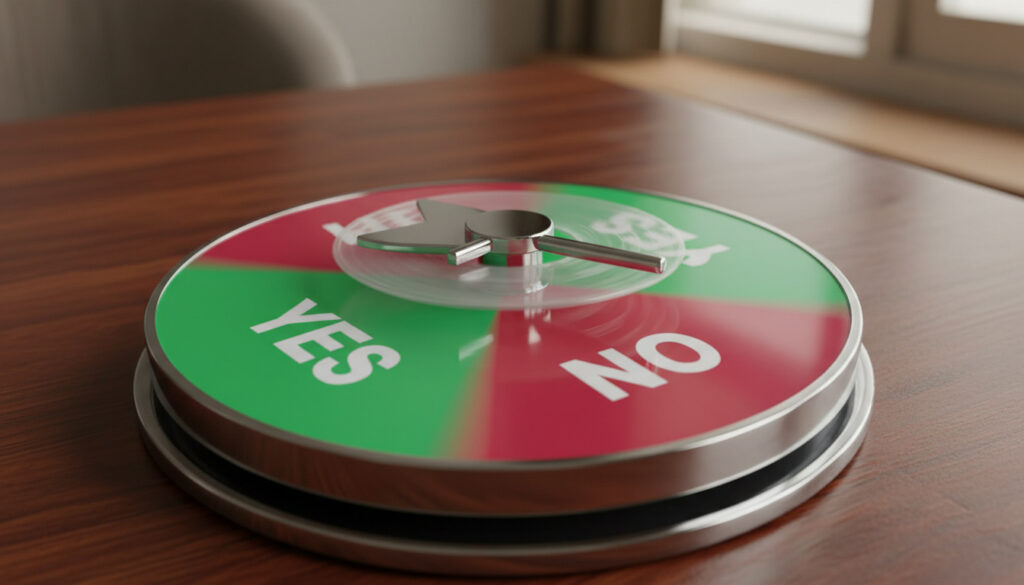
Yes or No Wheel – Free Spinner for Quick Decisions
A Yes or No wheel is a free online random spinner tool that functions as a virtual decision maker. Divided into segments labeled “Yes,” “No,” and sometimes “Maybe,” these web-based applications provide instant, unbiased answers for quick choices, games, or resolving friendly debates.
Unlike physical props that require setup, these digital spinners load immediately in browsers across phones, tablets, and computers. Users simply input a question, activate the spinner, and receive a randomized outcome within seconds.
The appeal lies in the removal of human bias. When facing indecision about trivial matters—ranging from what to eat to whether to attend an event—the wheel introduces an element of chance that absolves the user from responsibility for the outcome. Most platforms operate without advertisements, registration requirements, or download prompts, making them accessible to anyone with internet access.
What is a Yes or No Wheel?
Core Function
Random yes/no decision spinner providing immediate binary or ternary outcomes
Key Benefit
Quick random choice maker eliminating decision fatigue
Customization
Add questions or options, adjust themes, spin time, and visual effects
Platforms
Web-based responsive design, no installation needed
- Provides immediate binary or ternary outcomes without registration
- Operates on randomized algorithms ensuring unpredictable results
- Requires no financial commitment or account creation
- Adapts to both trivial daily decisions and entertainment-focused gaming
- Offers customizable visual themes, sound effects, and haptic feedback
- Supports accessibility through keyboard controls and screen readers
- Functions identically across mobile, tablet, and desktop browsers
| Feature | Details |
|---|---|
| Core Mechanism | Random spinner with segmented outcomes |
| Standard Options | Yes/No (50/50) or Yes/No/Maybe (33/33/33) |
| Cost Structure | 100% free, no advertisements on major platforms |
| Access Method | Web browser, no installation required |
| Control Types | Click, Spacebar, Ctrl+Enter, or touchscreen |
| Customization | Themes, spin duration, weights, confetti effects |
| Output Modes | Single spin or multiple consecutive spins |
| Accessibility | Responsive design for all screen sizes |
Uplup offers an ad-free experience with unlimited spins and optional account creation for saving custom wheels. Yes or No Wheel Spinner provides sound effects and haptic feedback for mobile users. Wheel Decide features a playful interface with Yes/No/50/50 modes. Picker Wheel supports up to five input sets with customizable colors and fonts.
How to Use a Yes or No Wheel with a Question?
Preparing Your Query
Effective use begins with formulating a clear binary question. Whether asking “Should I order pizza?” or “Is now the right time to message them?”, specificity improves the psychological impact of the result. Most interfaces provide a text box where users can type their question for contextual reference, though the wheel mechanism ignores the content and generates purely random outcomes.
Activation Methods
Users initiate spins through multiple input methods. Clicking the central “SPIN” button triggers the animation, while keyboard users may press Spacebar or Ctrl+Enter for faster access. Mobile participants simply tap the wheel center. The animation typically lasts several seconds, though pressing Escape stops the motion immediately if time is limited. Touchscreen devices often provide haptic feedback upon completion.
Most tools support Spacebar or Ctrl+Enter to initiate spins, and the Escape key to stop the animation early. Mobile users can tap the wheel center for identical results.
Interpreting Results
The segment landing under the indicator determines the answer. Psychological studies suggest that user reactions to results—whether relief or disappointment—often reveal true underlying preferences. This phenomenon makes the tool valuable not for the randomness itself, but for clarifying internal desires through surprised responses to outcomes.
What Are Popular Yes or No Wheel Variants?
Clean Interface Options
Minimalist platforms prioritize speed and clarity. LiveReacting offers multiple input sets specifically designed for group decision-making scenarios. Picker Wheel includes statistical tracking showing spin history. These interfaces remove visual clutter while maintaining core functionality.
Multi-Mode Configurations
Advanced variants extend beyond binary choices. The standard 50/50 split competes with 33/33/33 distributions when “Maybe” enters the equation. Some platforms allow weighting adjustments, increasing the probability of specific outcomes for demonstration purposes. Customizable spin times ranging from three to nine seconds accommodate different urgency levels.
Leading platforms including Uplup, Yes or No Wheel Spinner, and LiveReacting operate without charging fees or displaying advertisements. No registration is required to access core spinning functionality.
Entertainment-Focused Adaptations
Certain implementations incorporate celebratory confetti animations, sound effects, and emoji-based results such as thumbs up or down icons. SpinTheWheel connects to broader app ecosystems offering additional randomization tools. These features target social media sharing and party game environments rather than solitary decision-making.
Yes or No Dice as an Alternative?
Digital Dice Mechanics
Virtual dice provide similar functionality through different visual metaphors. Rather than watching segments rotate, users observe numericalrandomization typically simulating six-sided throws. Binary mappings—where results one through three indicate “Yes” and four through six indicate “No”—create comparable 50/50 probability splits. Some users prefer the immediate resolution of dice rolls over the theatrical suspension of spinning wheels.
Probability Comparisons
Both methods rely on pseudo-random number generation algorithms. Dice offer tactile familiarity for tabletop gamers, while wheels provide clearer visual confirmation of outcomes. Cross-platform compatibility remains identical, with both tools functioning in browsers without downloads.
These tools provide randomized entertainment outcomes only. Results should not substitute for professional advice in financial, medical, or legal decisions.
How Has the Yes or No Decision Tool Evolved?
- Physical Predecessors: Coin flips and spin-the-bottle games established binary chance mechanisms centuries before digital adaptation.
- Early Digital Randomizers: Basic web-based coin flips emerged in the 2000s, transitioning physical probability into algorithmic outputs.
- Mobile Optimization: Responsive design implementations between 2010 and 2015 enabled touchscreen spinning on smartphones without Flash dependencies.
- Feature Expansion: Recent developments added haptic feedback, customizable weighting, confetti celebrations, and keyboard accessibility shortcuts.
- Current Standards: Modern iterations emphasize ad-free experiences, privacy protection through no-registration policies, and multi-input set capabilities for complex scenarios.
What Is Fact and What Remains Uncertain?
Clear distinctions exist between verified capabilities and ongoing unknowns regarding these decision tools.
| Established Information | Information That Remains Unclear |
|---|---|
| Randomization provides mathematically equal 50/50 or 33/33/33 odds | Specific RNG algorithms and seeding methods used by individual developers |
| Tools are free and require no personal registration | Long-term sustainability of specific free platforms without revenue models |
| Web-based access works consistently across devices | Whether results maintain true randomness over millions of spins |
| Sound and haptics enhance user experience on supported devices | Psychological impact of regularly outsourcing personal decisions to chance |
Why Do People Use Random Decision Makers?
Decision fatigue represents a documented cognitive phenomenon where the quality of choices deteriorates after extended periods of decision-making. Randomization tools alleviate this burden by removing agency from low-stakes scenarios. Just as geographers categorize the planet into distinct bodies of water like those described in How Many Oceans Are There – The Five Oceans Explained, users categorize choices into binary outcomes to simplify complex mental landscapes.
Gamification elements transform mundane selections into entertainment. The anticipation of the spin creates dopamine responses similar to slot machines, though without financial stakes. Social contexts drive adoption, with groups using wheels to settle debates without assigning blame to individuals for unpopular choices.
Where Does This Information Come From?
Yes or No Wheels are free online random spinner tools designed as virtual decision makers, typically divided into segments labeled “Yes,” “No,” and sometimes “Maybe,” to provide instant, unbiased answers for quick choices.
Uplup
Think of a yes/no question, spin, and interpret the result—often revealing true preferences via reaction.
Yes or No Wheel Spinner
These tools derive from general picker wheels specialized for binary outcomes, often marketed as fortune wheels, decision makers, or spinners.
Wheel Decide
Should You Use a Yes or No Wheel for Your Next Decision?
For trivial choices where either outcome carries minimal consequence, these tools offer efficient resolution without cognitive strain. They serve party games, icebreakers, and low-stakes personal dilemmas effectively. From understanding measurements like How Many Units in a Pint – UK Guide for Lager, Guinness, Stella to selecting weekend activities, the yes or no wheel provides immediate answers while preserving mental energy for significant decisions requiring genuine deliberation.
Common Questions
What is the name of the Yes or No wheel?
These tools carry various names including Yes or No Wheel, Yes No Spinner, and Yes or No Decision Maker. Some platforms brand them as fortune wheels or random pickers depending on visual styling.
What is Google Yes or No?
This refers to using Google’s search engine to locate yes or no wheel tools, or voice queries asking Google Assistant binary questions. It is not a distinct Google product.
God Yes or No wheel?
Certain spiritual variations frame the spinner as divine guidance, though standard wheels use random number generation without theological significance or claimed supernatural influence.
What is Yes or No wheel Fortune?
This variant adds celebratory confetti and “fortune” branding to the standard binary spinner, treating outcomes as prophetic or lucky rather than purely algorithmic.
What is Yes or No wheel tarot?
Some practitioners combine yes/no wheels with tarot methodology, spinning to determine card orientations or simple answers before drawing, though this hybrid approach lacks traditional tarot structure.
How does Yes or No dice work?
Digital dice simulate physical rolls using random number generators, typically offering binary mappings where specific number ranges correspond to Yes or No answers versus segmented wheel approaches.
More related posts
 Zlatan Ibrahimovic: Biography, Career, Net Worth, Age
 Wet Wet Wet Songs – Top 10 Hits Discography Lyrics
 MC Hammer Downfall, Net Worth, and Life Today in 2025
 James May: Health, Relationships, Net Worth, Metrosexual Label
 Lia Thomas: First Openly Transgender NCAA Champion
 Shea Lacey: Man Utd Winger Bio, Stats, Family & More
 Statutory Sick Pay Ireland 2026: Rates & How to Claim
 TommyInnit: Age, Real Name, Diagnosis, Relationships, and More