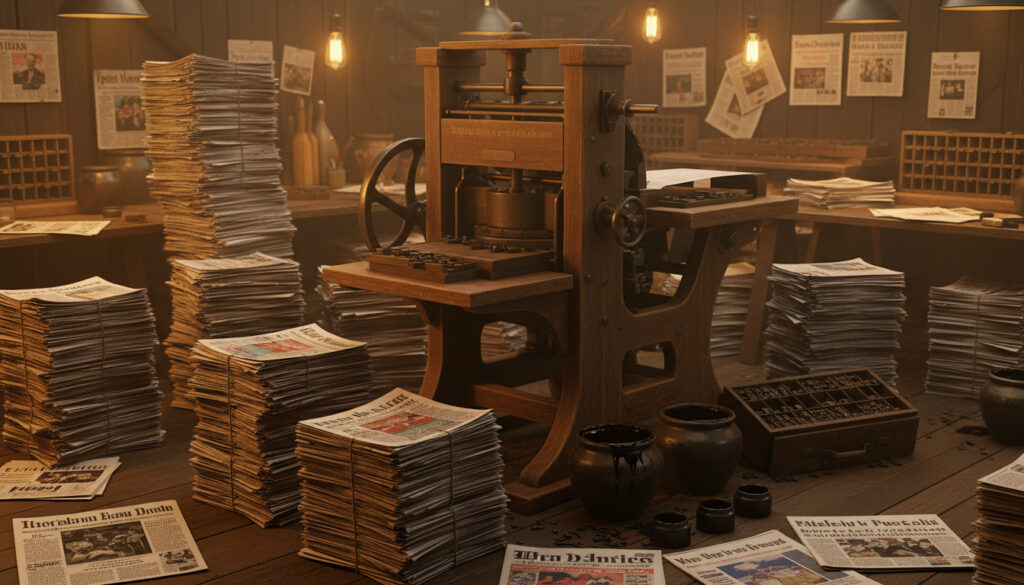
Newspaper – Definition, Origins and Types
A newspaper is a periodically published print or digital medium, typically issued daily or weekly, that delivers current news, views, features, public interest articles, correspondence, and advertisements on folded sheets.
Newspapers concentrate on events from the past 24 hours. They served as key sources of information before television, radio, and the internet emerged, and they hold strong appeal today.
Acting as a form of mass communication, newspapers blend content of general and specialist interest with advertising.
What is a newspaper?
| Aspect | Description |
|---|---|
| Frequency | Typically daily or weekly |
| Medium | Print or digital, often folded sheets |
| Content focus | Current news, views, features, public interest |
| Additional elements | Correspondence, advertisements |
- Newspapers prioritise recent events, mainly within the last day.
- They predate broadcast and digital media as primary information sources.
- Advertising forms a core part alongside editorial content.
- Content spans general interest and specialised topics.
- They enable mass communication to wide audiences.
- Formats include both print and digital versions today.
| Feature | Detail | Source |
|---|---|---|
| Definition | Periodically published medium with news and ads | Study.com |
| Time focus | Past 24 hours | UNF LibGuides |
| Mass role | Communication vehicle | Britannica |
| Popularity | Persists post-TV/internet | Study.com |
| Content mix | General/special interest | OKState Library |
| Advertising | Integral component | Britannica |
| Predecessors | Acta Diurna (59 BCE) | TAMU ODP |
| Print enabler | Gutenberg press (15th century) | OpenEd Alberta |
How did newspapers originate?
Rome’s Acta Diurna from 59 BCE marks an ancient precursor. It posted political and social events, births, deaths, and gossip publicly.
Late Middle Ages brought manuscript newsletters from traders, such as the Fugger family.
Modern emergence
Seventeenth-century Dutch corantos were dense 2-4 page papers. German pamphlets ran 8-24 pages. English corantos appeared in 1621, leading to the first daily, The Daily Courant, in 1702.
Gutenberg’s 15th-century press allowed mass production, broadening access beyond elites.
Key papers like The Times in 1785 established quality benchmarks. The Observer followed in 1791. North America’s Publick Occurrences launched in 1690 but faced a swift ban.
Historical Origins of Newspapers
What types of newspapers exist?
Newspapers differ by format, frequency including daily, weekly, semi-weekly, bi-weekly, or monthly, and content emphasis.
Broadsheet
Larger page size suits serious, in-depth coverage. Examples include Chicago Tribune and The Times.
Tabloid
Half the broadsheet size, compact and sometimes sensational. The US debut was New York Daily News in 1919; UK had Daily Mail from 1896. Others include Chicago Sun-Times.
Classification began with physical dimensions but now signals style differences.
Corantos stressed efficiency; pamphlets offered more detail.
Historical Origins of Newspapers
Newspaper history timeline
- : Rome’s Acta Diurna posts public notices (Britannica).
- 15th century: Gutenberg’s press enables mass printing (OpenEd Alberta).
- Late Middle Ages: Fugger family newsletters circulate (Britannica).
- 1621: English corantos emerge (Britannica).
- 1690: North America’s Publick Occurrences published and banned (Britannica).
- 1702: The Daily Courant, first English daily (Britannica).
- 1785: The Times sets quality standards (Britannica).
- 1791: The Observer launches (Britannica).
- 1896: UK Daily Mail tabloid debuts (OKState Library).
- 1919: US New York Daily News tabloid starts (OKState Library).
What facts about newspapers are established?
| Established Information | Information that remains unclear |
|---|---|
| Core definition as periodic news medium | Precise status of Acta Diurna as true newspaper |
| Historical milestones from 17th century | Exact transition points in early formats |
| Broadsheet vs tabloid distinctions | Future dominance of digital over print |
| Mass communication role with ads |
Why do newspapers matter?
Newspapers provided accessible information long before modern media. They democratised news through printing advances.
Today, they sustain relevance amid digital shifts, blending tradition with adaptation.
Reliable sources on newspapers
A newspaper is a periodically published print or digital medium… on folded sheets.
Newspapers focus on events from the past 24 hours…
Study.com
Newspapers in brief
Newspapers blend history, from ancient notices to modern dailies, with formats like broadsheet and tabloid serving mass audiences through news and ads.
What differentiates broadsheet from tabloid newspapers?
Broadsheets use larger pages for in-depth coverage; tabloids are compact, sometimes sensational.
Was Acta Diurna the first newspaper?
It served as an ancient precursor posting public events, but modern forms arose later. For more information, see Australiainsight.
How often are newspapers published?
Typically daily or weekly, also semi-weekly, bi-weekly, or monthly.
What role did Gutenberg play?
His 15th-century press enabled mass production and wider access.
Do newspapers include advertising?
Yes, alongside news, views, and features.
When was the first English daily?
The Daily Courant in 1702.
Are newspapers only print?
No, now also digital mediums.
More related posts
 Hilton Dalaman Sarigerme Resort & Spa – 2025 Reviews and Booking Guide
 Melissa O’Neil: Marriage, Kids, and The Rookie Facts
 Vlad Dracula: The Real History Behind the Legend
 Norm Macdonald: SNL, The Orville, and Legacy of a Comedy Icon
 Manchester United F.C. vs Ipswich Town – Stats, H2H and Analysis
 The Haunting of Hill House – Netflix Cast Episodes Book Guide
 Daniel Gillies: Marriage, Net Worth, Accent, and Current Projects
 Jeremy Kyle: From Cancellation to Comeback (2026)