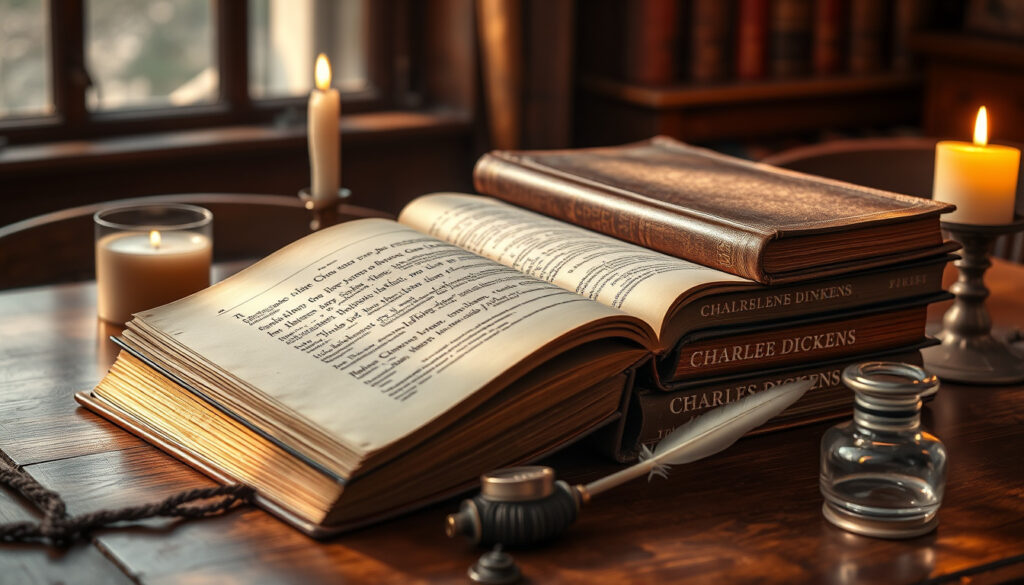
Charles Dickens Book: Complete Guide to His Novels & Best Works
Few authors from the 19th century still appear on bedside tables and reading lists as often as Charles Dickens. His novels have stayed alive through film, stage, and school syllabuses across the world.
Novels published during lifetime: 15 ·
Best-known work: A Tale of Two Cities ·
Most frequently adapted novel into film/TV: A Christmas Carol ·
Era of literary activity: Victorian era
Quick snapshot
- Charles Dickens completed 15 novels during his lifetime (Wikipedia general reference)
- A Tale of Two Cities and A Christmas Carol are the most widely recognized (Penguin Books publisher guide)
- The exact ranking of “most famous” among his novels is subjective (Penguin Books publisher guide)
- Determining the “hardest” book varies by reader experience (Charles Dickens Museum reader guidance)
- First novel: The Pickwick Papers (1836) (Tea and Ink Society literary blog)
- Last completed novel: Our Mutual Friend (1865) (Wikipedia bibliography)
- Start with A Christmas Carol or Oliver Twist for an easy entry (Charles Dickens Museum reader guidance)
- Audio books can help with dense passages (Charles Dickens Museum reader guidance)
Six biographical facts set the foundation before we look at the novels themselves.
| Label | Value |
|---|---|
| Full name | Charles John Huffam Dickens |
| Born | 7 February 1812 (Britannica encyclopedia) |
| Died | 9 June 1870 (Britannica encyclopedia) |
| Number of novels | 15 (Wikipedia general reference) |
| First novel | The Pickwick Papers (1836) (Tea and Ink Society literary blog) |
| Last completed novel | Our Mutual Friend (1865) (Tea and Ink Society literary blog) |
The biographical data shows a concentrated writing career spanning three decades.
What are the 15 books Charles Dickens wrote?
List of novels by publication date
Charles Dickens published 15 novels between 1836 and 1865. Here they are in order:
- The Pickwick Papers (1836) – the book that launched his fame (Tea and Ink Society literary blog)
- Oliver Twist (1837)
- Nicholas Nickleby (1838)
- The Old Curiosity Shop (1840)
- Barnaby Rudge (1841)
- Martin Chuzzlewit (1843)
- Dombey and Son (1846)
- David Copperfield (1849)
- Bleak House (1852)
- Hard Times (1854)
- Little Dorrit (1855)
- A Tale of Two Cities (1859)
- Great Expectations (1860)
- Our Mutual Friend (1864)
- The Mystery of Edwin Drood (unfinished, 1870)
Sketches by Boz and other shorter works
Dickens also wrote shorter works like Sketches by Boz (1836) and A Christmas Carol (1843). These are novellas or story collections, not counted among the 15 novels, but they are essential to his legacy. The Penguin Books publisher guide says Dickens authored at least 19 novels and short stories when counting all publications.
The publication order shows Dickens’s maturation. Early works are episodic and lighter; later novels like Bleak House and Little Dorrit weave darker social critiques with multiple plot threads.
What is Charles Dickens most famous book?
A Tale of Two Cities as a best-known work
Among the 15 novels, A Tale of Two Cities is often cited as Dickens’s best-known work. It opens with the iconic line “It was the best of times, it was the worst of times” and is set against the French Revolution. The Penguin Books publisher guide includes it in its starter list, which is notable because it is one of Dickens’s best-known historical novels.
A Christmas Carol as a cultural phenomenon
While not a novel, A Christmas Carol is his most adapted work. The Charles Dickens Museum reader guidance recommends it as one of the easiest entry points. Its story of Ebenezer Scrooge has been filmed over 30 times and adapted into stage productions worldwide.
What are Charles Dickens 5 most famous books?
Five novels consistently appear on “best of” lists for Dickens.
- Oliver Twist – addresses child labor and poverty (Charles Dickens Museum reader guidance cites it as an easy starting point)
- A Christmas Carol – a holiday staple (same source recommends it)
- David Copperfield – semi-autobiographical, often called Dickens’s favorite (Penguin Books publisher guide includes it in its starter list)
- Great Expectations – a coming-of-age story (also in Penguin’s starter list)
- A Tale of Two Cities – set during the French Revolution (Penguin includes it as a starter)
“The books that Dickens wrote were meant to be savored, not rushed. Read them aloud or with an audio book to catch the rhythm.”
— Charles Dickens Museum, A Millennial’s Guide to Reading Dickens
The same five titles appear on most “best of” lists, but that consensus hides a real diversity: a child’s story, a ghost story, a memoir, a mystery, and a historical epic.
What is the hardest Dickens book to read?
Bleak House due to narrative complexity
Bleak House is widely considered Dickens’s most challenging novel. It uses two narrators, a dense legal plot involving the fictional case of Jarndyce and Jarndyce, and dozens of characters. The Penguin Books publisher guide still includes it in its starter list, suggesting it is often treated as approachable enough for guided reading despite its complexity.
Little Dorrit and dense social commentary
Little Dorrit requires patience for its slow burn, with heavy themes of bureaucracy, debt, and imprisonment. The Charles Dickens Museum reader guidance notes that Dickens often wrote with colorful description, which is part of why his books can feel immersive but also dense to modern readers.
Was Charles Dickens in the Elizabethan era?
Dickens lived in the Victorian era
Charles Dickens lived from 7 February 1812 to 9 June 1870 (Britannica encyclopedia). That places him squarely in the Victorian era, named after Queen Victoria, who reigned from 1837 to 1901.
Victorian vs. Elizabethan time periods
The Elizabethan era ended in 1603 with the death of Queen Elizabeth I. Dickens was born more than 200 years later. He is a Victorian author, not an Elizabethan one.
“The best way to tackle Dickens is to look up summaries and characters before you start—the books are more than a century old and the references may be unfamiliar.”
— Charles Dickens Museum reader guidance
Summary
Charles Dickens wrote 15 novels that continue to be read, taught, and adapted. For a new reader, the choice between A Christmas Carol, Oliver Twist, and Great Expectations defines the first impression. The pattern is consistent: the earlier the novel, the lighter the tone. For someone looking to start reading Dickens without frustration, the clear recommendation is to begin with A Christmas Carol or Oliver Twist, then gradually move through publication order. Skip Bleak House and Little Dorrit until you’ve built up momentum. A beginner in 2025 should start with a novella already familiar from Christmas movies, then move to the novels that made him famous.
Frequently asked questions
How many novels did Charles Dickens write?
Charles Dickens completed 15 novels during his lifetime. The first was The Pickwick Papers (1836), and the last completed was Our Mutual Friend (1865). The unfinished The Mystery of Edwin Drood (1870) is sometimes counted as a sixteenth.
What was the first novel Charles Dickens wrote?
His first novel was The Pickwick Papers, published in monthly installments starting in 1836. It launched his literary fame (Tea and Ink Society literary blog).
What was the last novel Charles Dickens wrote?
The last novel he completed was Our Mutual Friend (1865). He died while working on The Mystery of Edwin Drood, which remained unfinished (Wikipedia bibliography).
What is Charles Dickens best book for a beginner?
The Charles Dickens Museum reader guidance recommends A Christmas Carol or Oliver Twist as easy entry points because of their simpler language and shorter length.
What is the longest Charles Dickens novel?
David Copperfield and Bleak House are among the longest, each running well over 800 pages in standard editions. David Copperfield is often described as his “favourite child” and is semi-autobiographical.
Are Charles Dickens books still in print?
Yes, nearly all of Dickens’s novels remain in print, often in multiple editions from publishers like Penguin Classics and Oxford University Press. They are also freely available online through Project Gutenberg.
Related reading
- Ella Fitzgerald: Biography, Songs, Legacy – another profile of a major historical cultural figure
- The Zone of Interest True Story – a story rooted in historical events and literary adaptation
More related posts
 Laura Ashley: History, Products, and Where to Buy in 2025
 Kate Abdo: Biography, Career, and Jamie Carragher Incident
 What Time Does Royal Mail Deliver – Hours Weekends 2025 Rules
 Neil Morrissey: Career, Net Worth, Pubs, and Martin Clunes
 Mount Teide: Visitor’s Guide to Spain’s Highest Volcano
 Mr. Krabs: Species, Sins, Catchphrases Explained
 Gabourey Sidibe: Facts on Weight Loss, Family, Career
 Super Hans Actor Matt King: Real Name, Health Update, Quotes