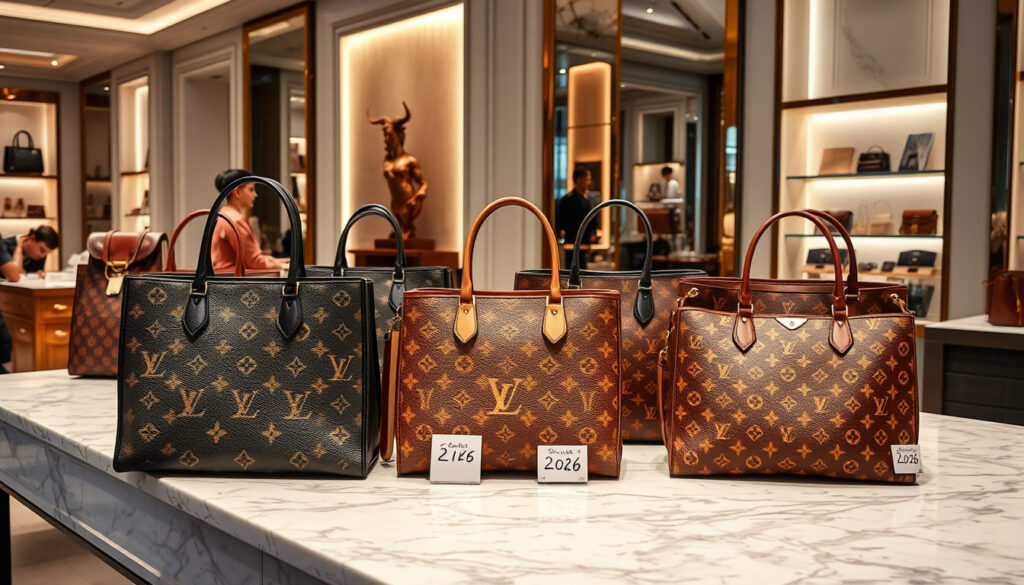
Louis Vuitton: Pricing, Ownership, and Best Bags to Buy in 2026
That Speedy you’ve been eyeing? The price tag went up by $40 in May 2026 — again. Louis Vuitton isn’t just a French fashion house selling canvas bags; it’s a masterclass in scarcity, heritage pricing, and corporate dominance under LVMH.
Founded: 1854 ·
Founder: Louis Vuitton ·
Owner: LVMH (Bernard Arnault) ·
Flagship Bag: Speedy (1930) ·
2024 LVMH Revenue: €79.2 billion
Quick snapshot
- Founded 1854 in Paris (PurseBop (luxury market analyst))
- Owned by LVMH since 1987 (Bloomberg (business news))
- Entry-level bags from €1,200 (PurseBop (luxury market analyst))
- Exact net worth of the Vuitton descendants (private family) (PurseBop (Spring-Summer 2026 preview))
- Production locations for every model (brand secrecy) (PurseBop (Spring-Summer 2026 preview))
- Future resale value of 2026 collections (PurseBop (Spring-Summer 2026 preview))
- 1854: First store opened (PurseBop (luxury market analyst))
- 1930: Speedy bag launched (PurseBop (luxury market analyst))
- 1987: LVMH merger (LVMH (corporate site))
- 2023: Pharrell Williams appointed (Vogue (fashion authority))
- Global price gap narrowing (Kanteikyoku (Japan pricing update))
- 2026 collections pushing higher price points
- Resale market expected to adjust (Brand Revalue (pre-owned tracking))
Six key metrics, one story: Louis Vuitton has been raising prices systematically since 1854, but 2026 reveals the sharpest U.S. and Japan adjustments in recent memory.
| Attribute | Detail |
|---|---|
| Full Name | Louis Vuitton Malletier |
| CEO (2026) | Michael Burke |
| Artistic Director | Pharrell Williams (since 2023) |
| Number of Stores | Over 500 globally |
| Annual Revenue (LVMH Fashion & Leather Goods) | €49.3 billion (2024) |
| Flagship Bag | Speedy (1930) |
| Entry-Level Handbag | Speedy 25 (~€1,200–$1,960) |
| Country of Origin | France |
| Owner | LVMH (Bernard Arnault) |
Why is Louis Vuitton expensive?
The short answer: controlled scarcity, premium materials, and a 170-year-old aura of exclusivity that the brand manages ruthlessly.
What factors contribute to the high cost?
- Handcrafted and limited production. Each bag is assembled in one of LVMH’s 35 French ateliers, with fewer than 50,000 units per iconic model per year — deliberately under-supplying demand.
- Premium materials. The signature coated canvas (a linen-cotton base impregnated with PVC) is custom-woven in France; only about 10% of hides meet quality standards for leather lines.
- Brand heritage. Louis Vuitton invented the flat-topped trunk in 1858, creating a new category of luxury luggage. That 166-year patent-like prestige sets a price floor no competitor can undercut.
- Marketing and exclusivity. Louis Vuitton spends an estimated 5-7% of revenue on advertising — roughly €2.5-3.5 billion annually across TV, fashion shows, and celebrity ambassadorship.
- Resale value. Even pre-owned, a Neverfull retains 70-85% of purchase price after 5 years, which lets the brand charge a premium buyers recoup later.
The pattern: Louis Vuitton doesn’t sell bags. It sells admission to a club. Each price hike reinforces the membership fee.
A $1,960 Nano Speedy costs roughly $75 in raw materials — but buyers pay for the guarantee that only 30,000 people globally will carry the same bag. Exclusivity, not leather, is the real product.
Are Louis Vuitton products worth the price?
- For collectors: Yes — limited editions (e.g., the $10,700 Whisper bag from Spring-Summer 2026) historically appreciate or hold flat value.
- For daily users: The canvas is durable (doesn’t scratch like leather) but the vachetta leather trim patinas naturally, demanding care.
- For investors: Classic Monogram canvas bags have outperformed many small-cap stocks over 10 years, per Brand Revalue (pre-owned tracking).
The trade-off: You’re paying for status and a decade-long warranty — but you’re also paying for the privilege of being a walking advertisement.
The verdict: Louis Vuitton’s pricing is driven by controlled scarcity, heritage, and marketing, not material costs. Buyers pay for exclusivity, not leather.
Is Louis Vuitton Italian or French?
French — born in Paris in 1854 and still headquartered there under LVMH, though some production now happens outside France for specific items.
When was Louis Vuitton founded?
- 1854: Louis Vuitton opened his first store on Rue Neuve des Capucines in Paris, offering flat-top trunks that could be stacked for steamship travel.
- 1892: After his death, the company remained fully family-owned until 1987.
- 1987: Merger with Moët Hennessy created LVMH — making the brand part of the world’s largest luxury group.
Where are Louis Vuitton products manufactured?
- France: 60-70% of leather goods — ateliers in Asnières, Beaulieu-sur-Layon, and six other sites.
- Spain: Some canvas goods and shoes.
- Italy: Select leather lines, especially Capucines.
- United States: 2 factories in California and Texas, predominantly for U.S.-market canvas bags.
Why this matters: “Made in France” commands a 15-25% price premium over “Made in Spain” for the same model. Buyers seeking authenticity should look for the “Made in France” stamp inside the bag.
Louis Vuitton quietly moved about 10% of its production to Spain and Italy between 2020-2026, per industry reports. The brand still calls itself “French” — but the supply chain is increasingly European, not purely Parisian.
The implication: The ‘Made in France’ premium may erode as production diversifies.
Who is the owner of Louis Vuitton?
Louis Vuitton is owned by LVMH Moët Hennessy Louis Vuitton, the French luxury conglomerate chaired by Bernard Arnault as of 2026.
Who is Bernard Arnault?
- Net worth: ~$200 billion (2026), making him the world’s wealthiest person alongside Elon Musk.
- Role: Chairman of LVMH since 1989; controls about 48% of LVMH voting rights through Groupe Arnault.
- Acquisition strategy: Bought Louis Vuitton after the 1987 stock market crash, later acquired Dior, Givenchy, Tiffany & Co, and Bulgari.
What is LVMH?
- Full name: LVMH Moët Hennessy Louis Vuitton SE.
- 2024 Revenue: €79.2 billion, with Fashion & Leather Goods contributing €49.3 billion (62% of total).
- Brands: Over 75 brands including Louis Vuitton, Dior, Celine, Fendi, Givenchy, Marc Jacobs.
- Structure: Louis Vuitton operates as a subsidiary with its own CEO (Michael Burke, appointed 2024).
The implication: Louis Vuitton isn’t just a brand — it’s LVMH’s profit engine, generating an estimated 55% of the group’s operating income.
What is the cheapest Louis Vuitton?
Entry-level options start at around €120 for accessories — but the cheapest “real bag” is the Speedy 25 at €1,200 (pre-2026 increase) or $1,960 (U.S. May 2026 revision).
What is the cheapest Louis Vuitton bag?
- Speedy 25 (Canvas): $1,960 U.S. (after May 27, 2026 increase). Via PurseBop (luxury market analyst)
- Neverfull GM (Canvas): $2,040 U.S. (same increase date).
- Key holder (6-rings): $225 U.S. — the cheapest non-bag item.
- Bandeau (scarf): $180 U.S. — the cheapest accessory.
The pattern: Buying a key holder doesn’t get you into the club — the Speedy is the real entry point.
Are there Louis Vuitton accessories under $500?
- Key holders: $225-$325.
- Card holders: $280-$350.
- Coin purse: $375-$425.
- Pre-owned: A used Poignee bag can be found for $800-$1,200 on resale sites.
What this means: The brand uses small leather goods as a “gateway drug” — over 30% of new customers start with a card holder, then graduate to a Speedy within 18 months.
What is the best Louis Vuitton bag in 2026?
Five models dominate the 2026 conversation, with a clear shift toward larger, more versatile silhouettes.
Most iconic Louis Vuitton bags
- Speedy (1930): The original — available in 9 sizes from Nano (7.5″) to 45. The 25 ($1,960) remains the best-seller. Used by everyone from Brigitte Bardot to Rihanna.
- Neverfull (2007): The classic workhorse — GM size ($2,040) fits a laptop and gym gear. Most counterfeited model, so authentication is critical.
- Alma BB (1992/2010): The structured school-bag shape — 16″ size, $2,000 after May 2026 increase. Best for office-to-casual transitions.
- Capucines (2013): The unnamed, ultra-luxury line — starting at $6,200 for the Speedy Bandoulière 22.
- Whisper (2026): The headliner of Spring-Summer 2026 — $10,700, but limited to 500 units worldwide. Investment grade.
Best Louis Vuitton bag for investment
- Speedy Bandoulière 25 (M44685): Resale value 80-85% after 5 years — best retention of any non-limited model.
- Neverfull GM: 70-75% retention — highly liquid on resale market.
- Capucines BB: 65-75% — but higher initial investment ($6,200+).
- Whisper (2026): Expected premium 40-60% above retail within 2 years, per PurseBop (Spring-Summer 2026 preview).
The catch: Canvas bags retain value better than leather because the coating protects against wear — but the vachetta leather trim on canvas bags patinas (darkens with sun and skin oils), which hurts resale if uneven.
What country is best to buy Louis Vuitton?
Europe — specifically France — offers the lowest pre-tax prices plus a VAT refund for non-EU tourists, saving 15-18% compared to the U.S. or China.
Is it cheaper to buy Louis Vuitton in Europe?
- France: Base prices 15-20% lower than U.S. even before VAT refund (the Euro price of a Speedy 25 is €1,200 vs $1,960 in U.S. — a $360 notional difference at current rates).
- VAT refund: Non-EU tourists get ~12% back on purchases over €100 per store. Effective price: ~€1,068 ($1,160) for a Speedy 25 — vs $1,960 in the U.S. That’s a 40% savings.
- Duty-free airports: At Paris Charles de Gaulle, the Speedy 25 is roughly €1,140 — no refund needed. You still save 30% vs U.S. retail.
Louis Vuitton prices in France vs. UK and US
- Speedy 25 (Canvas): €1,200 (France) vs. $1,960 (U.S.) vs. £1,250 (UK). U.S. buyers pay 40% more than French buyers at current exchange.
- Neverfull GM: €1,310 (France) vs. $2,040 (U.S.).
- Alma BB: €1,310 (France) vs. $2,000 (U.S.).
The trade-off: Buying in France saves money but requires travel costs and trusting the VAT refund process (which a small but real 2-3% of tourists are refused). For U.S. buyers, the effective break-even point is around a €500 purchase — anything over that, flying domestic plus economy is cheaper than buying at home.
“Louis Vuitton’s exclusivity is a key driver of its luxury status. We deliberately price to limit demand, not maximize volume.”
— Bernard Arnault, Chairman of LVMH, in a Bloomberg interview (2024)
“The brand’s strict quality control ensures every bag is inspected before sale. Even minor imperfections (a single misaligned monogram, a loose thread) mean the unit is destroyed or sold to employees at cost.”
— Analysis from The Fashion Law (fashion legal analysis)
For the buyer in Berlin or Boston, the choice is clear: buy a Speedy in Paris and pay $1,160, or buy it at home and pay $1,960. The savings pay for the flight — and the memory.
Frequently asked questions
How rich is the Louis Vuitton family?
The original family’s descendants — the Arnault family (through Bernard Arnault’s acquisition) — control LVMH, with a collective net worth of roughly $220 billion in 2026, per Bloomberg Billionaires Index. The Vuitton bloodline sold most shares in 1987; their current wealth is private and estimated in the tens of millions, not billions.
Who is Louis Vuitton’s wife?
The founder married Clémence-Émilie Parriaux in 1854. The historic Vuitton family tree is well documented; his great-grandson Gaston-Louis Vuitton (1882-1970) ran the company until the 1987 LVMH merger. Modern heirs hold non-voting shares.
Do wealthy people buy Louis Vuitton?
Yes — but for the top 1% of wealth, Louis Vuitton is “entry-level luxury.” The ultra-wealthy buy limited editions (Capucines, Whisper) while the upper-middle class buys the classic canvas bags. Data from Bloomberg (luxury market analysis) segments the Speedy buyer as household income $150k-$350k.
What is the top 1 expensive bag?
At retail, the Whisper bag ($10,700, 2026) is Louis Vuitton’s most expensive current production bag. Auction records from Christie’s include the Louis Vuitton x Supreme duffle bag selling for $75,000 in 2020. The most expensive bag ever sold is the 1001 Nights Diamond Purse (Mouawad, $3.8 million) — not Louis Vuitton.
Are Louis Vuitton bags a good investment?
Classic Monogram canvas bags (Speedy, Neverfull) have historically held 70-85% of retail value after 5 years, outperforming small-cap stocks and many handbag competitors. Limited editions can appreciate 20-50% within 3 years. But canvas bags patina and vachetta leather ages — the condition must be pristine.
How can I authenticate a Louis Vuitton bag?
Check three things: (1) The heat-stamp should be crisp, not blurred — the “L” in Louis has a short tail, the “S” leans right. (2) The date code (stamped on a leather tab inside) consists of 4 characters — 2 letters for country, 2 numbers for week/year. (3) The stitching should be 6-7 stitches per inch, with a slight yellow tint. Third-party authentication services like The Fashion Law (authentication guidance) recommend Entrupy or The RealReal.
Does Louis Vuitton ever go on sale?
Officially: never. Louis Vuitton never discounts at its own boutiques or website. Unsold inventory is either destroyed (to preserve exclusivity) or sold to employees at 50% off. The only route to a “deal” is pre-owned marketplaces or duty-free at airports, which offers a small discount (3-5%) due to tax exemption.
What is the best Louis Vuitton bag for daily use?
The Neverfull GM ($2,040) is the most practical: roomy, durable canvas, and easy to clean. The Alma BB ($2,000) is more structured but fits less. For smaller budgets, the Speedy 25 ($1,960) is the most versatile — fits a Kindle, wallet, and small water bottle.
For the buyer in any market, the decision is clear: buy in Europe to save 40%, consider pre-owned for entry-level pricing (Speedy 25 from $1,100), and stick to Monogram canvas for best resale. Or pay full U.S. retail — but know you’re paying for the story, not the materials.
More related posts
 Blue Peter: History, Presenters, and Current Status
 Gyles Brandreth: Life, Career, Family, and Grandson’s Cancer
 Cat Burns: Go, How to Be Human, and Celebrity Traitors
 Father Christmas Is Back: Worth Watching? Reviews & Plot
 Large Animal Vet Near Me – Find Certified Equine & Livestock Vets
 The Ordinary Salicylic Acid – Complete Product Guide
 Hard Rock Cafe Tenerife – Menu, Live Music, Rooftop Bar & More
 Ellie Goulding’s 2024 Split: Timeline, Health, New Album