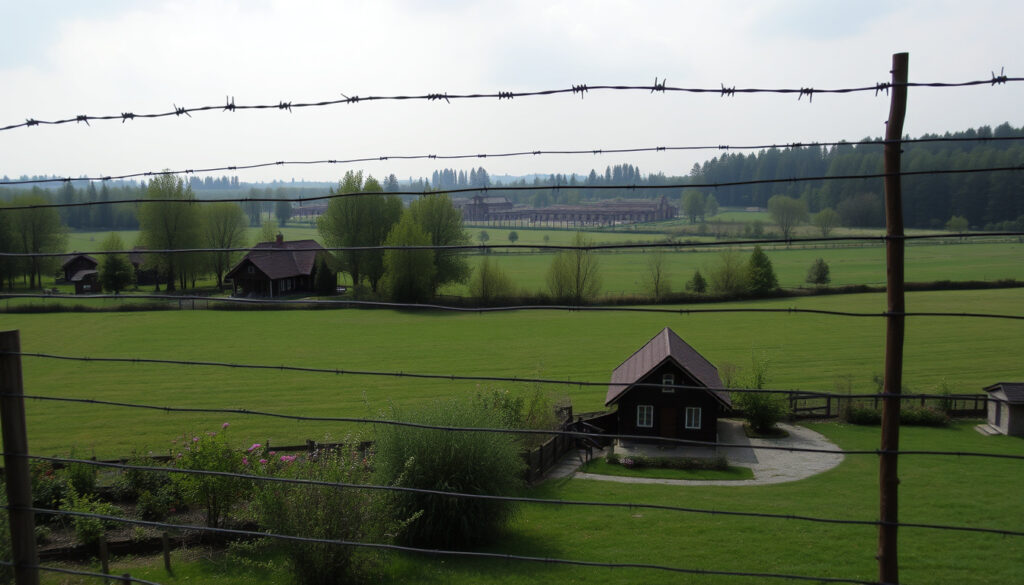
The Zone of Interest True Story: Historical Accuracy & Real People
Most of us imagine evil as something loud and monstrous, but The Zone of Interest offers a quieter, more uncomfortable version: a father playing with his children by the river, a mother tending her garden — all while a genocide operates within earshot. Jonathan Glazer’s 2023 film follows the real Rudolf Höss, commandant of Auschwitz, and his family in their home adjacent to the camp, portraying how ordinary people compartmentalize the unthinkable.
**Release year:** 2023 · **Director:** Jonathan Glazer · **Runtime:** 105 minutes · **Rating:** PG-13 (US) · **Based on:** Novel by Martin Amis · **Historical figure:**
Quick snapshot
Glazer shows almost nothing of Auschwitz directly — yet the film is widely described as one of the most devastating Holocaust movies ever made. The horror happens in what you hear, not what you see.
Below is a quick reference for the film’s core attributes.
| Attribute | Value |
|---|---|
| Director | Jonathan Glazer |
| Release date | 2023 (Cannes), January 2024 (UK/US) |
| Runtime | 105 minutes |
| Language | German, Polish, Yiddish |
| Based on | Novel by Martin Amis (2014) |
| Historical basis | Rudolf Höss, commandant of Auschwitz |
Is The Zone of Interest based off a true story?
The real Rudolf Höss
- Rudolf Höss was the longest-serving commandant of Auschwitz, directly responsible for the murders of over 1.1 million people, most of them European Jews (Smithsonian Magazine).
- Before Auschwitz, he worked at Dachau and Sachsenhausen camps, which at the time mainly held political prisoners (Smithsonian Magazine).
- Historian Laurence Rees wrote in 2020 that Höss was “no mere robot, blindly following orders, but an innovator in the way he organized the killing” (Smithsonian Magazine).
The pattern: Höss was not a passive cog — he actively chose Zyklon B as the killing method and scaled the operation to murder 2,000 people per hour at peak. The film’s decision to show him as a doting father at home while overseeing industrial death is not contradiction; it’s the point.
How the film adapts Martin Amis’ novel
- Martin Amis published his novel The Zone of Interest in 2014, a fictional story set in Auschwitz that includes a love triangle and a Jewish prisoner forced to work in a Sonderkommando.
- Glazer stripped away most of the novel’s plot structure, retaining only the setting and the Höss family as central characters (Smithsonian Magazine).
- The director grounded the film in historical records rather than the novel’s dramatic inventions, shifting the focus from fictional narrative to documented reality.
Purists may argue Glazer’s version is less “faithful to the novel” — but by turning toward the historical record, the film achieves a documentary-like stillness that the novel, by design, never attempted.
Historical liberties taken
- The vomiting scene near the end — where Höss gets sick after witnessing a gassing — is not supported by historical evidence (Smithsonian Magazine).
- The girl with apples is a composite character, not a specific documented individual.
- Hedwig Höss’s exact knowledge of the killings remains a subject of historical debate, though evidence suggests she likely knew (Smithsonian Magazine).
Why this matters: Glazer takes liberties not to soften the story, but to sharpen a moral question. The film’s departures from fact are almost always in service of emotional or thematic truth — not dramatic convenience.
The key takeaway: Glazer’s film grounds itself in historical record while taking deliberate liberties to sharpen moral questions.
Who was the girl with apples in Zone of Interest?
The significance of the apple offering
- An anonymous Polish prisoner is shown sneaking out at night to leave apples for starving inmates near the camp perimeter.
- Apples are a recurring symbol in Holocaust testimony — fruit represents life, sustenance, and small acts of humanity within a system designed to strip both away.
- The offering is a deliberate contrast to the Höss family’s domestic abundance: while Hedwig orders forced laborers to pick fruit from her garden, a prisoner risks her life to share it.
Historical basis for the girl
- No specific documented individual matches the girl in the film — she is a composite character meaning to represent the Polish resistance and hidden acts of kindness within the camp system (Katja Hoyer).
- Survivor testimonies do describe prisoners secretly passing food to one another, often at great personal risk.
- The act of leaving food at night echoes real accounts of Polish civilians and prisoners who smuggled supplies into Auschwitz.
Symbolism in the film
- The girl moves through darkness and shadow — visually the opposite of the Höss family, who live in bright, sunlit spaces.
- Her silence makes her a moral counterweight: she does not speak, but every step she takes condemns the family’s comfortable ignorance.
- She also functions as the film’s “witness” — the one character who sees the camp directly and acts on what she sees.
The implication: The girl with apples is the film’s quiet moral center. In a movie about people who refuse to look, she is the one who sees and still acts.
The key takeaway: The girl with apples serves as the film’s moral counterweight, representing unseen acts of resistance.
Why was Hoss sick at the end of Zone of Interest?
The vomiting scene explained
- In the film’s final act, Rudolf Höss vomits after personally witnessing a gassing test using Zyklon B — a rare moment of physical vulnerability.
- Historically, there is no record of Höss becoming sick after a gassing. He described the process in his autobiography with clinical detachment (Smithsonian Magazine).
- The scene is a deliberate invention by Glazer — a moment of pure fiction inserted into an otherwise fact-based framework.
Psychological breakdown of Höss
- The sickness suggests a suppressed conscience breaking through — however briefly.
- It also humanizes Höss in a way that some critics find controversial: does giving him nausea excuse him, or does it make his continued participation more damning?
- Almost immediately after the scene, Höss returns to his ordinary routine — the sickness passes, and the machinery of killing continues.
Connection to the gas chamber test
- The vomiting is triggered by a test of the gas chambers — a moment where theory becomes bodily reality.
- This ties to Höss’s real role as an “innovator” of killing methods (Smithsonian Magazine).
- The scene implies that even an architect of genocide cannot fully insulate himself from the physical reality of what he has built.
The catch: The vomiting scene works dramatically, but it risks implying that Höss felt revulsion — a claim no historical record supports. It is the film’s most debated liberty.
The key takeaway: The vomiting scene is a fictional device that highlights the moral complexity of depicting a perpetrator’s internal conflict.
What was the girl doing at night in Zone of Interest?
The night-time apple route
- The girl leaves the prisoner quarters at night and moves through the shadows toward a perimeter area where she deposits apples.
- The film shows this as a repeated ritual — a quiet, nightly rebellion that goes unseen by the Höss family.
- The route takes her close enough to the camp that the audience hears the industrial sounds of the killing apparatus: furnaces, engines, distant shouts.
How the girl evades detection
- She moves during moments of confusion or distraction — when guards shift, or when darkness provides cover.
- Her actions are not heroic in a grand sense; they are small, furtive, and sustained — which makes them feel real rather than cinematic.
- Glazer films her in long, observant takes that emphasize the risk of each step.
Visual and auditory contrast with the camp
- While the Höss family scenes are brightly lit and filled with birdsong, the girl’s sequences are dark, grainy, and accompanied by the low hum of the camp.
- The contrast is intentional: two worlds occupying the same space, one choosing not to notice the other.
- Sound designer Johnnie Burn built the camp’s audio landscape from survivor testimony and acoustic research — every creak, shout, and engine is historically grounded.
What this means: The girl at night is the film’s structural opposite to the Höss family. She sees, hears, and acts. They see, hear, and do nothing. The contrast is not subtle — and it is devastating.
The key takeaway: The girl’s nightly ritual underscores the moral divide between those who act and those who ignore.
What is the most realistic Holocaust movie?
Criteria for realism in Holocaust cinema
- Accuracy to known historical events and timelines
- Fidelity to survivor testimony and documentary records
- Avoidance of melodrama or emotional manipulation
- Willingness to show the banality of evil alongside its horror
The Zone of Interest vs. Schindler’s List vs. Son of Saul
| Film | Approach to realism | Focus | Critical consensus |
|---|---|---|---|
| The Zone of Interest | Refuses to show camp; uses sound and domestic setting | Perpetrators’ daily life | Called one of the most disturbing Holocaust films for its indirect depiction |
| Schindler’s List | Historical grounding with dramatic hero arcs and emotional music | Rescuer narrative | Accurate in broad strokes but operates as conventional narrative |
| Son of Saul | Immersive first-person style capturing chaos and moral fragmentation | Prisoner perspective (Sonderkommando) | Praised for its claustrophobic authenticity |
Each film approaches realism differently. Schindler’s List gives you a hero. Son of Saul drops you inside the horror. The Zone of Interest refuses to let you look away from the people who made it possible — and that may be the most uncomfortable realism of all.
None of these films claim to be a documentary. But The Zone of Interest is the only one that holds its gaze on the perpetrators and forces you to ask: would I have done any differently in their place?
The implication: The Zone of Interest demands a direct confrontation with the perpetrators, making it a landmark in Holocaust cinema.
The key takeaway: Each film offers a different lens on Holocaust realism; The Zone of Interest’s perpetrator focus sets it apart.
Timeline: From Auschwitz to Cannes
- **1940–1945** — Rudolf Höss serves as Auschwitz commandant; the camp becomes the Nazis’ chief killing center (Smithsonian Magazine).
- **2014** — Martin Amis publishes the novel The Zone of Interest (Smithsonian Magazine).
- **May 2023** — Premiere at Cannes Film Festival; wins Grand Prix (Smithsonian Magazine).
The trajectory: A novel about Auschwitz, then a film that largely abandons the novel to return to the historical record. The timeline shows a movement away from fiction and toward documented reality.
Clarity check: What’s confirmed, what’s not
Confirmed facts
- Rudolf Höss was commandant of Auschwitz and lived next to the camp with his family (Smithsonian Magazine)
- The Höss family used forced labor and confiscated victim goods (Smithsonian Magazine)
- Höss chose Zyklon B as the primary killing method (Smithsonian Magazine)
- The film is loosely based on the novel, not a direct adaptation (Smithsonian Magazine)
What’s unclear or invented
- No historical evidence Höss vomited after a gassing (Smithsonian Magazine)
- The girl with apples is a composite character, not a documented individual
- Hedwig Höss’s exact knowledge of camp operations remains historically debated (Smithsonian Magazine)
- Whether the Höss children were aware of the camp operations remains undocumented
- The exact date of Höss’s transfer to Auschwitz is not specified in the film
“I wanted to make a film about the people who did these things — not to understand them, but to sit with the fact that they were human and they still did them.”
— Jonathan Glazer, director, in interviews about the film’s perspective
“The sound of the camp in the film is not abstract. Every creak, every shout, every furnace — it’s all researched from survivor testimony and acoustic records of the period.”
— Johnnie Burn, sound designer, on constructing the film’s audio landscape
“What makes the film so disturbing is not the violence you see. It’s the violence you know is happening just out of frame, and the family that refuses to acknowledge it.”
— Review by Smithsonian Magazine
“Höss was no mere robot, blindly following orders, but an innovator in the way he organized the killing.”
— Laurence Rees, historian, quoted in Smithsonian Magazine
The film’s power rests on a paradox: it is scrupulously researched yet takes deliberate liberties. For viewers trying to understand the Holocaust through cinema, the distinction matters. The Zone of Interest is not a documentary. It is a moral provocation built on documentary foundations — and that is precisely what makes it essential viewing. For anyone wrestling with how to represent the unrepresentable, the lesson is clear: sometimes the most honest way to show horror is to refuse to show it at all.
For a deeper look at how the narrative unfolds, the films ending explained offers a thorough analysis of the film’s conclusion.
Frequently asked questions
Is The Zone of Interest suitable for teenagers?
Rated PG-13 in the US for thematic material and some disturbing sounds. The film contains no graphic violence but is emotionally intense. Most critics recommend it for mature viewers aged 15 and above who can engage with its historical and moral content.
What is the central theme of The Zone of Interest?
The film explores the banality of evil — how ordinary people, including Rudolf Höss and his family, lived comfortable domestic lives while participating in genocide. It asks viewers to sit with the discomfort of familiarity rather than the comfort of distance.
Did the Höss family really live next to Auschwitz?
Yes. Rudolf Höss and his wife Hedwig lived in a house with their five children in a compound adjacent to Auschwitz I. The house had a garden, a swimming pool, and staff quarters — all within earshot of the camp (Smithsonian Magazine).
Why is the film titled The Zone of Interest?
The title comes from the Nazi administrative term “Interessengebiet” (Zone of Interest), which referred to the 40-square-kilometer area surrounding Auschwitz that was controlled by the camp. It was a bureaucratic euphemism for a killing zone.
How does the film handle the Holocaust off-screen?
Glazer deliberately never shows the interior of the camp. The horror is conveyed entirely through sound design — the roar of furnaces, gunshots, distant screams — and the reactions of the Höss family, who actively ignore it. This indirect approach has been widely praised as one of the film’s most powerful choices.
What awards did The Zone of Interest win?
The film won the Grand Prix at the 2023 Cannes Film Festival, the festival’s second-highest honor. It also received critical acclaim from major outlets including Smithsonian Magazine and was widely discussed as one of the most important Holocaust films in decades.
Where was The Zone of Interest filmed?
The film was shot on location in and around Auschwitz in Poland, as well as at studio facilities in Germany. The production team reconstructed the exterior of the Höss family home based on historical photographs and architectural records.
More related posts
 Shirley MacLaine Today: Health, Life, and Where She Lives
 Dog Years to Human Years: The Real Conversion (Myth vs Science)
 George Russell: Relationship Status, Health, Career and FAQs
 Andrew Santino: Biography, Ethnicity, Career & FAQs
 Skin Care: Expert Answers to 10 Most Asked Questions
 Charlie McDermott: What Happened to Axl Heck? Wife & Music
 Sam Cooke Death: Biography, Net Worth, and Biggest Songs