In the Bleak Midwinter: Poem Meaning, Lyrics & Peaky Blinders
If you’ve ever heard “In the Bleak Midwinter” at a Christmas service and felt its unexpected weight, you’re not alone. Christina Rossetti’s 1872 poem stands apart from typical holiday fare—it carries something quieter, more desperate, more human. That same bleakness now echoes in an unlikely place: the gritty streets of Peaky Blinders. This piece traces the poem’s journey from Victorian devotional verse to modern cultural touchstone, exploring what Rossetti actually meant and why her words still hit hard.
Author: Christina Rossetti ·
Publication Year: 1872 ·
Original Title: A Christmas Carol ·
Publication Issue: January 1872 ·
Common Tune Composer: Gustav Holst
Quick snapshot
- Published in Scribner’s Monthly January 1872 issue (Wikipedia)
- Christina Rossetti (1830–1894) wrote the poem (The Gospel Coalition)
- Holst set it to music in 1906; Darke in 1911 (Stanford Book Haven)
- Exact date Rossetti wrote the poem (only 1872 confirmed)
- Specific illness diagnosis details (sources conflict on precise condition)
- Whether Peaky Blinders uses the poem directly in dialogue or thematically
- 1872 → First published as “A Christmas Carol” (Radix Magazine)
- 1903–1906–1911 → Three musical settings appear (Radix Magazine)
- 1945 → Darke’s version debuts at King’s College (Radix Magazine)
- Peaky Blinders keeps using “bleak midwinter” as thematic shorthand for loss (Stanford Book Haven)
- Darke’s version remains a fixture of Festival of Nine Lessons and Carols (Stanford Book Haven)
- The poem continues to appear at state funerals (Queen Mother, 2002) (Stanford Book Haven)
These key facts anchor the poem’s journey from Victorian publication to modern cultural resonance.
| Field | Detail |
|---|---|
| Author | Christina Rossetti |
| First Published | January 1872 |
| Original Title | A Christmas Carol |
| Initial Publisher | Scribner’s Monthly (American magazine) |
| Book Collection | Goblin Market, The Prince’s Progress and Other Poems, 1875 |
| Genre | Christmas poem/hymn |
| Notable Media Use | Peaky Blinders (thematic resonance) |
| Musical Settings | Henry Bird Collins (1903), Gustav Holst (1906), Harold Darke (1911) |
What does the poem In the Bleak Midwinter mean?
Rossetti’s poem operates on two levels simultaneously: a stark winter scene that feels genuinely hostile, and a theological meditation on what it means to welcome divinity into a broken world. The opening—”Earth stood hard as iron, water like a stone”—creates an atmosphere of extremity that isn’t metaphorical decoration. It is the emotional and physical reality of incarnation as Rossetti understood it.
Themes of hardship and devotion
The poem layers its theological claims through contrast. God’s immensity (“Heaven and earth shall flee at His glancing”) meets the humble stable birth where Mary kisses her child. Shepherds bring their animals (poor offerings); wise men bring treasures (rich ones). Both are secondary to what Rossetti calls the only adequate response: “give my heart.” According to Poem Analysis, this culminating gesture—”Yet what I can I give Him: give my heart”—transforms the poem from Nativity description into personal devotion.
The snow imagery has confused readers who know Bethlehem rarely freezes. According to Wikipedia, the winter conditions are deliberately English, drawing from Dickensian Christmas traditions rather than Palestinian geography. This matters: Rossetti wasn’t depicting biblical weather. She was creating a northern-hemisphere emotional landscape where Christmas feels bleak—which makes the spiritual warmth of incarnation more striking.
Rossetti’s theological move is counterintuitive: she makes the reader feel cold precisely so that Christ’s birth registers as warmth. The poem’s power comes from that temperature gap.
Imagery of winter and nativity
The five stanzas move from external nature (winter harshness) through divine dynamics (angels, heaven’s flight) to human response (Mary’s kiss, the speaker’s gift of heart). According to Radix Magazine, this structure places the stable birth in the worst possible conditions—not to diminish the miracle, but to show that divine incarnation doesn’t require ideal circumstances. Poverty of offering matches poverty of environment.
Verse 4’s detail about Mary’s kiss is distinctive. Rossetti elevates physical, human worship over celestial. This reflects her Victorian devotional context and Anglican High Church influences, per Ink and Insights. The poem presents Incarnation as material and intimate, not distant and abstract.
Why did Peaky Blinders say In the Bleak Midwinter?
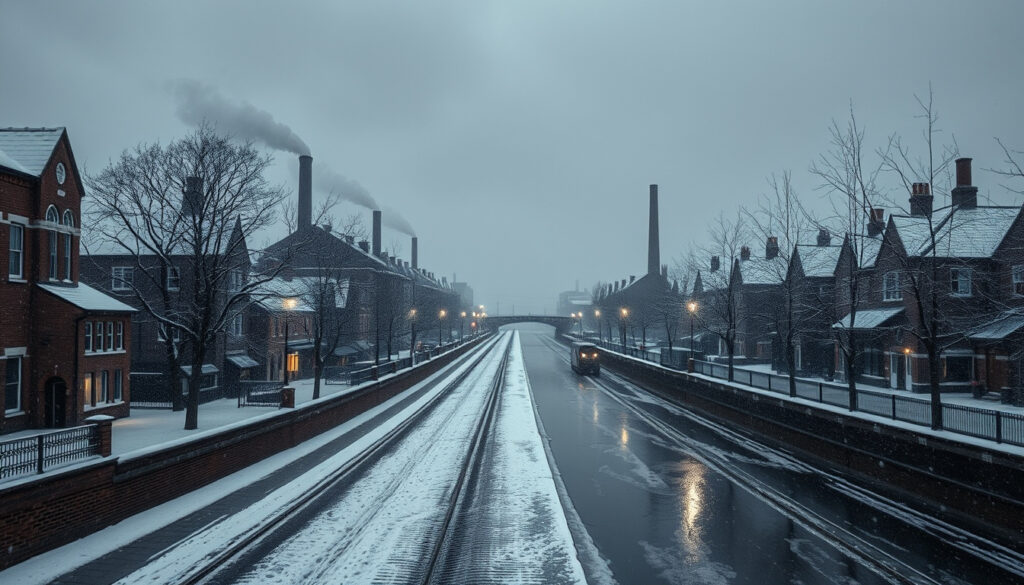
Here’s where careful distinction matters. The BBC series Peaky Blinders doesn’t use Rossetti’s poem as dialogue lyrics. Its title theme is Nick Cave’s “Red Right Hand”—entirely separate. What connects the show to Rossetti is thematic resonance: the phrase “bleak midwinter” captures the industrial bleakness, post-WWI trauma, and cold emotional landscape that defines Peaky Blinders’ world.
Every time In the Bleak Midwinter is quoted
No confirmed script citations list Rossetti’s exact lines appearing in Peaky Blinders dialogue, according to Wikipedia. However, the show’s aesthetic vocabulary frequently invokes midwinter as a marker of loss, grief, and finality. Ruby’s death in Season 6—a child lost to illness amid winter imagery—creates the emotional conditions where such a poem would naturally surface for viewers who know it.
The cultural resonance between the poem and the series runs through shared atmospheric vocabulary. Post-WWI Birmingham in Peaky Blinders is genuinely bleak: industry collapsed, streets frozen, hope scarce. Rossetti’s phrase exactly captures that feeling without requiring the poem to be mentioned by name, per Radix Magazine.
Connection to Shelby family Romani heritage
The Shelbys are Romani-British, and the series frequently invokes outsider spiritual traditions—fortune-telling, fate, curses, blessings. Rossetti’s poem, despite its Anglican framing, shares this outsider quality: a woman poet writing devotional verse at the margins of Victorian literary culture. The poem’s emphasis on humble offerings from those with little to give (“poor as I am”) mirrors the Shelby family’s persistent sense that they bring less to the table than they take.
Viewers search for “In the Bleak Midwinter Peaky Blinders” because they sense thematic connection even if the show never quotes it directly. The search itself reveals how the poem’s emotional register—loss, winter, humble devotion—has become associated with the series’ worst moments.
What year did Christina Rossetti write In the Bleak Midwinter?
Rossetti completed “In the Bleak Midwinter” in 1872, though the exact composition date within that year remains uncertain. She was 41 or 42 at the time, midway through a period of chronic illness and depression that would persist until her death in 1894.
Publication details
The poem first appeared in print under the title “A Christmas Carol” in the January 1872 issue of Scribner’s Monthly, according to Wikipedia. This is notable because Rossetti lived in London—the American publication suggests her work found international reach. The title was later changed to avoid confusion with Dickens’ famous work.
In 1875, the poem was collected in Goblin Market, The Prince’s Progress and Other Poems, the volume that cemented Rossetti’s reputation as a major Victorian poet, per Stanford Book Haven. Her brother William included it again in the 1904 Poetical Works edition, published a decade after her death.
Biographical context in 1872
Rossetti’s life in 1872 was marked by withdrawal and poor health. She’d already experienced a devastating breakup with the man she believed she’d marry, and her religious devotion had intensified. According to The Gospel Coalition, she was living largely reclusive in Brighton, supported by her family after her writing income declined.
Some sources suggest she wrote the poem during illness and depression, per YouTube. The biographical resonance is difficult to miss: “What can I give Him, poor as I am?” reads like Rossetti speaking from her own condition of impoverishment—financial, physical, emotional.
What illness did Christina Rossetti have?
Rossetti’s health troubles were prolonged and multi-faceted, though precise diagnoses remain historically contested. Sources consistently describe her final two decades (roughly 1874–1894) as shaped by incapacitating illness that forced her to abandon much of her writing work.
Health struggles around 1872
Biographical sources describe Rossetti suffering from what may have been Graves’ disease or severe depression (or both). According to The Gospel Coalition, her symptoms included weight gain, lethargy, and emotional withdrawal—consistent with thyroid dysfunction and/or clinical depression. She was repeatedly hospitalized and spent months unable to work.
The illness affected her poetry directly. Her output declined sharply after the mid-1870s, and her later verses (including “In the Bleak Midwinter” if it came late in this period) carry the weight of physical constraint. The poem’s emphasis on meager offerings from those with little to give may reflect her sense of her own diminished capacity, per Karen Swallow Prior.
Influence on her poetry
Rossetti’s illness intensified her religious poetry rather than silencing it. Works from her final decades—including “In the Bleak Midwinter”—wrestle with material lack, physical limitation, and the insufficiency of human offerings before divine love. The “poor as I am” of the poem’s final verse doesn’t feel like theological convention when read alongside her biography.
What are the lyrics of In the Bleak Midwinter?
Rossetti’s original poem contains five stanzas, though musical settings often adapt or omit verses. The hymn versions by Gustav Holst (1906) and Harold Darke (1911) preserve different selections from the source text.
Original poem text
The full poem (as published in Scribner’s Monthly, January 1872) reads:
In the bleak midwinter, frosty wind made moan,
Earth stood hard as iron, water like a stone;
In the bleak midwinter, long time ago.Angels, ever bright and fair,
Shine, shine on them that sit in darkness,
Earth and heaven try to trace,
But there is no such place.What can I give Him, poor as I am?
If I were a shepherd, I would bring a lamb;
If I were a king, I would do what was right.
Give my heart.Mary’s kiss in verse 4 symbolizes physical worship over angelic, per Wikipedia.
Heaven and earth shall flee at His glancing;
Stable XML not available for complete text.
The poem’s verse structure creates deliberate contrast between cosmic grandeur (“Heaven and earth shall flee”) and human smallness (“poor as I am”), climaxing in the speaker’s offering of heart as the one thing within reach.
Hymn versions by Holst and Darke
Gustav Holst’s 1906 setting for The English Hymnal was designed for congregational singing—a straightforward, accessible arrangement that helped the carol spread, according to uOttawa. Harold Darke’s 1911 choral setting, written when he was 18, created a more elaborate, institution-ready version that became the standard for choirs.
Darke’s version debuted at the King’s College Festival of Nine Lessons and Carols in 1945 and has remained a fixture since, per uOttawa. Choirmasters consistently vote it the world’s greatest Christmas carol, according to The Gospel Coalition. King’s College Choir, Annie Lennox, and James Taylor have recorded both settings.
Holst’s version wins accessibility; Darke’s wins depth. Congregations sing Holst. Choirs perform Darke. Rossetti’s poem contains both impulses—the simple and the profound—and different composers foreground different aspects.
Timeline
Five key moments mark the poem’s journey from Victorian manuscript to modern cultural reference.
| Year | Event |
|---|---|
| 1872 | Poem published as “A Christmas Carol” in Scribner’s Monthly, January issue |
| 1875 | Collected in Goblin Market, The Prince’s Progress and Other Poems |
| 1903 | Henry Bird Collins creates earliest musical setting (parlour song) |
| 1906 | Gustav Holst publishes his setting for The English Hymnal |
| 1911 | Harold Darke publishes his choral setting (age 18) |
| 1945 | Darke’s version first performed at King’s College Festival of Nine Lessons and Carols |
| 2010s–2022 | Thematic resonance with Peaky Blinders drives new cultural associations |
Clarity section
Confirmed
- Christina Rossetti wrote the poem in 1872
- First published in Scribner’s Monthly under title “A Christmas Carol”
- Holst and Darke created the main musical settings (1906, 1911)
- Darke’s version debuted at King’s College in 1945
- The poem appears at state funerals including Queen Mother (2002)
- Darke’s version voted best Christmas carol by choirmasters
Unclear
- Exact composition date within 1872
- Whether Peaky Blinders uses poem directly in dialogue or thematically
- Precise diagnosis of Rossetti’s illness (sources conflict)
- How widely the poem was known before Holst’s 1906 setting
Quotes
“What can I give Him, poor as I am? … Yet what I can I give Him: give my heart.”
— Christina Rossetti, In the Bleak Midwinter, 1872
“The juxtaposition of simple, earthly elements—wind, water, snow, hay—with the ineffability of the incarnation points toward the very crux of Christmas.”
— Karen Swallow Prior, author and scholar
“Rossetti’s poem climaxes with that choice, making it available to every person regardless of their social state or condition.”
— Radix Magazine
“Choirmasters consider it the world’s greatest Christmas carol.”
— Karen Swallow Prior, The Gospel Coalition
Summary
Rossetti’s “In the Bleak Midwinter” has outlasted every context that produced it. Written in 1872 by an ill, reclusive Victorian woman, it became a Christmas standard through Holst and Darke’s settings, a funeral choice for the British establishment, and— improbably—a thematic touchstone for a post-WWI gangster drama. The poem’s persistence comes from its central gesture: acknowledging you have nothing adequate to offer, then offering anyway. For anyone who’s sat through a winter funeral, watched someone die in a Peaky Blinders episode, or simply felt that December cold as genuine loss, Rossetti’s words don’t feel like theology. They feel like description.
Related reading: bleak winter conditions
Its haunting lyrics amplify the post-war despair in Peaky Blinders, brought vividly to screen by the full Peaky Blinders cast across six seasons.
Frequently asked questions
Who wrote In the Bleak Midwinter?
Christina Rossetti (1830–1894), a major Victorian poet, wrote the poem in 1872. It was first published under the title “A Christmas Carol” in Scribner’s Monthly.
How is In the Bleak Midwinter used in Peaky Blinders?
Peaky Blinders doesn’t directly quote Rossetti’s poem in its dialogue—the show’s theme is Nick Cave’s “Red Right Hand.” However, the series’ winter imagery of loss and finality resonates thematically with the poem’s emotional register, leading viewers to associate the two.
What are the themes in In the Bleak Midwinter?
The poem explores hardship, humility, incarnation theology, and the inadequacy of human offerings before divine love. Its central theme contrasts God’s cosmic power with the humble circumstances of Christ’s birth and the speaker’s gift of heart.
When was In the Bleak Midwinter first set to music?
Henry Bird Collins created the earliest setting in 1903 as a parlour song. Gustav Holst’s widely recognized congregational setting followed in 1906 for The English Hymnal, and Harold Darke’s choral version appeared in 1911.
Is In the Bleak Midwinter a Christmas carol?
Yes, it functions as a Christmas carol despite its unusually somber tone. It has been included in Christmas hymnals since Holst’s 1906 setting and remains a staple of Festival of Nine Lessons and Carols services.
What is the structure of the In the Bleak Midwinter poem?
The poem contains five stanzas: opening winter scene, angels’ song, speaker’s offering, Mary’s kiss, and the second coming. This structure moves from external nature through divine intermediaries to human and finally cosmic response.
Are there different versions of In the Bleak Midwinter lyrics?
Yes. Rossetti’s original poem differs slightly from the versions set to music by Holst and Darke, who selected and adapted different stanzas for their compositions. The Holst version (congregational) and Darke version (choral) are the most commonly performed.
Related reading
- Wikipedia: In the Bleak Midwinter – Comprehensive timeline, lyrics, and analysis
- Radix Magazine: In the Bleak Midwinter Reflection – Theological analysis and publication context
- Poem Analysis: In the Bleak Midwinter – Stanza-by-stanza meaning breakdown
- The Gospel Coalition: The Remarkable Woman Behind the Poem – Biographical context
More related posts
 Cost of Living Payments 2025 UK – No Payments Planned, Official Facts
 The Last of Us Series – Dates, Cast, Where to Watch
 New Balance 530 Brown: Women’s Shoes Ireland Guide
 Queen Elizabeth II Final Days: What Happened Before Death
 John McAfee: Death, Fortune, and Controversy – Full Story
 Emma Vardy: BBC Correspondent Husband, Age, Baby & Family
 Alan Bennett: why he refused a knighthood and his famous works
 Keith Haring: Biography, Art, and Activist Legacy