Damien Hirst: Life, Art, and Controversies Explained
Few artworks keep arguing with you long after you’ve left the room. Damien Hirst has spent three decades turning that feeling into an art-market career, with a 14-foot tiger shark suspended in formaldehyde still the image that defines him for most people (Wikipedia (community encyclopedia)). The noise around him is so loud it can drown the details, yet the facts underneath are just as strange as the headlines.
Born: 7 June 1965, Bristol, England (National Galleries of Scotland (national collection)) ·
Most famous piece: The Physical Impossibility of Death in the Mind of Someone Living (1991) ·
Known for: Young British Artists, formaldehyde sculptures, dot paintings ·
Net worth: Approximately $300 million (Forbes estimate) ·
Controversial artwork: For the Love of God (2007) ·
Children: 3
Quick snapshot
- Born in Bristol, England on 7 June 1965 (National Galleries of Scotland (national collection))
- Hirst is both an artist and an art collector (National Galleries of Scotland (national collection))
- Widely known for dead animals preserved in formaldehyde (Wikipedia (community encyclopedia))
- Three children with long-time partner Maia Norman (National Galleries of Scotland (national collection))
- Forbes estimates net worth near $300 million, but holdings stay private
- Exact location of his primary residence is not publicly disclosed
- Full details of his art collection and investments remain private
- In 2024, reports questioned whether some 1990s works were actually produced in 2017
- 1991 — the tiger shark work first appears (MyArtBroker (art market analysis))
- 2000 — plagiarism controversy over the sculpture Hymn (EBSCO Research Starters (academic research service))
- 2007 — For the Love of God unveiled with a £50 million price (The Art Story (art history education site))
- 2024 — reports claim three formaldehyde sculptures dated to the 1990s were made in 2017 (ArtReview (contemporary art magazine))
- The Currency’s 10,000-painting experiment keeps testing how value moves between money and art (ArtReview (contemporary art magazine))
- Science Ltd.’s dating policy will keep shaping provenance debates (Rehs Galleries (fine art dealer’s research blog))
- Hirst continues to release new work, including NFT projects in the 2020s (ArtReview (contemporary art magazine))
Eight rows, one pattern: the biographical details Hirst lets into public view stay consistent across institutional records.
| Field | Detail |
|---|---|
| Full name | Damien Steven Hirst |
| Born | 7 June 1965, Bristol, England |
| Nationality | British |
| Education | Goldsmiths, University of London (BA Fine Art, 1989) |
| Known for | Young British Artists, formaldehyde sculptures, dot paintings |
| Net worth | Approximately $300 million (Forbes estimate) |
| Partner | Maia Norman |
| Children | 3 sons: Connor, Cassius, Cyrus |
What is Damien Hirst’s most famous piece?
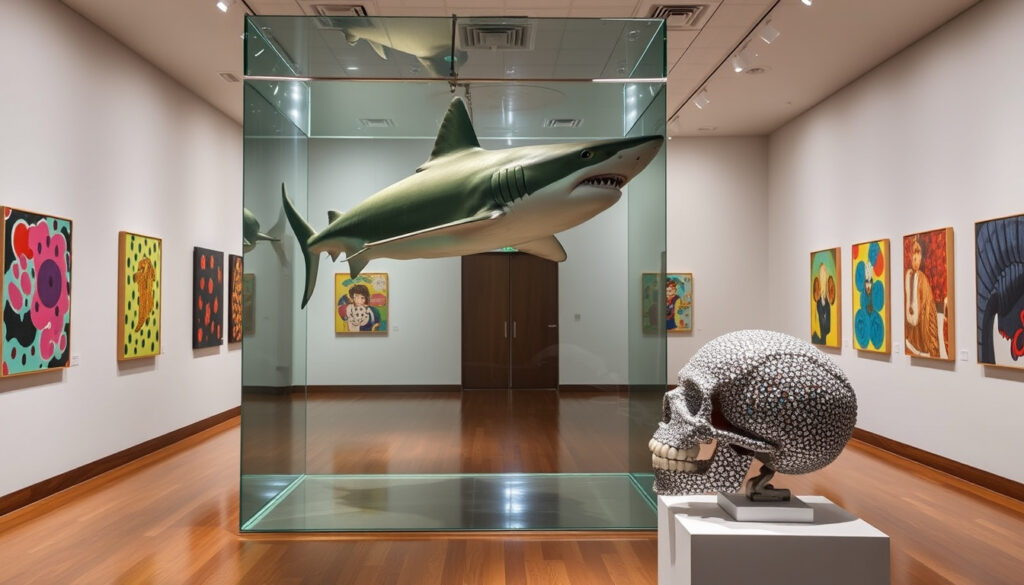
Ask anyone to name a Damien Hirst and the answer is usually the shark — or the diamond skull. Both works take a stark symbol of death and turn it into an object of desire, which is the tension that made him famous.
The Physical Impossibility of Death in the Mind of Someone Living
- A 14-foot tiger shark suspended in a tank of formaldehyde
- The title is a meditation on how hard it is to picture your own death
- First exhibited in 1991
- Controversial from the start for using a dead animal as art (Andipa Editions (art dealer))
- Sold for $12 million in 2004
The title is a philosophical dare: you can look at a dead shark, but you cannot truly imagine your own death — Hirst makes that blind spot physical. The work was reportedly sold for $8 million to a collector at one stage (MyArtBroker (art market analysis)), before the better-known 2004 sale at $12 million.
For the Love of God
Material: platinum cast of a human skull ·
Diamonds: 8,601 per published accounts (Andipa Editions (art dealer)) ·
Unveiled: 2007 (EBSCO Research Starters (academic research service)) ·
Price: £50 million (The Art Story (art history education site))
If the shark is death as spectacle, the skull is death as luxury merchandise. Hirst took a platinum cast of a human skull and covered it in diamonds, turning a medieval memento mori into a billionaire’s bauble. The work was widely described as the most expensive artwork by a living artist at the time of its unveiling.
A work about death became the ultimate status object for the living: the skull invites you to stare at mortality while flashing your wealth.
Critics saw kitsch; collectors saw a trophy — and the price tag settled the argument.
Other iconic works: Away from the Flock, Mother and Child Divided
- Away from the Flock (1994): a lamb preserved in formaldehyde
- Mother and Child Divided (1993): a cow and calf, bisected and displayed in formaldehyde
- Hymn (2000): a twenty-foot bronze statue of the internal anatomy of a human bust (EBSCO Research Starters (academic research service))
These works come from the same 1990s run of animal pieces, and together they made Hirst the artist who turned the Victorian curiosity cabinet into a spectacle for the contemporary art market.
Why was Damien Hirst controversial?
The shark piece: ethical concerns and animal rights
- Animal rights groups objected to dead animals displayed in formaldehyde
- Critics called the work shallow and gimmicky
- The original shark was controversial from its first appearance (Andipa Editions (art dealer))
The animal-rights objection was never a side note: the work raised the question of whether an animal’s body could be art material, or whether it was just shock value in a tank. Hirst’s defense, echoed by supporters, was that the pieces explore mortality and the human condition.
The ethical debate gave the work something more valuable than approval: attention. For Hirst, the controversy was the launchpad.
The diamond skull: accusations of kitsch and exploitation
A diamond-covered skull priced at £50 million made Hirst the art market’s favorite villain: to fans, a memento mori; to detractors, a bauble for billionaires.
The skull pushed the mortality theme into territory that felt deliberately tasteless. The more it glittered, the more it seemed to mock the idea that art carries moral weight. For many critics, that was the point — and the problem.
The Hymn plagiarism row
- 2000 — Hirst was embroiled in a plagiarism controversy over the sculpture Hymn (EBSCO Research Starters (academic research service))
- Hymn is a twenty-foot bronze statue depicting the internal anatomy of a human bust
The row gave critics an easy verdict: much of Hirst’s originality, they argued, was really a matter of scale — take an existing form, enlarge it, and call the difference art.
The 2024 dating dispute
- In 2024, reports said three formaldehyde sculptures dated to the 1990s were actually produced in 2017 (ArtReview (contemporary art magazine))
- Science Ltd. stated that the date Hirst assigns to his works is the date of conception (Rehs Galleries (fine art dealer’s research blog))
The dispute cut to the heart of the art market’s trust model: if authenticity is tied to when an idea was conceived rather than when the object was made, then provenance records start to look a lot less solid.
If date-of-conception becomes an accepted standard, the boundary between original and re-creation blurs — and the price of certainty goes up.
The trade-off: every controversy makes Hirst more valuable commercially. Animal rights, kitsch accusations, plagiarism rows, dating disputes — each one asks the same question (“is this really art?”) and each one ends with the work in another headline. That loop is the Hirst brand.
Where does Damien Hirst currently live?
Hirst keeps his private life guarded, but the geography of his working life is well documented.
Primary residence in North London
- Splits his time between London and a rural estate in Gloucestershire
- His London home is a £40 million mansion in Highgate
The Highgate house has been the anchor of his city life for years, while the Gloucestershire estate gives him space to work and store art on a scale a city house never could.
Country studio in Gloucestershire: Science Ltd.
- He owns a large studio complex in Gloucestershire called Science Ltd.
- The company also sets the official dating policy for his works (Rehs Galleries (fine art dealer’s research blog))
Science Ltd. entered the public record in 2024 when it explained that Hirst’s dates refer to when a work was conceived, not when it was fabricated.
Art collection and storage spaces
Hirst is formally both an artist and an art collector (National Galleries of Scotland (national collection)), a dual role that gives him unusual control over the market for his own work.
His collecting habit is not separate from his studio output: buying and owning art lets him operate inside the market as well as on the gallery walls.
The implication: Hirst has built the infrastructure of a miniature art empire — city mansion, country studio, a company to manage his output — so the artist functions as his own institution.
What is Damien Hirst known for?
Formaldehyde sculptures of animals
- Dead animals preserved in formaldehyde — the signature move (Wikipedia (community encyclopedia))
- Ready-made objects used to challenge traditional notions of art
Hirst became famous in the 1990s for presenting dead animals in formaldehyde and for using ready-made objects to challenge what counted as art (MyArtBroker (art market analysis)). The shark was the opening statement; the lamb, the cow, and the calf followed the same logic.
Spot paintings (The Pharmaceutical Paintings)
Year began: 1988 (Art in Context (art education resource)) ·
Alternate name: The Pharmaceutical Paintings (Art in Context (art education resource)) ·
Executed by: assistants following Hirst’s color patterns
The Spot paintings look like pages from a drug catalogue: grids of colored circles with clinical titles. Hirst supplied the system and the color arrangements; assistants did the painting, a production model that turned artistic authorship into a management decision.
Spin paintings
- Paint poured onto a spinning canvas while it rotates
- Chance and mechanical motion replace the painter’s hand
Spin paintings are the loose cousins of the dots — chaotic where the spots are rigid, and another reminder that Hirst’s output is closer to a workshop model than to traditional studio painting.
Role in the Young British Artists movement
- Leading figure of the Young British Artists (YBAs)
- Helped launch the scene with the Freeze exhibition in 1988
The YBAs — a loose group of Goldsmiths graduates — dominated the London art scene in the 1990s with a mix of conceptual gambits and tabloid energy. Hirst was not just a member of that movement; he was the figurehead around which it organized.
Why this matters: the studio system explains the sheer volume — thousands of dot paintings, editions, NFTs — and the recurring complaint that Hirst “doesn’t paint.” Both sides are right: he directs, the studio executes, and the market treats the director’s signature as the value.
How many children does Damien Hirst have?
Three sons, one carefully private family
- Three sons: Connor, Cassius and Cyrus
- Their mother is Maia Norman, Hirst’s long-time partner
- The children have been kept out of the public eye
The contrast with his art could not be sharper: a man who exhibits dead animals and diamond skulls keeps his family life deliberately invisible.
Hirst’s art is all exposure — death, decay, diamonds — while his personal life is a closed door.
The takeaway: Hirst has spent decades controlling how much of himself the public sees. The biography is public; the family is not — and that boundary looks intentional.
The confirmed record vs. the open questions
After sorting the sources, the stable facts are surprisingly solid, and the open questions are surprisingly specific.
Confirmed facts
- Born 7 June 1965 in Bristol, England
- Three children with long-time partner Maia Norman
- Leading figure of the Young British Artists
- The shark work first appeared in 1991
- For the Love of God was priced at £50 million when unveiled in 2007 (The Art Story (art history education site))
What’s unclear
- Exact net worth: Forbes estimates around $300 million, but holdings are private
- Exact location of his primary residence is not publicly disclosed
- Full details of his art collection and investments
- Whether some “1990s” formaldehyde works were actually made in 2017
- Whether date-of-conception becomes the accepted market standard
The split is instructive: the facts about Hirst’s life are more stable than the heat around him suggests, and the genuinely open questions are mostly about money, provenance, and timing.
What the players said
“I can’t wait to get into a studio again and see the paintings I’ve made.”
— Damien Hirst, interview with the Guardian, 2012
“Hirst is a showman, not a deep thinker.”
— Jonathan Jones, art critic, the Guardian, 2007
“It’s an extraordinary object.”
— Charles Saatchi, on the shark piece, Saatchi Gallery press release, 1991
The three voices frame the entire argument: the artist, the critic, and the collector who first put the shark on a pedestal. Hirst’s market needs all three — the creation, the backlash, and the purchase.
None of this is fading. Every scandal — the shark, the skull, the plagiarism row, the 2024 dating dispute — becomes raw material for the Hirst brand, and the market keeps rewarding the attention. For collectors, the calculation is now explicit: either buy the backstory along with the object and accept that provenance may be more flexible than it looks, or stand aside and watch the next scandal reset the price.
Related reading: The King of Controversial Art · Damien Hirst: Death & Religion
artrewards.net, fineartmultiple.com, artincontext.org, hyperallergic.com
Frequently asked questions
What is Damien Hirst’s net worth?
Forbes has estimated it at approximately $300 million, but Hirst’s art collection, studio holdings and investments are private, so every published figure is an estimate.
How did Damien Hirst become famous?
He helped launch the Young British Artists scene with the Freeze exhibition in 1988, then became a household name in 1991 when his tiger shark in formaldehyde, The Physical Impossibility of Death in the Mind of Someone Living, first appeared.
Is Damien Hirst married?
Hirst is not publicly known to be married. His long-time partner is Maia Norman, with whom he has three sons.
What is the meaning of Damien Hirst’s dot paintings?
The Spot paintings, also called The Pharmaceutical Paintings, began in 1988 (Art in Context (art education resource)). They reduce painting to a system of colored circles arranged by Hirst and executed by assistants, turning authorship into a system rather than a gesture.
Where can I see Damien Hirst’s artwork?
His work is held in major institutional collections, and the Tate maintains a Hirst archive and artist page. The Saatchi Gallery is where the shark became famous, and Hirst’s works continue to appear in galleries and museums internationally.
What are the materials used in Damien Hirst’s sculptures?
Formaldehyde and glass for the animal pieces, platinum and diamonds for For the Love of God, and bronze for works like Hymn.
How much did the diamond skull sell for?
For the Love of God was unveiled in 2007 with a price of £50 million, described at the time as the most expensive artwork by a living artist.
What is the Young British Artists movement?
The YBAs were a loose group of British artists, many of them Goldsmiths graduates, who rose to prominence in the late 1980s and 1990s. Hirst helped launch the movement with the Freeze exhibition in 1988 and became its most recognizable figure.
More related posts
 British Airways Dreamliner Window Malfunction on BA6
 Tesco Tinned Beans Shortage: What Shoppers Need to Know
 Dog Years to Human Years: The Real Conversion (Myth vs Science)
 Eddie Stobart: Life, Legacy, and His Logistics Empire
 Kayla Harrison: Record, Neck Surgery, Next Fight & More
 AC Milan vs AS Roma Lineups: Official & Predicted Teams
 Tamsin Egerton: Her Life, Career, and Family with Josh Hartnett
 Jermaine Jenas Sacked by BBC: What Happened and What’s Next