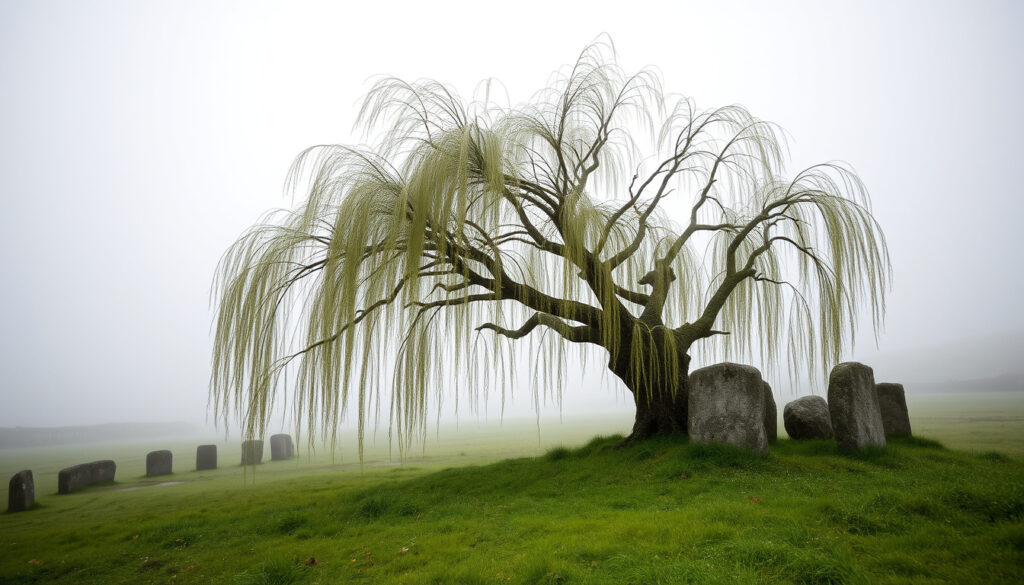
Willow Tree in Ireland: Growth, Lifespan & Folklore
Willow trees grow fast, live short, and carry a heavy load of Irish superstition — a contrast that makes them both practical and mystical. In Ireland, this tree is more than just a pretty sight; it’s woven into the landscape, the language, and the old stories.
Scientific name: Salix ·
Number of species: ~350 ·
Native to Ireland: Yes, several varieties ·
Growth rate: Up to 8 feet per year ·
Lifespan: Typically 30–50 years ·
Irish name: Saileach
Quick snapshot
- Several Salix species native to Ireland (BuzzLayer, Irish horticulture guide)
- Common names: sallow, osier (Wikipedia, botanical genus)
- Irish: Saileach (BuzzLayer, Irish name)
- Fast-growing: up to 8 ft/year (Wikipedia, growth)
- Lifespan: 30–50 years average (Wikipedia, lifespan)
- Weeping willows can live 50+ years (Glenard Park, nursery data)
- Basket-weaving (osiers) (Wikipedia, uses)
- Decorative in gardens and parks (Glenard Park, ornamental)
- One of the five sacred trees of Ireland (Outdoors Ireland, folklore blog)
- Associated with water, moon, and mourning in Celtic folklore (BuzzLayer, folklore)
- Irish name Saileach appears in place names (BuzzLayer, place names)
Six facts about the willow tree in Ireland, one clear pattern: the tree is both a fast-growing resource and a cultural symbol deeply rooted in the landscape.
| Label | Value |
|---|---|
| Scientific name | Salix |
| Number of species | ~350 |
| Native to Ireland | Yes |
| Growth rate | Fast (up to 8 ft/year) |
| Lifespan | 30–50 years (some longer) |
| Irish name | Saileach |
What is special about a willow tree?
- Willows are among the fastest-growing trees in temperate climates, with growth reported at up to 2 m per year under ideal conditions (BuzzLayer, Irish horticulture guide).
- They produce catkins (pussy willows) in early spring, providing early pollen for bees.
- Willow bark contains salicin, a natural compound used in traditional medicine for pain relief (Wikipedia, botanical encyclopedia).
- The flexible branches have been used for basket-weaving, fencing, and even thatching for centuries.
What this means: Willow is a tree that works hard — it grows fast, offers medicinal value, and has been a practical material for Irish communities for generations. Few other trees combine such rapid growth with such a wide range of uses.
Do willow trees grow well in Ireland?
Yes — several willow species are native to Ireland and thrive in the country’s damp, mild climate. The Irish name for willow is Saileach, a word that appears in many place names and surnames. In fact, willow is traditionally considered one of the five sacred trees of Ireland, alongside oak, ash, hazel, and hawthorn.
- Willows are strongly associated with wet ground and often grow near water (Amayodruid Blog, hedgerow folklore).
- Common native species include the goat willow (Salix caprea) and the crack willow (Salix fragilis).
- Weeping willow (Salix babylonica) is a non-native ornamental but widely planted in Irish parks and gardens.
What is the Irish name for the willow tree?
- The Irish word is Saileach (pronounced “SAL-ukh”). It appears in place names like Ballysallagh (“townland of the willow”) and the surname Sallows.
The pattern: where you see Saileach on the map, you’re likely near a damp, willow-friendly spot.
What are the five sacred trees of Ireland?
- Oak, ash, hazel, hawthorn, and willow — according to some modern retellings of Irish myth (Outdoors Ireland, folklore blog).
- Note: The exact list varies among sources; some traditions include the yew or the rowan instead of willow.
The implication: willow’s place in the sacred list is not universally agreed upon, but it’s consistently remembered as a tree of deep significance in Irish lore.
How quickly does a willow tree grow?
Willow trees are among the fastest-growing deciduous trees, capable of adding 3–8 feet per year. Weeping willows can grow even faster, reaching up to 15 metres in height and spread within a few decades (Glenard Park, tree nursery).
- Growth rate depends on species, soil, and water availability. Willows planted near water can achieve the maximum rate.
- Some varieties, like the osier willow, are coppiced for biomass and can produce 2 m of new growth per year.
How many years does a willow tree live?
- Most willow species have a lifespan of 30–50 years (Wikipedia, lifespan).
- Weeping willow is described as having a shorter lifespan of 30–40 years (Glenard Park, nursery data).
- Some species, like the white willow (Salix alba), can live 100 years in ideal conditions (Wikipedia).
The trade-off: fast growth usually means a shorter life. Willow gives you quick shade and structure, but don’t expect it to outlive your grandchildren.
What are the downsides of having a willow tree?
- Willow roots are invasive and can damage pipes, foundations, and underground utilities (BuzzLayer, horticulture guide).
- Branches are brittle and prone to breakage in storms, especially on weeping willows.
- Trees require abundant water — they can dry out surrounding soil and compete with nearby plants.
- Leaf and twig litter can be messy, and the tree drops branches regularly.
Should I Plant a Weeping Willow Tree?
- Weeping willows share all the above issues plus a very large mature spread (up to 15 m), making them unsuitable for small gardens.
- They are best planted in open spaces near water, away from buildings and underground services.
- If you have the room and the ground is wet, they can be a stunning feature tree — but only if you can manage the space and maintenance.
Upsides
- Fast shade and screening
- Excellent for erosion control on wet ground
- Provides early spring nectar for bees
- Flexible wood for crafts and biomass
- Deep cultural significance in Ireland
Downsides
- Invasive roots damage pipes and foundations
- Brittle wood — storm damage risk
- Short lifespan (30–50 years)
- High water demand
- Messy leaf and twig drop
The catch: a willow tree is a commitment. It will grow fast and look beautiful, but it demands space, water, and a plan for what happens when it dies.
For a gardener in Ireland with a small plot, the weeping willow’s rapid growth becomes a liability: roots will find pipes, and branches will snap in Atlantic storms. The same vigour that makes it a wonder in a park makes it a headache in a suburban garden.
The pattern: a willow tree is a commitment that demands space, water, and a plan.
What is the superstition about willow trees?
- In Western folklore, weeping willow is associated with sadness, mourning, and witches (Outdoors Ireland, folklore blog).
- In Celtic mythology, willow is linked to the moon, water, and intuition. The willow is said to be the tree of the goddess Bóinn (Boann), linked to the River Boyne (Celtic Myths, mythology resource).
- Some traditions hold that planting a willow near a house brings bad luck — or even death — though other accounts say it protects against witches (Glenard Park, nursery folklore).
- Willow rods were believed to protect milk and cattle in Irish folk practice (Glenard Park).
Why this matters: the superstition is a double-edged sword — willow is both protective and ominous. The conflicting stories reflect the tree’s ancient, watery character: life-giving and dangerous, like the rivers it grows beside.
The same willow twig that a farmer once hung on a door to keep evil away could also be seen as a sign of sorrow if planted near the house. Irish folklore doesn’t give a single answer — it leaves the willow as a riddle.
The implication: the willow’s conflicting folklore mirrors its dual nature as both protector and omen.
Confirmed facts
- Willows belong to the genus Salix (Wikipedia).
- Several species are native to Ireland (BuzzLayer).
- Willows are among the fastest-growing trees (Wikipedia).
- The Irish name for willow is Saileach (BuzzLayer).
The pattern: willow facts are well-established, but some details remain contested.
What’s unclear
- The exact list of the five sacred trees of Ireland varies among sources — some include yew or rowan instead of willow.
- Lifespan can vary significantly by species and environment; some willows live over 100 years while others last only 30.
- The specific origin of some superstitions (e.g., willow as a protection against witches) is hard to pin down to a single tradition.
- Erosion control and shelter belts (common in Ireland but not corroborated by a specific cited source).
The implication: the uncertainty around willow’s lore is part of its enduring mystery.
Quotes from the experts
Willow is associated in Irish folklore with life, fertility, good luck, protection, water, and milk.
— BuzzLayer, Irish horticulture guide
Weeping willow can reach about 15 metres in height and spread, with a short lifespan of 30–40 years.
— Glenard Park, tree nursery
Willow has also been associated with grief, especially the weeping willow.
— Outdoors Ireland, folklore blog
The pattern across these voices: the willow tree is a creature of contrasts — fast life and short life, protection and grief, utility and mystery. For the Irish gardener, the choice to plant one is as much about respecting the old stories as it is about managing the practical trade-offs.
youtube.com, glenardpark.com, buzzlayer.org, x.com, amayodruid.blogspot.com, icysedgwick.com, livinglibraryblog.com, outdoorsireland.blogspot.com, aktuellblick.at
For those seeking detailed information on native species and folklore, the willow tree guide for Ireland offers a thorough overview.
Frequently asked questions
How to prune a willow tree?
Prune in late winter or early spring while the tree is dormant. Remove dead, damaged, or crossing branches. For weeping willows, thin the canopy to allow light and air. Avoid heavy pruning in autumn as it can stimulate new growth that won’t harden before frost.
Are willow trees poisonous to pets?
Willow bark contains salicin, which is related to aspirin. In large quantities, it can cause stomach upset in dogs and cats. The leaves and twigs are generally not highly toxic, but it’s best to prevent pets from chewing on them.
Can I grow a willow tree from a cutting?
Yes — willow cuttings root very easily. Take a 30–60 cm cutting from a healthy branch in late winter, push it into damp soil, and keep it well-watered. It will often root within a few weeks.
What is the best willow species for a small garden in Ireland?
Consider a compact or shrubby willow like Salix caprea (goat willow) or Salix purpurea (purple osier). These stay smaller than weeping willow and are easier to manage. Alternatively, coppice a willow for screening.
How far should a willow tree be planted from a house?
At least 15–20 metres from buildings, drainage pipes, and underground services. Willow roots are aggressive and can travel far in search of water.
Do willow trees attract pests?
Willows can be host to aphids, caterpillars, and willow scale. They are also susceptible to diseases like willow scab and black canker. Healthy trees usually tolerate minor infestations.
What is the difference between a willow and a weeping willow?
“Willow” refers to the entire genus Salix (about 350 species). “Weeping willow” is a specific species (Salix babylonica) or its hybrids, known for its drooping branches. All weeping willows are willows, but not all willows weep.
Related reading
- Cadair Idris Hiking Guide: Routes, Myths & Snowdon Comparison
- Sleeping Beauty: Story, Versions, Meaning, and Moral Lesson
More related posts
 Wet Wet Wet Songs – Top 10 Hits Discography Lyrics
 What Will My Car Tax Be in 2025 GOV.UK – VED Rates Explained
 Gold Necklace Gold: 14k, 18k & 24k Buying Guide
 Penny Big Bang Theory: Kaley Cuoco, Health, and Myths Explained
 How Long Does Sunburn Last? Duration, Stages, and Healing Tips
 Denis Sulta: real name, age, nationality, and biography
 Millennial Generation Age Range and Key Characteristics
 Cote de Pablo: Biography, Personal Life, and Current Projects