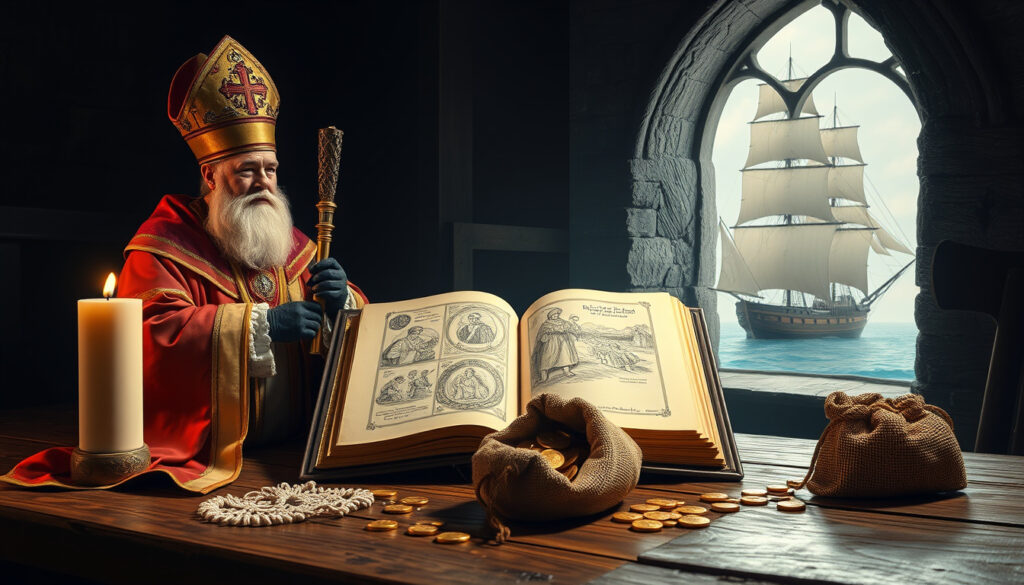
Saint Nicholas: The Real History of the Original Santa Claus
Most people know the jolly man in the red suit, but the figure behind the legend lived a very different life. Saint Nicholas was a 4th-century Greek bishop in what is now Türkiye, and his story involves secret charity, a legendary slap, and a transformation into a global icon of generosity, separating the historical bishop from the modern myth.
Born: c. 270 AD in Patara, Lycia (modern Turkey) ·
Died: 343 AD in Myra, Lycia ·
Feast Day: December 6 ·
Patron Saint of: Children, sailors, merchants, brewers, pawnbrokers, and many others ·
Known for: Secret gift-giving, inspiring the figure of Santa Claus ·
Relics: Housed in the Basilica of St. Nicholas, Bari, Italy
Quick snapshot
- Saint Nicholas was a 4th-century Christian bishop of Myra (Britannica)
- His feast day is December 6 (St. Nicholas Center)
- He is the patron saint of children, sailors, and merchants (Britannica)
- His relics are in Bari, Italy (St. Nicholas Center)
- Exact year of birth (c. 270 AD is an estimate) (Biography.com)
- The story of him slapping Arius at the Council of Nicaea is likely legendary (Britannica summary)
- Details of the three poor sisters story are part of tradition, not verified history (NPR)
- c. 270 AD: Born in Patara, Lycia (St. Nicholas Center)
- 343 AD: Died December 6 in Myra (Britannica)
- 1087: Relics translated to Bari, Italy (St. Nicholas Center)
- 19th century: Modern Santa Claus emerges (Britannica summary)
- Global celebrations of St. Nicholas Day on December 6 continue to grow (St. Nicholas Center)
- New scholarship continues to refine the historical record of Nicholas’s life (National Geographic)
Six key facts about Saint Nicholas, from his birth to his lasting legacy:
| Label | Value |
|---|---|
| Full Name | Saint Nicholas of Myra (also Nicholas of Bari) |
| Born | c. 270 AD |
| Died | 343 AD |
| Feast Day | December 6 |
| Patronage | Children, sailors, merchants, brewers, pawnbrokers, and many others |
| Known For | Secret gift-giving, slapping Arius (legend), inspiring Santa Claus |
What is Saint Nicholas known for?
Saint Nicholas was a 4th-century Christian bishop of Myra in modern-day Turkey, as recorded by Britannica. He is best known for secret gift-giving, most famously the story of the three poor sisters, to whom he reportedly gave gold for dowries, as reported by NPR. He is the patron saint of children, sailors, merchants, and many other groups, including brewers and pawnbrokers, according to Britannica. His feast day is December 6, celebrated in many Christian traditions, as noted by the St. Nicholas Center.
What this means: The historical Nicholas earned his reputation through concrete acts of charity, not through myth. His patronage over such a wide range of groups reflects a figure whose influence was deeply practical and community-focused.
Why is St. Nicholas associated with Christmas?
The tradition of gift-giving on St. Nicholas Day
St. Nicholas Day (December 6) was historically a day for gift-giving, which later merged with Christmas. According to Britannica, after the Reformation, Nicholas’s cult largely disappeared in Protestant Europe except in Holland, where he was known as Sinterklaas. The Dutch Sinterklaas tradition brought gift-giving on December 5, the eve of the feast, and this practice heavily influenced the modern Christmas figure, as reported by Britannica summary.
Evolution of St. Nicholas into a Christmas figure
In many countries, St. Nicholas remains a separate figure from Santa Claus, but elsewhere they merged. Franciscan Media notes that Nicholas’s generosity eventually evolved into the modern-day Santa Claus tradition through the spread of the saintly gift-giver idea. The transition accelerated when Dutch colonists brought the Sinterklaas tradition to New Amsterdam, and English-speaking Americans later adopted him as Santa Claus, according to Britannica summary.
The pattern: The merger of St. Nicholas Day with Christmas was a slow cultural shift, not a single event. The Dutch kept the tradition alive when much of Protestant Europe abandoned it, and that preservation became the seed for the modern global Santa.
Is St. Nicholas the same as Santa Claus?
Two figures, one origin — but they are not the same. Here are the key differences:
Seven contrasts between the historical bishop and the modern legend:
| Aspect | Saint Nicholas | Santa Claus |
|---|---|---|
| Time period | 4th century AD (c. 270–343) | 19th century to present |
| Origin | Historical bishop of Myra, Lycia (modern Turkey) | Legendary figure based on St. Nicholas, Father Christmas, and other folk figures |
| Role | Christian bishop, patron saint, miracle worker | Gift-giver at Christmas, lives at the North Pole |
| Gift-giving day | December 6 (St. Nicholas Day) | December 24–25 (Christmas Eve/Night) |
| Appearance | Traditional bishop’s robes, mitre, staff | Red suit, white beard, sleigh and reindeer |
| Key influences | Christian tradition, hagiography | Clement Clarke Moore’s poem (“The Night Before Christmas”), Coca-Cola advertising |
| Geographic base | Myra (modern Turkey), relics in Bari, Italy | North Pole |
According to Britannica summary, the modern Santa Claus figure in the United States is described as living at the North Pole and bringing gifts to children at Christmas. National Geographic states that the historical saint behind Santa Claus was a Greek born around 280 CE and became bishop of Myra in what is now Turkey. The modern Santa Claus was popularized in the 19th century by Clement Clarke Moore’s poem and later by Coca-Cola advertisements, as noted by Biography.com.
The figure we call Santa Claus today is a composite — St. Nicholas provided the gift-giving core, but the sleigh, reindeer, and North Pole address came from other traditions entirely. The historical bishop would not recognize his modern counterpart.
The trade-off: St. Nicholas gave us the moral foundation of anonymous generosity. Santa Claus gave us the spectacle. For families choosing how to celebrate, the question is whether to preserve the saint’s religious and historical roots, or embrace the fully commercialized modern figure.
The takeaway: Saint Nicholas is a historical 4th-century bishop; Santa Claus is a 19th-century cultural composite. The bishop’s legacy of secret charity stands in contrast to the commercialized North Pole figure.
Who is older, Jesus or Santa Claus?
Historical timeline of Jesus and St. Nicholas
Jesus Christ is believed to have been born around 4–6 BC, based on historical estimates. Saint Nicholas was born around 270 AD, so Jesus is older by several centuries. The concept of Santa Claus as a distinct figure is much younger, emerging in the 19th century — roughly 1,800 years after Jesus. According to Britannica, Nicholas was a minor saint associated with Christmas and a reputed miracle-worker in medieval tradition, but the Santa Claus persona is a modern invention.
For parents explaining the holiday season to children, the historical sequence is helpful: Jesus lived first, then Saint Nicholas lived centuries later, and Santa Claus as we know him is barely 200 years old. The timeline helps clarify which figure comes from history and which comes from legend.
The implication: The question “Who is older?” reveals a deeper confusion about the relationship between religious history and folk tradition. Jesus is the oldest of the three, Saint Nicholas is the middle figure, and Santa Claus is the most recent cultural creation.
What do other countries call Santa?
Different names for Santa Claus around the world
According to DW, different cultures use different names for the same gift-bringer tradition, including Papai Noel in Brazil, Santa Claus in the US and Canada, Kalėdų Senelis in Lithuania, and Babbo Natale in Italy. In the UK, Santa is often called Father Christmas. In the Netherlands, he is Sinterklaas, which is the direct linguistic and cultural ancestor of Santa Claus, as reported by Britannica summary.
Santa’s family lore
In many countries, Santa’s wife is called Mrs. Claus. There is no official female Santa Claus, but Mrs. Claus is a common companion. Santa’s mom is not a traditional figure; some modern stories have created her. Santa Claus does not have a girlfriend in the traditional lore. According to Britannica summary, the modern Santa Claus figure is a composite of St. Nicholas, Father Christmas, and other folk figures, and the family lore around him is a 20th-century addition to the myth.
The catch: The global diversity of names for Santa reflects how each culture adapted the core St. Nicholas story to its own traditions. The Dutch Sinterklaas is the most direct link to the original saint, while the American Santa Claus is the most commercialized version.
For families in the US and Canada, the Santa Claus figure carries almost no trace of the historical bishop’s story. But in the Netherlands, Belgium, and parts of Germany, Sinterklaas retains the December 6 date, the bishop’s robes, and the focus on charitable giving. The choice is between a cultural tradition and a commercial one.
Timeline
- c. 270 AD: Saint Nicholas born in Patara, Lycia (modern Turkey) (St. Nicholas Center).
- c. 300 AD: Becomes Bishop of Myra (Britannica).
- 325 AD: Attends the First Council of Nicaea; legend says he slapped Arius (Britannica summary).
- 343 AD: Saint Nicholas dies on December 6 (Biography.com).
- 1087: Relics of Saint Nicholas are translated to Bari, Italy (St. Nicholas Center).
- 12th century: St. Nicholas becomes widely venerated across Europe (Britannica summary).
- 19th century: Modern Santa Claus figure emerges from St. Nicholas and other traditions (Britannica summary).
The timeline shows a clear pattern: the historical Nicholas lived and died in the 4th century, but his legend only became a global cultural phenomenon nearly 1,500 years later. The relics in Bari remain a pilgrimage site, while the modern Santa Claus continues to evolve.
Confirmed facts
- Saint Nicholas was a 4th-century bishop of Myra (Britannica).
- His feast day is December 6 (St. Nicholas Center).
- He is the patron saint of children, sailors, and merchants (Britannica).
- His relics are in Bari, Italy (St. Nicholas Center).
- The Dutch Sinterklaas tradition directly influenced the American Santa Claus (Britannica summary).
- Nicholas was born in Patara, Asia Minor, and died in Myra (St. Nicholas Center).
What’s unclear
- Exact year of birth (c. 270 AD is an estimate) (Biography.com).
- The story of him slapping Arius at the Council of Nicaea is likely legendary (Britannica summary).
- Details of the three poor sisters story are part of tradition, not verified history (NPR).
- The full extent of his patronage list is based on medieval tradition, not contemporary records (Wikipedia).
- Whether Nicholas actually attended the Council of Nicaea is debated by historians, with no contemporary documentation confirming his presence (Britannica summary).
- The story of Nicholas restoring three children to life is considered legendary rather than historically verified (Britannica summary).
Quotes
Saint Nicholas is the patron saint of sailors, merchants, archers, repentant thieves, children, brewers, pawnbrokers, toymakers, unmarried people, and students.
Saint Nicholas’ life is one of history and mystery. Saint Nicholas lived in Myra, during the fourth century. Nicholas became the bishop of Myra.
After the Reformation, Nicholas’s cult largely disappeared in Protestant Europe except in Holland, where he was known as Sinterklaas.
— Britannica summary
Dutch colonists brought the Sinterklaas tradition to New Amsterdam, and English-speaking Americans later adopted him as Santa Claus.
— Britannica summary
The historical Saint Nicholas lived a life of quiet charity that became the foundation for one of the world’s most recognizable figures. The modern Santa Claus is a cultural construction built on that foundation, but the original bishop’s story — of a man who gave in secret, served his community, and became a symbol of generosity — remains a powerful counterpoint to the commercialized holiday figure. For anyone looking to understand the real meaning of the season, the 4th-century bishop of Myra is a better guide than the 19th-century invention at the North Pole. Readers interested in other historical figures who shaped cultural traditions may also find the story of Helen Keller: Life, Education, and Political Activism illuminating, while the legacy of modern institutional figures is examined in Queen Elizabeth II Final Days: What Happened Before Death.
christianity.com, europe.factsanddetails.com, sttammanylibrary.org
Frequently asked questions
Who is the original Santa Claus?
The original Santa Claus is Saint Nicholas, a 4th-century Greek bishop of Myra (modern Turkey) known for his secret gift-giving and charitable acts. The modern Santa Claus is a 19th-century cultural figure based on him, but the historical Saint Nicholas is the original inspiration.
What is the story of St. Nicholas and the three poor sisters?
According to tradition, Saint Nicholas secretly gave gold to three poor sisters to provide dowries for them, preventing them from being sold into poverty or slavery. This story is the foundation of his reputation as a secret gift-giver.
Why is St. Nicholas the patron saint of children?
Saint Nicholas is the patron saint of children because of his legendary acts of charity and protection toward them, including the story of restoring to life three children allegedly killed by a butcher, as well as the story of the three poor sisters. His feast day, December 6, became associated with gift-giving to children.
Where are the relics of St. Nicholas?
The relics of Saint Nicholas are housed in the Basilica of St. Nicholas in Bari, Italy. They were translated there in 1087 from Myra, where they had originally been buried. A unique substance called manna is said to have formed in his grave.
What is the legend of St. Nicholas slapping Arius?
According to legend, during the First Council of Nicaea in 325 AD, Saint Nicholas slapped Arius, a theologian who denied the divinity of Christ. The story is widely considered likely legendary rather than historical, as it does not appear in contemporary records.
How did St. Nicholas become associated with gift-giving?
Saint Nicholas became associated with gift-giving through the story of the three poor sisters, where he secretly gave gold for dowries. This tradition of secret charity evolved into the practice of giving gifts on his feast day, December 6, which later merged with Christmas gift-giving traditions.
More related posts
 Vittorio Angelone: Biography, Age, Tour, Podcast & More
 Ella Maisy Purvis: Biography and Neurodiversity
 David Haye: Boxing Record, Relationships, Net Worth, ITV Lawsuit
 Ruth Jones: Biography, Net Worth, Weight Loss, and More
 Paul Gascoigne Now: Health, Sobriety, and Net Worth in 2025
 How to Screenshot on Samsung: Phones, Tablets, S24 Guide
 How Long Does Sunburn Last? Duration, Stages, and Healing Tips
 Nolan Gould IQ: Genius Behind Luke Dunphy