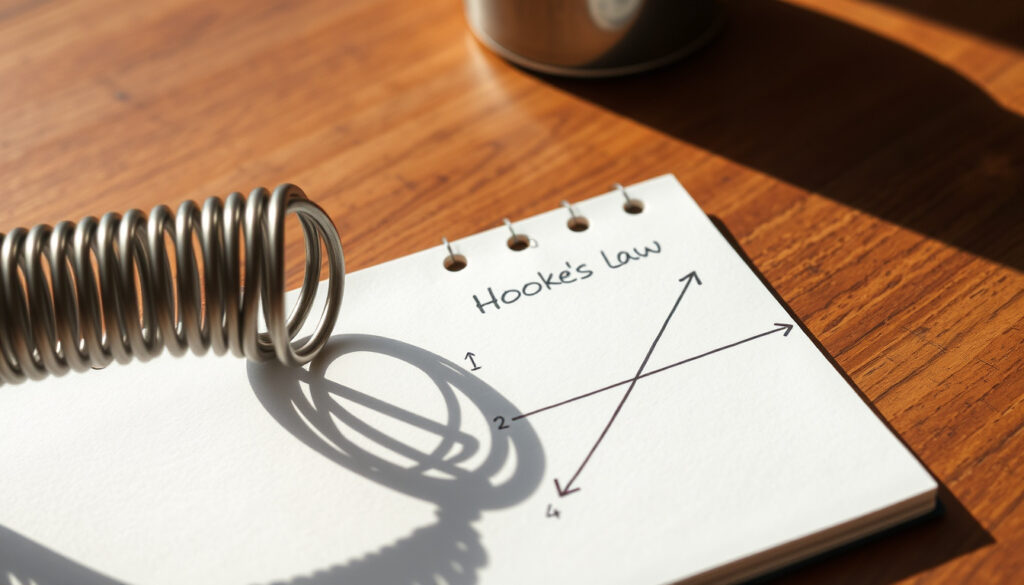
Hooke’s Law Explained: Formula, Examples, and Uses
If you’ve ever stretched a spring and felt it pull back, you’ve already experienced Hooke’s law in action. This simple principle of elasticity, discovered more than 360 years ago, still governs how engineers design everything from car suspensions to medical stents. By the end of this guide, you’ll understand the formula, the graph, and why the elastic limit matters in real-world materials.
Year proposed: 1660 ·
Named after: Robert Hooke ·
Standard formula: F = -kx ·
Type of law: empirical law of elasticity
Quick snapshot
- Force is proportional to extension within the elastic limit (BBC Bitesize (UK educational site))
- Discovered by Robert Hooke in 1660 (BBC Bitesize)
- Formula F = -kx or F = kx depending on sign convention (University of Tennessee Knoxville (university physics lab))
- The exact materials Robert Hooke used in his original experiments are not precisely documented.
- Whether Hooke fully anticipated the stress-strain formulation of elasticity is debated.
- 1660 — Hooke first observes the proportional relationship (BBC Bitesize)
- 1678 — Hooke publishes the law as an anagram, later revealing the full statement (BBC Bitesize)
- Modern engineering continues to apply Hooke’s law in materials science, biomechanics, and product design (BBC Bitesize)
Eight key facts about Hooke’s law, one pattern: each variable matters for predicting how materials behave under load.
| Label | Value |
|---|---|
| Full name | Hooke’s law of elasticity |
| Discoverer | Robert Hooke |
| Year of discovery | 1660 |
| Core principle | Force is proportional to displacement (linear elastic response) |
| Equation (vector) | F = -kx |
| Equation (magnitude) | F = kx |
| Spring constant unit | N/m |
| Applicable region | Within elastic limit of material |
What is Hooke’s law in simple terms?
Everyday analogy: a spring and a weight
- Hooke’s law says that the force needed to stretch or compress a spring is directly proportional to the distance you move it — as long as you don’t go too far (BBC Bitesize (UK educational site)).
- Think of a bathroom scale: the more you weigh, the more the spring inside stretches, and the needle moves accordingly.
The law works for any elastic object, not just springs — even a rubber band obeys up to a point. The catch is that the relationship only holds within the elastic limit, beyond which the material deforms permanently (University of Tennessee Knoxville (university physics lab)).
The mathematical relationship: force and extension
- Mathematically, it’s written as F = kx, where F is force, x is displacement (extension or compression), and k is the spring constant — a measure of stiffness (BBC Bitesize).
- A larger k means a stiffer spring; a smaller k means a more flexible one (BBC Bitesize).
The implication: if you double the pull, you double the stretch — but only until you hit the limit of proportionality, after which the graph bends and the law stops applying (BBC Bitesize).
The spring constant k is the key that turns a vague idea of “stiffness” into a precise number. Engineers use it to guarantee that a suspension spring won’t sag under a car’s weight — or that a medical stent expands exactly as needed.
Is Hooke’s law F = -kx or F = kx?
The meaning of the negative sign
- The negative sign in F = -kx indicates that the restoring force points opposite to the direction of displacement (Engineering ToolBox (engineering reference resource)).
- If you pull a spring to the right, the spring pulls back to the left — the minus sign captures that direction.
This vector form is essential when calculating forces in multiple dimensions, such as in suspension systems or vibration analysis (LibreTexts (university physics textbook)).
When to use each version
- Use F = -kx when direction matters — in physics problems involving vectors, forces, and motion.
- Use F = kx (magnitude only) when you only care about how much force is needed for a given stretch, ignoring direction (Dummies (educational resource)).
The trade-off: both are correct in context. The scalar form is simpler for introductory calculations; the vector form is necessary for real engineering where forces act in three dimensions.
Many textbooks introduce F = kx first, then add the negative sign later. If you’re solving a problem that asks for “the force exerted by the spring,” the sign tells you whether it’s a push or a pull — get it wrong and your entire free-body diagram will be off.
How is Hooke’s law used in real life?
Spring scales and weighing devices
- Spring scales work by measuring the extension of a spring under a load — the more weight, the more the spring stretches, and the dial reads the force (BBC Bitesize (UK educational site)).
- This is a direct application of Hooke’s law: the spring constant k is calibrated so that extension equals weight.
From produce scales at the grocery store to luggage scales at the airport, the principle is the same — and it only works if the spring stays within its elastic limit.
Vehicle suspension systems
- Car suspension coil springs obey Hooke’s law to absorb shocks from bumps and potholes (JB Springs (spring manufacturer)).
- When a wheel hits a bump, the spring compresses proportionally, then returns to its original length — thanks to the restoring force predicted by F = -kx.
If the spring is pushed beyond its elastic limit, it sags permanently and your car’s ride quality degrades. That’s why desk chair gas springs (which also obey Hooke’s law) are rated for specific weight ranges.
Medical devices like stents and catheters
- Elastic stents and catheters are designed using Hooke’s law to predict how they expand inside blood vessels (LibreTexts (university physics textbook)).
- The spring constant k of the material determines the expansion force — too little and the stent won’t stay open, too much and it could damage the artery.
The pattern: Hooke’s law gives engineers a predictable, linear relationship that they can rely on when human lives depend on consistent performance.
From the spring in your car to the stent in a patient’s artery, Hooke’s law is the hidden rule that makes predictable elastic behavior possible. When designers ignore the elastic limit, the result is permanent failure — a sagging suspension or a collapsed stent.
Confirmed facts vs what’s unclear
Confirmed facts
- Hooke’s law is an empirical law valid for many elastic materials within their elastic limit (BBC Bitesize).
- The formula F = -kx correctly models the restoring force of an ideal spring (University of Tennessee Knoxville).
- Robert Hooke discovered the relationship in 1660 (BBC Bitesize).
- The SI unit of the spring constant is newton per meter (Engineering ToolBox).
What’s unclear
- The exact materials Robert Hooke used in his original experiments are not precisely documented.
- Whether Hooke fully anticipated the stress-strain formulation of elasticity is debated.
Quotes from the experts
“Ut tensio, sic vis” — as the extension, so the force.
— Robert Hooke (1678), original description of what became Hooke’s law
“Hooke’s law, law of elasticity that relates the size of the deformation of an object to the deforming force or load.”
— Encyclopaedia Britannica (authoritative reference work)
“Hooke’s law says that the amount of force you apply is proportional to the stretch.”
— BBC Bitesize (UK educational site)
These three perspectives — from the discoverer, a modern encyclopedia, and a classroom resource — show how the same principle has been articulated across centuries: force and stretch go hand in hand, as long as you stay within the elastic limit.
What this means for you
Hooke’s law isn’t just a textbook formula. It’s the reason your car’s suspension absorbs bumps, your weighing scale gives a consistent reading, and a medical stent expands reliably inside a vessel. The moment you push a material beyond its elastic limit, the predictability disappears — and that’s when engineers start worrying about failure. For anyone designing products that flex, absorb, or return to shape, the lesson is clear: know your spring constant, respect your elastic limit, or face the consequences of permanent deformation.
Related reading
- Desk Chair Buying Guide Ireland — How gas springs and tension mechanisms obey Hooke’s law in ergonomic seating.
- Willow Tree in Ireland — Natural elasticity in tree branches and wood follows Hooke’s law at small displacements.
en.wikipedia.org, labman.phys.utk.edu, allen.in, youtube.com, youtube.com, pmt.physicsandmathstutor.com, cns.gatech.edu, newsedition.uk
Frequently asked questions
What does Hooke’s law tell us about springs?
It tells us that the force a spring exerts is proportional to how far it’s stretched or compressed, as long as the elastic limit isn’t exceeded. The spring constant k determines how stiff the spring is.
Why is there a negative sign in Hooke’s law?
The negative sign in F = -kx indicates that the restoring force acts in the opposite direction to the displacement. If you pull the spring to the right, it pulls back to the left.
Can Hooke’s law apply to materials other than springs?
Yes, it applies to any elastic material for small deformations — including rubber bands, metal wires, and even human bones (within their elastic range).
What happens if you stretch a spring beyond its elastic limit?
The spring deforms permanently and no longer returns to its original length. The force-extension graph becomes nonlinear, and Hooke’s law no longer applies.
How do you calculate the spring constant from a Hooke’s law experiment?
Hang known weights on a spring, measure the extension, and plot force vs extension. The gradient of the linear portion of the graph equals the spring constant k.
Is Hooke’s law still used in modern engineering?
Absolutely. It’s fundamental in mechanical engineering, materials science, biomechanics, and product design — from suspension systems to medical implants.
Does Hooke’s law work for compression as well as extension?
Yes, the law applies equally to compression — the spring shortens proportionally to the applied force — as long as the material remains within its elastic limit.
What is the difference between Hooke’s law and elasticity?
Elasticity is the general property of materials to return to their original shape after deformation. Hooke’s law is a specific mathematical model that describes linear elasticity for small deformations.
More related posts
 Brock Lesnar 2025: Accusations, Net Worth, Retirement & UFC Record
 Adeel Akhtar: Bio, Wife, Ethnicity, BAFTA & Recent TV Shows
 Daryl Sabara: Spy Kids Star on Marriage, Family, and Sobriety
 Danny Boyle: Knighthood Refusal, Oscars & iPhone Films
 S26 Ultra Release Date: March 11, 2026 Specs & Price
 Gyles Brandreth: Life, Career, Family, and Grandson’s Cancer
 Melinda French Gates: Divorce, Wealth, and Life After Bill
 Sanctuary: A Witch’s Tale Canceled – Is It Worth Watching