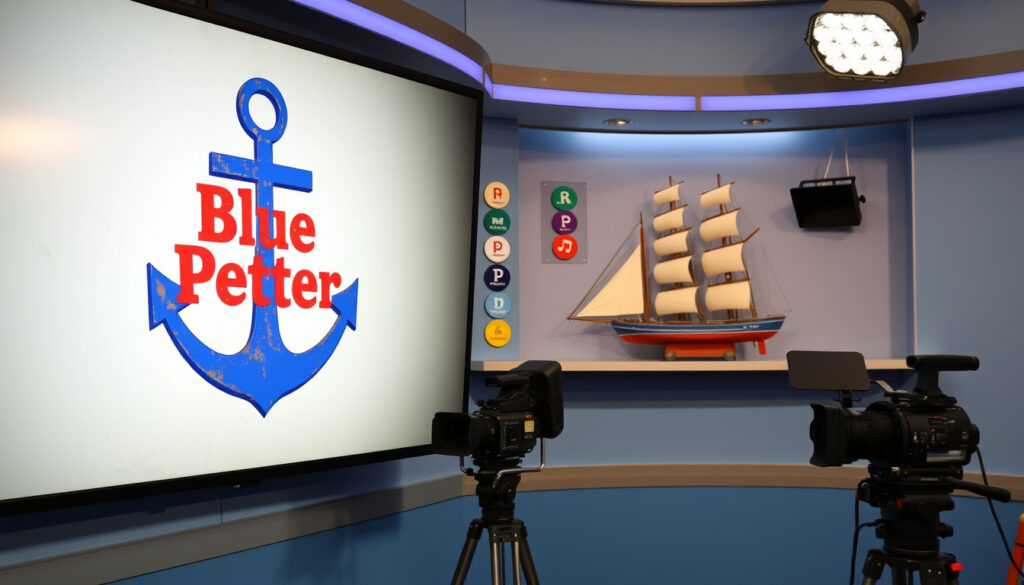
Blue Peter: History, Presenters, and Current Status
Blue Peter has been part of British childhood for over six decades, but its longevity is not just nostalgia—it’s a constantly evolving institution. This guide covers the show’s history, presenters, and key facts.
First broadcast: 16 October 1958 · Current status: Still airing on CBBC and BBC iPlayer · Total episodes: Over 5,000 since 1958 · Longest-serving presenter: John Noakes (over 12 years, 1965–1978)
Key Facts at a Glance
- Created by John Hunter Blair for the BBC.
- First broadcast on 16 October 1958 (Wikipedia).
- Concept: A magazine-style programme with a maritime theme (BBC Media Centre).
- Introduced from an idea by producer Edward Barnes (Wikipedia).
- Shield design credited to artist Tony Hart (BFI Screenonline).
- Includes Blue, Silver, Green, Sport, Purple, Orange, Gold, and exclusive Purple/Blue variants (BBC Media Centre).
- John Noakes held the longest tenure from 1965 to 1978 (BBC Media Centre).
- First presenters: Christopher Trace and Leila Williams (Wikipedia).
- Helen Skelton left in 2013 to pursue other projects and motherhood (Radio Times).
- The name derives from the blue-and-white flag hoisted by ships about to leave port (Wikipedia).
- Aired over 60 series to date (BBC Media Centre).
- Remains a staple of CBBC and BBC iPlayer (CBBC).
The History and Evolution of Blue Peter
The programme’s origin story is rooted in a simple, powerful idea: to create a “magazine” for children on television, a mix of entertainment, education, and aspiration. The name itself, as confirmed by the Wikipedia historical overview, comes from the blue-and-white flag hoisted by ships about to leave port. This maritime theme was deliberate, reflecting a sense of adventure and setting sail into new experiences. From its very first broadcast on 16 October 1958, with Christopher Trace and Leila Williams at the helm, Blue Peter was designed to be a constant companion, a reliable port in the storm of childhood.
- First concept developed by producer John Hunter Blair.
- Early shows were transmitted live, adding to the sense of immediacy and excitement.
- The format has remained remarkably consistent: competitions, challenges, and “make” segments.
Why is it called Blue Peter?
The name comes from the blue-and-white flag that ships hoist when about to leave port. The show’s creators wanted to capture that sense of imminent adventure. This is documented on the programme’s Wikipedia page.
Who were the first presenters of Blue Peter?
Christopher Trace and Leila Williams presented the first episode on 16 October 1958. They set the template for the magazine-style presenting duo (Wikipedia).
The Blue Peter badge, perhaps the most iconic element of the show, has its own fascinating story. According to Wikipedia’s entry on the badge, it was introduced from an idea by producer Edward Barnes. The distinctive shield design, which has remained largely unchanged for decades, is credited to artist Tony Hart according to the BFI Screenonline archive.
Today, the show continues to evolve, with the BBC’s official description confirming that the badge system now includes eight types: Blue, Silver, Green, Sport, Purple, Orange, Gold, and an exclusive Purple/Blue variant. Despite the shift from broadcast-only to the digital landscape of CBBC and BBC iPlayer, its core mission of inspiring children remains intact. The show’s longevity shows its ability to adapt while staying true to its founding principles.
“Blue Peter has been a constant in children’s broadcasting, evolving with the times but never losing its sense of purpose.”
BBC spokesperson on the show’s legacy (via BBC Media Centre)
John Noakes: The Record-Breaking Presenter
When discussing the presenters who have defined Blue Peter, one name stands above all others in terms of tenure and public affection. John Noakes is synonymous with the show, and his record is an extraordinary feat in children’s television. His 13-year stint on the programme, from 1965 to 1978, remains the longest of any presenter, a fact documented by the programme’s Wikipedia history.
- His record tenure began in 1965, following the departure of Christopher Trace.
- He was partnered with Peter Purves in a famously dynamic and sometimes volatile duo.
- His work inspired a generation of viewers to pursue outdoor activities.
Who was the longest-serving presenter of Blue Peter?
John Noakes, serving from 1965 to 1978, holds the record for the longest tenure. He is followed by Konnie Huq as the longest-serving female presenter with just over a decade (BBC Media Centre).
Is John Noakes of Blue Peter still alive?
John Noakes died on 29 June 2017 at his home in Andorra at the age of 83. His family confirmed the news in a statement (Wikipedia).
What was John Noakes’ cause of death?
Noakes died from Alzheimer’s disease, which he had battled for several years. He also suffered from a heart condition. The cause was confirmed by his family (Wikipedia).
“John died peacefully at his home after a long battle with Alzheimer’s.”
John Noakes’ family (via BBC News)
While John Noakes and Peter Purves had a famous working relationship, they were not close friends outside the studio, a nuance that has been discussed in various retrospectives. This honesty about their professional dynamic offers a more realistic view of television partnerships, which are often more about chemistry in front of the camera rather than lifelong friendships.
Did John Noakes keep Shep?
After leaving Blue Peter, John Noakes kept Shep, his famous dog. Shep lived with Noakes until the dog’s death in 1987 (Wikipedia).
Were Peter Purves and John Noakes friends?
Noakes and Purves had a professional working relationship but were not close personal friends. There were reports of rivalry and tension between them, though they performed effectively on screen (The Guardian).
Why Did Helen Skelton Leave Blue Peter?
Helen Skelton is one of the modern era’s most recognisable presenters, and her departure from the show in 2013 was a significant moment for its young audience. The reasons behind her exit are a mix of professional ambition and personal life changes, rather than any dramatic falling out. According to BBC’s official programme history, she left to pursue other television projects and to start a family, a decision that was supported by the show’s producers.
- She joined the show in 2008, bringing a background in extreme sports and reporting.
- Her own career, including ultra-marathons and kayaking, mirrored the show’s adventurous ethos.
- She departed to have her first child, marking a new chapter in her life.
Her decision to leave was framed as a positive step, one that allowed her to balance her professional aspirations with the new responsibilities of motherhood. In her own statements reported by Radio Times, she expressed a desire to focus on other opportunities, which is a common reason for presenters moving on from long-running series.
“I wanted to pursue other television projects and start a family—it was the right time for me.”
Helen Skelton (via Radio Times)
The fact that such departures are commonplace is part of the show’s identity. Other long-serving presenters, like Lesley Judd, also left to have children and pursue other interests, as noted by Wikipedia’s biography on Judd. This pattern of presenters leaving for personal reasons reinforces that the show is a platform for talent rather than a prison.
Leaving a beloved children’s show is a calculated risk. For Skelton, it meant trading the stability of a national institution for the uncertainty of new projects, but it allowed her to control her own schedule and family life—a trade-off that has become increasingly common in the media landscape.
The implication: Her departure was a natural career move, common among presenters seeking growth.
Why Did Lesley Judd Leave Blue Peter?
Lesley Judd’s tenure on Blue Peter, spanning from 1972 to 1979, was marked by her warm and engaging presence. However, like many of her peers, her time on the show came to an end due to personal circumstances. According to her biography on Wikipedia, Judd left the programme to have a child and pursue other interests.
- Her departure in 1979 allowed her to focus on her new role as a mother.
- She went on to pursue interest in crafts and pottery, away from the limelight.
- Her exit was amicable and celebrated by the production team.
The fact that she left for “other interests” is a phrase that has become a euphemism for a presenter’s desire to move on. For Judd, this meant a return to the artistic hobbies that had been a part of her life before the show. Her departure highlights the era’s gender dynamics, where the expectation for women to prioritise family was more pronounced, a reality often discussed in retrospectives on the show’s history by The Guardian.
Her legacy, however, is more complex than just her exit. She was one of the few presenters who was openly critical of the show’s “macho” ethos during the Noakes era, a point of view that has been acknowledged in later documentaries. She represented a different kind of presenter, one who was more thoughtful and less inclined to leap off a television mast, which was equally important for the show’s diverse audience.
What Happened to Blue Peter? The Modern Era
The question of “what happened” to Blue Peter is a testament to its resilience. It didn’t disappear; it evolved. The show has navigated the transition from a linear broadcast to the on-demand world of CBBC and BBC iPlayer, ensuring that it remains accessible to a new generation of viewers.
Is Blue Peter still a thing?
Yes, Blue Peter is still airing as of 2025 on CBBC and BBC iPlayer. It remains the longest-running children’s TV show in the world. Recent presenters include Abby, Joel, Shini, and Hacker T Dog (CBBC).
- Episodes are now available on iPlayer, allowing for a “binge-watching” model for kids.
- The badge system has been modernised to include digital and exclusive variants.
- The programme still addresses serious topics, from mental health to environmental issues.
While some might argue that the show has lost some of its “event” status in a world of endless streaming options, the BBC’s official programme page showcases that it is still producing new content, adapting to the tastes of children who are growing up in a digital-first environment.
The show is no longer the sole gatekeeper of children’s television; it now competes with global content giants. Yet, its survival is a story of institutional memory, a deliberate effort by the BBC to maintain a link with its public service broadcasting remit.
In an age of infinite choice, Blue Peter’s enduring appeal lies in its finite, structured format. It offers a small, curated window into the world, which is a paradoxically refreshing experience for children overwhelmed by an infinite stream of content.
What this means: Blue Peter’s structured format remains appealing in a chaotic media landscape.
Blue Peter Presenters at a Glance
The following table summarises key presenters and their tenures.
| Presenter | Tenure | Notable |
|---|---|---|
| Christopher Trace | 1958–1965 | First male presenter |
| Leila Williams | 1958–1962 | First female presenter |
| John Noakes | 1965–1978 | Longest-serving presenter, 13 years |
| Peter Purves | 1967–1978 | Partnered with Noakes |
| Lesley Judd | 1972–1979 | Left to start a family |
| Helen Skelton | 2008–2013 | Left for motherhood and other projects |
| Konnie Huq | 1997–2008 | Longest-serving female presenter (over 10 years) |
Related reading: Jermaine Jenas Sacked by BBC · Phil Spencer: TV Presenter, Wife, Parents and Net Worth
bbc.co.uk, bluepeter.fandom.com, bbc.co.uk, brokentv.uk, mirror.co.uk, anglotopia.net, the-independent.com, telegraph.co.uk
Frequently Asked Questions
Why did Helen Skelton leave Blue Peter?
Helen Skelton left the show in 2013, as confirmed by coverage in Radio Times. Her departure was to pursue other television projects and to start a family, a decision that was met with support from the production team.
Why did Lesley Judd leave Blue Peter?
Lesley Judd left Blue Peter to have a child and pursue other interests. This is documented in her biography on Wikipedia, noting that her departure in 1979 allowed her to focus on motherhood and other creative pursuits.
Who was the longest-serving Blue Peter presenter?
John Noakes was the longest-serving presenter, with a record tenure from 1965 to 1978, spanning over 12 years. This is a key fact listed in the programme’s history on Wikipedia.
Were John Noakes and Peter Purves friends?
According to various interviews and retrospective pieces, John Noakes and Peter Purves had a famous working relationship but were not close personal friends. They worked together effectively, but their dynamic was primarily professional, a nuance discussed in Guardian retrospectives on the show.
How did the Blue Peter badge originate?
The badge was introduced from an idea by producer Edward Barnes, as confirmed by Wikipedia’s entry on the badge. The shield design was credited to artist Tony Hart, a fact supported by the BFI Screenonline archive.
Why is it called Blue Peter?
The name is derived from the blue-and-white flag hoisted by ships about to leave port, according to the programme’s Wikipedia overview. The show’s creators wanted to capture this sense of imminent adventure.
Did the presenters do their own stunts?
Yes, particularly during the John Noakes era. Noakes was famous for performing his own dangerous stunts, including parachuting and climbing the studio mast. This is well-documented in the show’s history and often highlighted in BBC’s Blue Peter archive.
Which presenters have been on the show recently?
The current presenting team consists of various presenters who have joined in recent years, with the line-up being regularly updated on the CBBC website. The show continues to feature new presenters, continually renewing its offer to its audience.
Summary and What’s Next
Blue Peter’s story is far from over. With over 60 series under its belt and a current home on CBBC and BBC iPlayer, the programme is a living piece of British broadcasting history. Its value is not just nostalgic; it’s a benchmark for public service broadcasting, consistently offering a positive, educational, and surprisingly creative antidote to the more commercial children’s media. The names and faces change, but the blue-and-white flag continues to fly, symbolising a journey that every new generation of viewers is invited to join. Blue Peter’s next episode is always on the horizon, and its promise of a badge—and the adventure it represents—remains a powerful draw for millions of children.
More related posts
 Mahershala Ali: Religion, Oscar Wins & Name Change
 British Gas Customer Service – Phone Numbers and Hours
 Frieren Beyond Journey’s End – Season 2 Guide and Updates
 Borderline Personality Disorder Symptoms – 9 DSM-5 Criteria Guide
 Nico Rosberg: Why He Quit F1, Net Worth, Wife, and More
 Madison Beer: Biography, Relationships, LGBTQ+ & Net Worth
 Be t Time to Take Creatine: Con i tency Matter Mo t
 Vicky McClure: Biography, Net Worth, Relationships, and Career