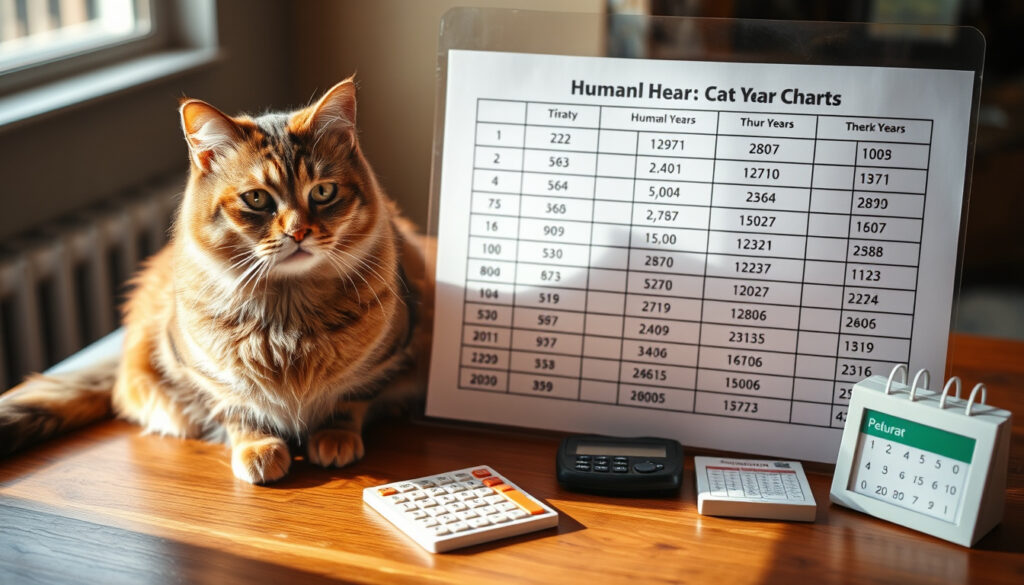
Human Cat Years Conversion: Chart & Age Calculator Guide
Anyone who has looked at their cat and wondered, “How old would you be if you were human?” has tried to do the math. The answer isn’t as simple as multiplying by seven—the 15-9-4 rule used by veterinarians is a far better benchmark—and this guide breaks down the conversion, shows you how to estimate your cat’s age using physical signs, and explains when a cat is considered a senior so you can adjust care accordingly.
First cat year: 15 human years · Second cat year: 24 human years total · Each subsequent year: ~4 human years · Average cat lifespan: 12–18 years
Quick snapshot
- First year = 15 human years (PetMD (veterinary-reviewed resource))
- Senior status begins at 7–10 cat years (AAHA (American Animal Hospital Association) guidelines)
- Indoor cats live 12–18 years on average (PetMD)
- Exact conversion for mixed-breed cats (Virbac UK (veterinary pharmaceutical company))
- Individual variation in aging rate (Purina (pet nutrition brand))
- Precise age estimation without a veterinary exam (Chewy (pet education platform))
- Kitten: 0–1 year = 15 human years (Chewy chart)
- Adult: 3–6 years = 28–40 human years (Iams (pet food brand))
- Senior: 7–10 years = 44–56 human years (AAFP (American Association of Feline Practitioners) guidelines)
- Geriatric: 15+ years = 76+ human years (Zoetis Australia (animal health company))
- Adjust diet for senior needs (Virbac UK)
- Schedule bi-annual vet checkups (AAHA senior care guidelines)
- Monitor for arthritis and kidney disease (Virbac UK)
Six key conversion facts, one pattern: the 15-9-4 rule is the most consistent veterinary benchmark, but the first two years account for the biggest jump.
| Life stage / fact | Human equivalent |
|---|---|
| First year | 15 human years |
| Second year | 24 human years |
| Third year | 28 human years |
| Average lifespan (indoor) | 12–18 years |
| Senior age | 7–10 cat years |
| Oldest cat on record | 38 years (Creme Puff) |
Is one human year 15 cat years?
The first year conversion
- The first calendar year of a cat’s life equals roughly 15 human years, according to the 15-9-4 rule endorsed by PetMD (veterinary-reviewed resource).
- The second year adds about 9 more human years, bringing the total to 24 human years by age 2 (Iams (pet food brand)).
- Each subsequent year adds approximately 4 human years (Chewy (pet education platform)).
Why the 15-year rule is approximate
- The rule is a simplification; individual cats age at different rates depending on breed, diet, and genetics (Purina (pet nutrition brand)).
- Mixed-breed cats may not follow the pattern as neatly as purebreds (Blue Grass Veterinary (veterinary practice)).
The 15-9-4 rule is the best approximation for the average cat, but it’s a guideline, not a biological constant. Owners who treat it as a hard science may misjudge when their cat enters senior territory.
How do I tell how old my cat is in human years?
Using a cat age chart
- Reference charts from Chewy and Purina provide quick lookup from 1 to 20 cat years.
- For example, Chewy maps 7 cat years to 47 human years and 15 cat years to 83 human years.
Estimating age by physical signs
- Examine teeth: Kittens have clean white teeth; tartar buildup and wear indicate adult or senior age (PetMD).
- Check eye clarity: Clear, bright eyes are typical of young cats; lens cloudiness or a blueish haze often appears in seniors (Zoetis Australia).
- Feel coat texture: A soft, shiny coat suggests youth; coarse, thinning fur or graying around the muzzle signals maturity (Virbac UK).
- Assess activity level: High energy and playfulness are typical of cats under 6; reduced activity, stiffness, or less jumping indicates senior age (AAHA guidelines).
Physical signs give a rough estimate, but only a veterinarian can pinpoint a cat’s age with reasonable accuracy especially for stray or rescue cats with unknown history.
The implication: physical signs offer a useful ballpark, but a veterinary exam remains the gold standard for age estimation.
When Is a Cat Considered a Senior?
Senior cat age range
- The AAFP (American Association of Feline Practitioners) guidelines define senior as over 10 years, while many veterinary practices start senior care at 7–8 years (Blue Grass Veterinary).
- Virbac UK places the senior stage at 11–14 years, with geriatric starting at 15.
What to expect at senior age
- Veterinary care shifts to bi-annual checkups including blood work, dental exams, and weight monitoring (AAHA senior care guidelines).
- Common age-related health issues: chronic kidney disease, hyperthyroidism, arthritis, and dental disease (PetMD).
Starting senior care earlier catches problems sooner, but many owners wait until their cat is visibly slowing down, missing the window for early intervention.
The pattern: the earlier you start senior monitoring, the better the chances of catching age-related diseases early, but many owners delay until symptoms appear.
At what age do cats usually pass away?
Average cat lifespan
- Indoor cats live on average 12 to 18 years, with purebred cats averaging 12.5 years and crossbred cats about 14 years (PetMD).
- Outdoor cats face significantly shorter lives, averaging 2 to 5 years due to risks such as traffic, predators, and disease (Purina).
Factors affecting longevity
- Breed, diet, spay/neuter status, and access to regular veterinary care all influence lifespan (Chewy).
- Indoor cats with good nutrition and preventive care commonly reach 15–18 years, and some exceed 20 (Virbac UK).
The catch: lifespan varies dramatically by environment, with indoor cats living three to four times longer than outdoor cats on average.
Is 20 very old for a cat?
What 20 cat years means in human years
- Using the 15-9-4 rule, a 20-year-old cat is roughly 96 human years old (15 + 9 + 18×4) (Chewy chart).
- Few cats reach this age; it’s considered exceptional longevity (Purina).
Caring for a very old cat
- Special care includes a soft diet for dental issues, joint supplements for arthritis, and frequent vet visits every 6 months (AAHA senior care guidelines).
- Monitor for signs of pain, changes in appetite, and litter box habits (Virbac UK).
A 20-year-old cat is a rare achievement, but the care required is intense. Owners who anticipate this stage can plan for the financial and emotional commitment it demands.
What this means: reaching 20 cat years is a milestone that demands proactive, specialized care for the cat’s remaining years.
Three common conversion methods compared: the 15-9-4 rule, Purina’s 25-first-two-years approach, and Chewy’s detailed chart. The pattern: the first two years are compressed, then the pace slows.
| Method | First year | Second year | Third year | 10 cat years |
|---|---|---|---|---|
| 15-9-4 rule (AVMA/PetMD) | 15 | 24 | 28 | 56 |
| Purina (25-first-two-years) | ~15 | ~25 | ~29 | ~57 |
| Chewy chart | 15 | 24 | 28 | 60 |
Confirmed facts
- First year = 15 human years (AVMA via PetMD)
- Second year = 24 human years (Iams (pet food brand))
- Each subsequent year ≈ 4 human years (Chewy (pet education platform))
- Senior status begins at 7–10 cat years (AAHA guidelines)
What’s unclear
- Exact conversion for mixed breeds (Virbac UK)
- Individual variation in aging rate (Purina)
- Precise age estimation without veterinary exam (Chewy)
- Indoor cats live longer than outdoor cats (Purina)
- The 15-9-4 rule is a guideline, not a biological constant (PetMD)
“The first year of a cat’s life is roughly equivalent to 15 human years, and the second year adds about 9 more.”
— American Veterinary Medical Association (AVMA) guidelines, as cited by PetMD
“Physical signs such as dental wear, eye clarity, and coat condition can give a rough estimate of a cat’s age, but they are not precise.”
— PetMD veterinary review
“Senior cats benefit from twice-yearly veterinary checkups, including blood work and dental exams, to catch age-related diseases early.”
— ICatCare (International Cat Care charity)
For cat owners, the implication is clear: stop using the 7-year myth and start using the 15-9-4 rule, or risk misjudging your cat’s life stage and missing critical senior care windows. The trade-off is between a simple rule of thumb and the reality of individual variation — but the veterinary consensus is consistent. Your cat’s age in human years matters most when it guides when to adjust diet, increase vet visits, and watch for age-related changes.
Frequently asked questions
How old is a 10-year-old cat in human years?
Using the 15-9-4 rule, a 10-year-old cat is about 56 human years (15 + 9 + 8×4). Chewy’s chart gives a slightly higher number (60 human years).
What is the oldest cat on record?
The oldest verified cat, Creme Puff, lived to 38 years old. The record is held by a cat owned by Jake Perry of Texas.
Do cats age faster than dogs?
In the first two years, cats age faster than most dog breeds. After that, the aging rate of cats is roughly 4 human years per cat year, similar to medium-sized dogs.
How can I slow my cat’s aging process?
You cannot stop aging, but you can promote longevity with a high-quality diet, indoor living, regular veterinary care, dental maintenance, and weight management.
What is the mortality rate for senior cats?
Mortality increases with age. A 2010 study found that cats over 15 had a mortality rate of about 18% per year, with kidney disease and cancer being the leading causes.
How do I calculate cat years to human years for a 2-year-old cat?
A 2-year-old cat is approximately 24 human years under the 15-9-4 rule. That’s 15 for the first year plus 9 for the second.
Is there a difference between indoor and outdoor cat aging?
Indoor cats generally live longer because they are protected from traffic, predators, and diseases. An indoor cat of 10 may be biologically equivalent to a 5-year-old outdoor cat in terms of health risk.
More related posts
 Prince Charles: King Charles III Biography, Health & Succession
 Donald Duck Facts: Real Name, Twin Sister, and Richest Duck
 David Haye: Boxing Record, Relationships, Net Worth, ITV Lawsuit
 Justin Timberlake: Marriage, Kids, and DWI Arrest Facts
 Roller Skates for Beginners: Size, Cost & Tips
 Belinda Carlisle Biography: Her Sobriety, Music and Life
 Louis Vuitton: Pricing, Ownership, and Best Bags to Buy in 2026
 Harry Hamlin: Biography, Relationships, Rumors, and Family