Michael Heseltine: Career, Wealth, and Tarzan Nickname
There aren’t many politicians who build a fortune in publishing, grab the House of Commons mace mid-debate, and still end up as deputy prime minister. Michael Heseltine did all three, and a few things he wasn’t supposed to do. His resignation as Defence Secretary on 9 January 1986 — after walking out of a Cabinet meeting over the Westland helicopter deal — is the moment that defined him (UK Government (official ministerial records)). The full picture follows: the property and media money, the Thatcher battles, the Liverpool regeneration, the Tarzan nickname, and the family behind it.
Born: 21 March 1933 (age 91) ·
Political party: Conservative ·
Spouse: Anne Heseltine (m. 1962) ·
Children: 4 (including Annabel Heseltine) ·
Title: Baron Heseltine
Quick snapshot
- Born 21 March 1933 in Swansea, Wales (History of Parliament Online (parliamentary archive))
- Resigned as Defence Secretary on 9 January 1986 (UK Government (official ministerial records))
- Westland affair: a 1985-86 battle over competing bids for the helicopter maker (University of Cambridge (Thatcher archives review))
- Exact net worth — no official figure is published; estimates vary widely
- The story that he had to buy his own ministerial furniture — anecdotal, never confirmed
- Westland escalated from December 1985 to the resignation on 9 January 1986 (BBC News On This Day (historic news archive))
- He backed a European consortium; Thatcher backed the Sikorsky-led US bid (BBC News (established UK broadcaster))
- A life peerage as Baron Heseltine kept him inside the system after the Commons
- The Liverpool regeneration model still shapes urban policy debates
Six rows, one pattern: Heseltine kept accumulating roles — and titles — until he was too big for the party to ignore.
| Label | Value |
|---|---|
| Full name | Michael Ray Dibdin Heseltine, Baron Heseltine |
| Born | 21 March 1933, Swansea, Wales |
| Political party | Conservative |
| Office held | Deputy Prime Minister; Secretary of State for the Environment, Defence, and Trade and Industry |
| Nickname | Tarzan |
| Spouse | Anne Heseltine |
How Did Michael Heseltine Make His Money?
Property development in the 1950s
The money came first: Heseltine was wealthy before he was an MP, and the wealth let him fight the party establishment on his own terms.
He started out in property development in the 1950s, when Britain’s city centres were being rebuilt and the first fortunes were being made in office blocks. According to Wikipedia’s profile, the property work led naturally to publishing: in 1957 he helped found Haymarket Media Group, the company that made him genuinely rich (Wikipedia (public biography)).
The parliamentary record fills in the rest: educated at Shrewsbury School and Pembroke College, Oxford, he served as a commissioned officer in the Welsh Guards, contested Gower in 1959 and Coventry North in 1964, and entered the Commons as MP for Tavistock in 1966. By 1964 he was also chairman of Haymarket Press — and in government he went on to run the Environment department (1979-83), Defence (1983-86), and later Trade and Industry, holding the Henley seat from 1974 to 2001 along the way (History of Parliament Online).
Haymarket Media Group and media ventures
- Publishing gave Heseltine a platform, not just an income.
- The cash flow bankrolled a political career that owed nothing to party donors.
None of this made him a typical Tory grandee. The point of the business career was independence: Haymarket’s profits meant Heseltine never had to depend on the whips, the party machine, or anyone else’s goodwill.
The self-made wealth-to-public-life pipeline is still running in Britain; Duncan Bannatyne is the modern businessman who turned a fortune into a public profile (Duncan Bannatyne).
Estimated net worth
- No official net-worth figure is published.
- Estimates vary widely — and none is authoritative.
What is documented is the direction: a 1950s start-up, a publishing group, a property portfolio, and ministerial salaries on top. Heseltine’s private wealth has always been treated as real but unquantified.
Independent money bought political independence — but it made every rebellion look like ambition rather than conviction.
The implication: money made Heseltine unresignable. He could always afford to walk away — and the party knew it.
Why Did Michael Heseltine Resign?
The Westland affair
The argument was never really about helicopters: it was about who controls the story a minister tells.
The Westland affair concerned competing bids for the British helicopter manufacturer Westland in 1985-86 (BBC News (established UK broadcaster)). Heseltine backed a European consortium’s bid; Thatcher backed a US-led bid involving Sikorsky (University of Cambridge).
The row escalated on 23 December 1985, when Heseltine wrote to Thatcher raising concerns about possible Libyan involvement connected with a consortium bidder (BBC News).
Conflict with Margaret Thatcher
- Thatcher’s allies read the letter as a manoeuvre against her authority.
- Heseltine read it as a duty to flag a national-security risk.
The fight became a question of collective Cabinet government and the management of ministerial statements — an issue that outlived the helicopters (Washington Post (US political reporting)).
Resignation speech and aftermath
- 9 January 1986 — walked out of a Cabinet meeting and resigned, saying trust between the Prime Minister and the Defence Secretary no longer existed (BBC News On This Day (historic news archive)).
- The resignation turned a departmental dispute into a personal feud with Thatcher.
Heseltine never rejoined Thatcher’s Cabinet. The rupture widened until, in 1990, he challenged her for the party leadership — a challenge that ended her premiership.
Heseltine lost the argument inside Cabinet — yet the resignation made him the only Conservative who could seriously challenge Thatcher.
What this means: a resignation can be a weapon. Heseltine turned his exit into a four-year campaign that ended with Thatcher gone.
Why Was Michael Heseltine Nicknamed Tarzan?
The hair and the build
- Long, swept-back blond hair — a visual anomaly among Conservative frontbenchers.
- An athletic build that fit the part, and a press pack happy to play along.
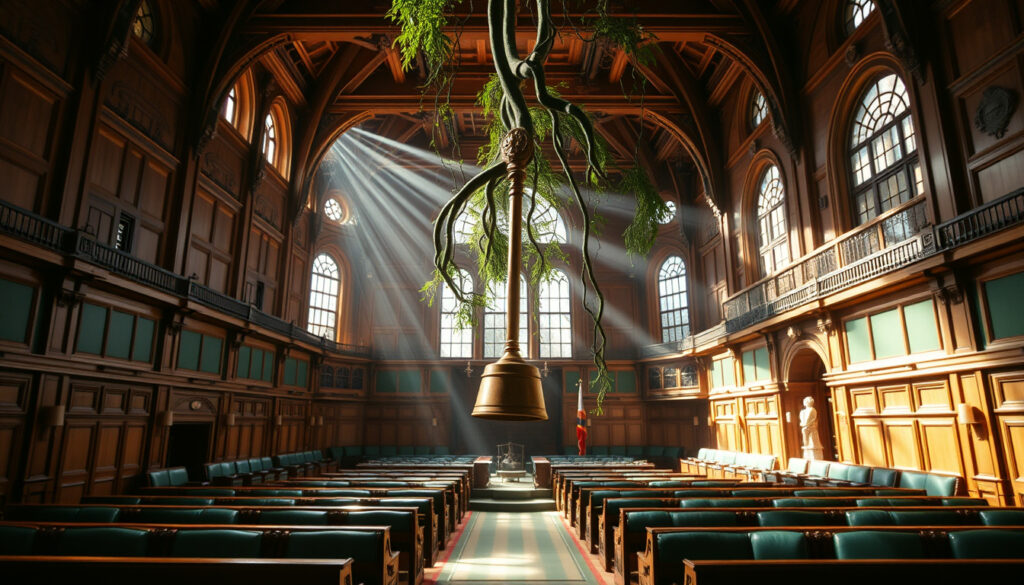
The label derived from that appearance, and it became permanent after a famous incident in the Commons. Wikipedia’s biography records that Heseltine seized the House of Commons mace during a debate — the moment that turned a nickname into an identity (Wikipedia).
The mace incident
Tarzan made Heseltine instantly recognisable — and permanently hard for the party to control.
The mace is the symbol of the Commons’ authority. Seizing it during a high-voltage debate was the kind of gesture that usually ends a career; in Heseltine’s case, it built one.
Public persona
- The press used the nickname constantly; Heseltine never bothered to fight it.
- “I don’t mind being called Tarzan, it’s better than being called Jane” — a line widely attributed to him.
A leading Conservative with a jungle nickname was a gift to cartoonists and a headache for the whips: every Tarzan headline made Heseltine sound more like an outsider — which is exactly what the party establishment feared he was.
The catch: the joke worked for him and against him. It made him famous, but it also made him safe to mock — and mocking a rival is how establishments contain threats.
What Did Michael Heseltine Do for Liverpool?
Minister for Merseyside
- Appointed Minister for Merseyside after the 1981 Toxteth riots, while already serving as Secretary of State for the Environment (History of Parliament Online).
- His brief: bring jobs and investment back to a city in visible collapse.
The riots had exposed a Liverpool that national government barely touched. Heseltine treated the city like a turnaround project, pushing investment and development into areas the market had abandoned.
Regeneration after the riots
- Led regeneration efforts after the 1981 Toxteth riots.
- Helped secure significant investment for Liverpool’s development.
The approach was physical and fast — and it made him the rare Conservative minister with a visible urban success on his record.
Investment and legacy
Liverpool gave Heseltine the one thing Westminster never did: a legacy he could point to as proof that Conservative government could help a struggling city.
The Heseltine playbook — visible ministerial commitment, public and private money, quick physical results — became a reference point for later urban policy in Britain.
The pattern: send Heseltine somewhere broken and he behaves like an owner, not a visitor. Liverpool still remembers the difference.
Who Is Michael Heseltine Married To?
Anne Heseltine (née Williams)
- Married Anne Williams in 1962 — a marriage that spanned his entire political career (Wikipedia).
Wikipedia’s biography records that the couple had four children — Annabel, Alexandra, Rupert, and Francis — with Annabel building her own public career as a journalist and author.
Annabel Heseltine and the family name
- Annabel Heseltine — journalist and author, and the most visible of the four siblings.
- The family name has stayed in the news long after Michael left the Commons.
A political marriage that lasts is rare; the Heseltines made it look structural. The stable base at Thenford House in Northamptonshire gave the maverick a conventional anchor.
Thenford and the title
Even in retirement, the Heseltine household stayed news — the family name kept the maverick brand alive.
When he left the Commons in 2001, he took the title Baron Heseltine — a life peerage that moved him from the elected chamber to the Lords. Thenford House remains the family base.
Why this matters: the stable home and the grand title gave the rebel a conventional base. Heseltine could challenge the establishment from inside it, not from the cold.
Michael Heseltine Timeline: Key Dates
The sequence below runs from his birth to his life peerage; the major dates carry the same source links used in the sections above.
- Born in Swansea, Wales (History of Parliament Online).
- Started in property development; helped found Haymarket Media Group in 1957 (Wikipedia).
- Elected Conservative MP for Tavistock; moved to Henley in 1974 (History of Parliament Online).
- Appointed Secretary of State for the Environment (History of Parliament Online).
- Became Minister for Merseyside after the Toxteth riots (History of Parliament Online).
- Resigned as Defence Secretary over Westland (BBC News On This Day (historic news archive)).
- Challenged Margaret Thatcher for the party leadership.
- Returned to Cabinet as Trade and Industry Secretary.
- Became Deputy Prime Minister.
- Left the Commons and entered the House of Lords.
Confirmed Facts vs. What’s Unclear
This profile is built from parliamentary records, government documents, and journalism; where material is anecdotal, it is flagged as such.
The public record settles some things conclusively and leaves others open. The lists below separate what has hard documentary support from what is still folklore.
Confirmed facts
- The Westland affair consumed British politics in 1985-86, a dispute over competing bids for the helicopter maker (BBC News (established UK broadcaster)).
- Heseltine resigned as Defence Secretary on 9 January 1986 (UK Government (official ministerial records)).
- The affair raised real questions about collective Cabinet government (Washington Post (US political reporting)).
What’s unclear
- Exact net worth — no official figure exists and estimates vary widely.
- The furniture story — the claim that he had to buy his own ministerial furniture is anecdotal and never confirmed.
- Motive for the 1990 leadership challenge — her memoirs cast it as personal ambition; supporters framed it as principle.
Key Quotes From the Heseltine Years
Two voices frame the Heseltine effect better than any summary: the prime minister who accused him of ambition, and the prime minister who trusted him with the deputy’s job.
Heseltine resigned for personal ambition.
Margaret Thatcher, as paraphrased in her memoirs
He was a force of nature in government.
John Major, from his memoirs
Between the accusation and the tribute lies the whole Heseltine career: too dangerous to praise, too effective to ignore.
The Legacy Question
Michael Heseltine is the answer to a question the Conservative Party keeps asking itself: what happens when a minister is more independent — and more ambitious — than the leadership that tries to hold him back? The Westland resignation and the 1990 challenge turned him into the man who could, and the party could never decide whether to embrace him or contain him. The same Conservative-insider-turned-critic arc has a modern echo in the career of Rory Stewart, who walked the same road from Cabinet minister to outsider (Rory Stewart). For today’s Conservative Party, the choice is concrete: make room for its most disruptive talent, or watch that talent force the change from the outside.
Frequently asked questions
The short answers below draw on the sources cited above.
Is Michael Heseltine still alive?
Yes. Born on 21 March 1933, he now lives at Thenford House in Northamptonshire.
What is Michael Heseltine’s full name?
Michael Ray Dibdin Heseltine, Baron Heseltine.
Did Michael Heseltine ever become Prime Minister?
No. He served as Deputy Prime Minister from 1995 to 1997 but never held the top job.
When did Michael Heseltine resign from the Cabinet?
He resigned as Secretary of State for Defence on 9 January 1986 during the Westland affair.
How long was Michael Heseltine an MP?
He represented Tavistock from 1966 to 1974 and Henley from 1974 to 2001 — 35 years in total.
What is Baron Heseltine’s official title?
He took the title Baron Heseltine when he became a life peer in 2001.
What is Michael Heseltine doing now?
He lives in Northamptonshire and holds the title Baron Heseltine, a life peerage created in 2001.
Related reading
More related posts
 IKEA Wardrobes: Complete Guide to PAX, Doors, and Small Room Ideas
 Andy Gibb: Cause of Death, Relationships, and Life Story
 Https://192.l.168.1.1 – Router Login Guide & Troubleshooting
 Thomas Shelby: Character Guide, Facts & Quotes
 World Cup Play-Off Draw – Results, Teams and Schedule
 Erika Kirk Biography: Age, Family, and Turning Point USA CEO Role
 Sam Heughan: Relationship Status, Outlander Facts & FAQs (2025)
 Tesco Tinned Beans Shortage: What Shoppers Need to Know