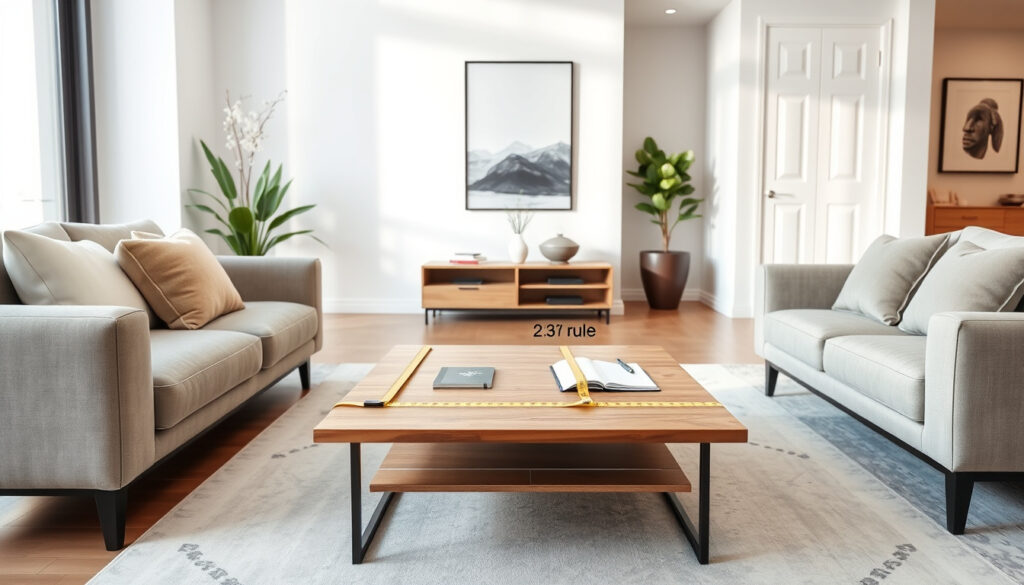
Coffee Table Sizing Guide for 2026: 2/3 Rule, Height & Trends
There is a moment in almost every living room rearrangement when you place the sofa, step back, and realize the space between it and the TV is just… empty. That empty void is where a coffee table earns its keep—but choosing the wrong one can make the whole room feel off. The good news? Getting it right is less about luck and more about a couple of simple, well-documented proportions. Whether you are kitting out a compact London flat or a sprawling country living room, there’s a distinct set of rules and trends for 2026 that will help you nail the balance between style and function.
Coffee Table Quick Facts
- The two-thirds rule: table should be about two-thirds the length of the sofa, as recommended by Castlery UK.
- Measure the sofa’s full length, then multiply by 0.66 for a starting point. (Castlery UK)
- Addresses table length relative to sofa length, not height, as clarified by the Sitting Room Guide.
- Provides a proportional anchor for the entire living room layout. (Sitting Room Guide)
- Leave at least 45 cm (18 inches) between the table edge and sofa, according to home goods reviewers at UKPicks.
- Essential for legroom and easy walkways in smaller rooms. (UKPicks)
Before diving into the specific measurements, there’s one core concept to grasp: the coffee table isn’t just a standalone object. It’s a partner to your sofa. The single most important relationship is the one between the table’s height and the sofa’s seat. Getting this wrong is the most common—and most visible—mistake.
What is the current trend for coffee tables?
Trend predictions for 2026 highlight a clear shift toward bold, organic shapes, natural wood finishes, and integrated storage. Popular styles include round pedestal tables and lift-top designs. These aren’t just aesthetic choices—they reflect how we increasingly live, work, and dine in our living rooms.
For flexible styling, consider a lift-top design. These are crafted to align with the 1–2 inch rule for comfort and offer a practical surface for laptops or meals, as noted in UK recommendations.
For minimalists, Living Room Online suggests choosing a table that sits no more than 1–2 inches lower than the sofa seat height—a rule they stress for comfort. For maximalists, a sculptural piece with a live edge or fluted details adds character.
The best way to future-proof your purchase is to follow the size rules, then inject style. A well-proportioned table will look modern for years. If you prefer a lift-top, you also gain the bonus of a laptop station or a dining tray, aligning with practical multipurpose living.
Are coffee tables no longer in style?
No. While trends shift toward lighter, more sculptural forms, the coffee table remains a functional anchor for the living room. The 2026 trend is toward curved, natural shapes, proving the piece is evolving, not disappearing.
What is the 2/3 rule for coffee tables?
The most reliable length guideline is the “two-thirds rule.” A coffee table should be roughly two-thirds the length of your sofa. For a standard three-seater sofa at around 72 inches, a coffee table around 48 inches long works beautifully.
The Sitting Room Guide notes the 2/3 rule addresses table length, not height. A table that’s too long overwhelms the sofa, while one that’s too short looks lost in the space. As a secondary measure, Castlery UK notes the table should extend at least a few inches past the sofa’s outer edges to maintain visual balance.
- Two-seater sofa: length around 36–42 inches
- Three-seater: length around 48–54 inches
- Large corner sofa: look for wide tables 60+ inches
For smaller UK living rooms, Living Room Online echoes the 2/3 rule but stresses it’s a starting point. Always measure your sofa’s full length and multiply by 0.66 for a precise starting point.
There’s a trade-off between the 1-2 inch and 2/3 rule. If you have a compact space, a slightly shorter table frees up visual floor space. Conversely, a longer table makes a small sofa feel larger by providing a continuous horizontal line.
| Sofa Type | Sofa Length (approx.) | Recommended Coffee Table Length (2/3 rule) |
|---|---|---|
| Two-seater | 60 inches | 40 inches |
| Three-seater | 72 inches | 48 inches |
| Large corner sofa | 90+ inches | 60+ inches |
The implication: choosing a table that adheres strictly to the 2/3 rule ensures the furniture arrangement feels intentional rather than accidental.
What is the rule for a coffee table?
The single most direct piece of guidance comes from UK retailers and interior specialists who agree on a simple benchmark: your coffee table should be level with your sofa’s seat cushions or slightly lower. As a rule, the standard sofa seat height is around 17–18 inches, which is why the standard coffee table height sits at 16–18 inches.
Should a coffee table be higher or lower than a sofa?
The most direct piece of guidance comes from UK retailers and interior specialists who agree on a simple benchmark: your coffee table should be level with your sofa’s seat cushions or slightly lower. As a rule, the standard sofa seat height is around 17–18 inches, which is why the standard coffee table height sits at 16–18 inches.
FCI London recommends selecting a coffee table that sits no more than 5 cm lower than the top of the sofa seat. Meanwhile, Evelyn Lily Interiors states the standard sofa height range is 66–92 cm tall. This small offset is practical—it keeps drinks within easy reach without requiring you to lean over excessively.
If you’re choosing between a 16-inch and an 18-inch model, consider your seating. If your sofas are on the lower, more modern side, go for the lower end of the range. For traditional, deeply cushioned sofas, aim for the higher end of the 16–18 inch band.
Who sells the best coffee tables?
Top UK retailers for coffee tables include Next, Habitat, Harvey Norman, Furniturebox, and Furniture Village. The best choice depends on your budget, material preference, and style. Living Room Online suggests that for a standard 200 cm three-seater sofa, tables between 120–140 cm work best under the 2/3 rule.
Which is the best coffee table?
There is no single best coffee table for every home. The best coffee table balances the 2/3 length rule, the 1–2 inch height rule, and your personal taste. For UK buyers in 2026, round pedestal tables with natural wood finishes offer the strongest combination of trend alignment and practicality, according to Meet Felix.
What are the most popular coffee tables in 2026?
Trend predictions for 2026 highlight a clear shift toward bold, organic shapes, natural wood finishes, and integrated storage. Popular styles include round pedestal tables and lift-top designs. These aren’t just aesthetic choices—they reflect how we increasingly live, work, and dine in our living rooms.
For minimalists, Living Room Online suggests choosing a table that sits no more than 1–2 inches lower than the sofa seat height—a rule they stress for comfort. For maximalists, a sculptural piece with a live edge or fluted details adds character.
What are some common mistakes to avoid when decorating a coffee table?
Even with the right dimensions, people often make one of two errors: choosing a table that’s too low or too far away. A table that’s more than 2 inches lower than the seat creates a “leaning reach” that strains your back.
- Too low: Looks disconnected from the sofa.
- Too high: Visually blocks the sofa’s lines.
- Too far: Makes the table useless for its purpose.
There’s a compromise to be made. If you can’t find a table that matches your seat height exactly, aim for the 1–2 inch lower rule. If you’re stuck between two sizes, go with the larger one for a more grounded look.
What makes a house look tacky?
Common coffee table mistakes that contribute to a tacky look include overcrowding the surface with too many small items, using plastic plants instead of real ones, leaving cluttered magazines, and mismatched coasters. Streamlining to a few intentional pieces—like a single decorative bowl or a stack of hardcover books—creates a cleaner, more expensive look.
How can I make my coffee table look more expensive?
To make your coffee table look more expensive, use a tray to corral items, add a stack of hardcover books, and incorporate a sculptural object. Avoid plastic plants in favour of real greenery or high-quality faux greenery.
What do you put in the middle of a coffee table?
The middle of a coffee table works best with a single anchor piece: a decorative bowl, a stack of books, or a centrepiece plant. This creates visual focus without clutter.
Height: The 1–2 Inch Rule
The most direct piece of guidance comes from UK retailers and interior specialists who agree on a simple benchmark: your coffee table should be level with your sofa’s seat cushions or slightly lower. As a rule, the standard sofa seat height is around 17–18 inches, which is why the standard coffee table height sits at 16–18 inches.
FCI London recommends selecting a coffee table that sits no more than 5 cm lower than the top of the sofa seat. Meanwhile, Evelyn Lily Interiors states the standard sofa height range is 66–92 cm tall. This small offset is practical—it keeps drinks within easy reach without requiring you to lean over excessively.
Length: The 2/3 Rule
The most reliable length guideline is the “two-thirds rule.” A coffee table should be roughly two-thirds the length of your sofa. For a standard three-seater sofa at around 72 inches, a coffee table around 48 inches long works beautifully.
The Sitting Room Guide notes the 2/3 rule addresses table length, not height. A table that’s too long overwhelms the sofa, while one that’s too short looks lost in the space. As a secondary measure, Castlery UK notes the table should extend at least a few inches past the sofa’s outer edges to maintain visual balance.
The 2/3 Rule and Sofa Proportions
The two-thirds rule is often quoted by furniture outlets as a baseline, but it’s worth applying it with nuance. Castlery UK champions this ratio, stating it should be the primary driver for length. This principle ensures the table anchors the seating area without dominating it.
Avoid a table that’s less than half the sofa length—you’ll end up with a “dwarf” effect. Likewise, exceeding 75% makes the room feel cluttered.
Beyond length, consider the visual weight. A chunky, solid wood table might feel huge even if short, while a glass table visually disappears. For small spaces, Homary UK suggests round tables are a great fit, as they allow for smoother traffic flow around them.
Clearance and Practicality for UK Spaces
A common mistake is ignoring the clearance around the table. You need enough room to sit down and stand up comfortably, and to walk past without hitting your shins. The general rule is to leave a gap of 30–45 cm between the table and sofa.
UKPicks specifically says to leave at least 45 cm clearance between the table edge and sofa for legroom and walkways in smaller UK rooms. This is non-negotiable in a busy family room where the coffee table doubles as a footstool and a snacking spot.
If the gap is too small, the room feels cramped and the TV view is obstructed. If the gap is too large, you’ll be stretching awkwardly for your mug. The 45 cm figure strikes the perfect balance for most British living rooms.
2026 Style Trends and Popular Designs
Trend predictions for 2026 highlight a clear shift toward bold, organic shapes, natural wood finishes, and integrated storage. Popular styles include round pedestal tables and lift-top designs. These aren’t just aesthetic choices—they reflect how we increasingly live, work, and dine in our living rooms.
For minimalists, Living Room Online suggests choosing a table that sits no more than 1–2 inches lower than the sofa seat height—a rule they stress for comfort. For maximalists, a sculptural piece with a live edge or fluted details adds character.
Coffee Table vs. Sofa: Common Mistakes
Even with the right dimensions, people often make one of two errors: choosing a table that’s too low or too far away. A table that’s more than 2 inches lower than the seat creates a “leaning reach” that strains your back.
- Too low: Looks disconnected from the sofa.
- Too high: Visually blocks the sofa’s lines.
- Too far: Makes the table useless for its purpose.
There’s a compromise to be made. If you can’t find a table that matches your seat height exactly, aim for the 1–2 inch lower rule. If you’re stuck between two sizes, go with the larger one for a more grounded look.
What the Experts Say
“The coffee table should sit 1–2 inches lower than the seat height, and for our UK market we stick to that as a hard rule for comfort.”
Evelyn Lily Interiors (UK home styling)
“We recommend leaving at least 45 cm between the coffee table and your sofa. This is the sweet spot for legroom and walkways in a UK living room.”
UKPicks (Home goods reviewers)
“The 2/3 rule focuses on the table’s length to the sofa, but we always tell customers to consider the seat height offset as the real decision maker.”
FCI London (Furniture retailer)
“For a standard 200 cm three-seater sofa, a coffee table of 120–140 cm creates the most balanced visual effect.”
Meet Felix (Interior buying guide)
Summary: Your Check and Forward Stake
Choosing the right coffee table for 2026 is about finding the intersection of ergonomics and aesthetics. The measurements aren’t arbitrary—they’re built on the golden rules of interior design that keep your room functional and beautiful. When you sit down, the table should meet your body at the right height; when you walk by, it should offer a path that feels open.
The forward stake is your confidence. Armed with the two-thirds length rule and the 1-inch height offset, you can shop with certainty. You’ll be able to walk into any store, pull out a tape measure, and know instantly whether a piece will work in your home. The consequence: you will avoid the buyer’s remorse that comes from mismatched proportions.
Frequently Asked Questions
Are coffee tables going out of style?
No. While trends shift toward lighter, more sculptural forms, the coffee table remains a functional anchor for the living room. The 2026 trend is toward curved, natural shapes, proving the piece is evolving, not disappearing.
Should a coffee table be taller or lower than the sofa?
It should be level with the sofa seat or up to 1–2 inches lower than it. Going lower creates a leggy, airy feel but risks awkward reaching. Matching the seat height is the safest, most comfortable choice.
What if my sofa is higher than average?
If your sofa’s seat is higher than 18 inches, you can go up. Just apply the rule: table height should be equal to or slightly lower than the seat. Always measure from the floor to the top of your seat cushion, not the armrest.
What is the best shape of coffee table for a small living room?
Round tables are the best choice for small living rooms. They have no sharp corners, make a space feel larger, and allow for easier traffic flow. A round pedestal table is a top 2026 recommendation for tight spaces.
Are lift-top coffee tables worth the extra cost?
If you work from home or often eat in the living room, yes. Lift-top tables are ergonomically excellent, providing a surface that lets you sit with good posture. They add mechanical complexity and a higher price tag, but offer significant versatility for modern living.
How long should a coffee table be for a 2-seater sofa?
For a standard two-seater sofa around 60 inches long, your coffee table should be around 40 inches long. Use the two-thirds rule: measure the full sofa length (not the legs) and multiply by 0.66.
What is the standard height of a coffee table in the UK?
The standard coffee table height in the UK is between 16 and 18 inches (approximately 41–46 cm). This is based on the UK standard seat height of 17–18 inches.
How far should a coffee table be from the sofa?
For comfort and functionality, leave about 45 cm (18 inches) between the front edge of the table and the front of the sofa cushions. This allows for legroom and a walkway without it feeling detached.
More related posts
 Linda Robson Health Update: Illness, Husband, and Career
 Garth Brooks 2026: Health, Tours, LGBTQ Views & Net Worth Update
 Julia Donaldson: Biography, Net Worth, and Famous Books
 Rebecca Zamolo: Real Name, Children, Miscarriage & Family Facts
 Gerran Howell: Age, Wife, The Pitt Role & Career Timeline
 Judge Frank Caprio Dies at 88: Last Words and Legacy
 What Causes Back Pain in Females – Upper, Lower & Side Pain
 Hilton Dalaman Sarigerme Resort & Spa – 2025 Reviews and Booking Guide