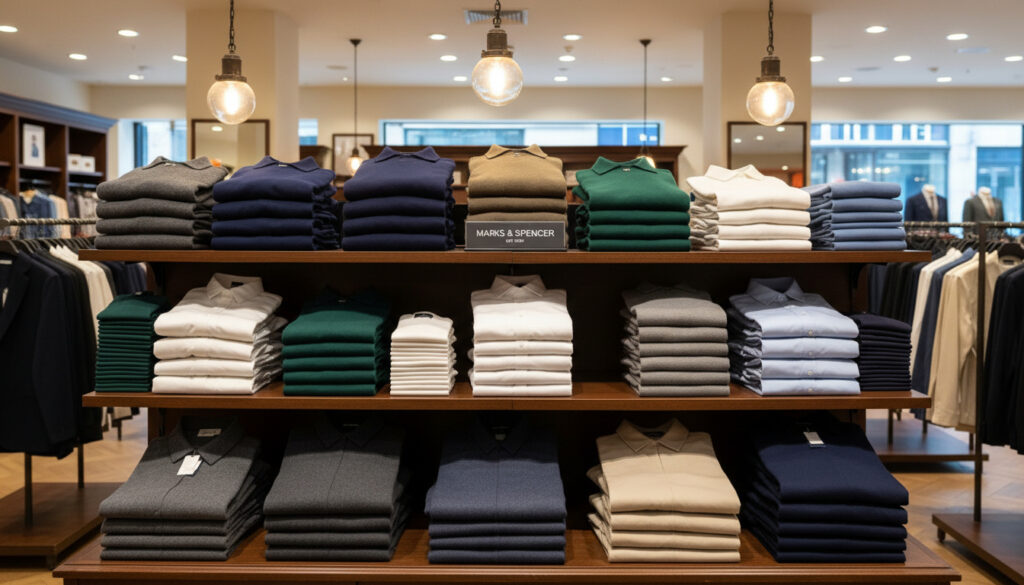
Marks and Spencer Clothes – Sizes, Quality, History Guide
Marks & Spencer has clothed British families for over 140 years, evolving from a single market stall into one of the UK’s most recognised fashion retailers. The brand built its reputation on accessible quality, establishing standards that influenced the entire British high street.
Today, M&S operates across womenswear, menswear, and childrenswear, maintaining a significant physical presence while expanding its digital footprint. Shoppers navigate between seasonal collections, core basics, and the iconic Percy Pig merchandise that occasionally accompanies fashion lines.
Drawing from corporate archives, historical records, and verified company data reveals the current state of Marks & Spencer clothing, including sizing accuracy, return policies, and market positioning against international competitors.
What Defines Marks & Spencer’s Clothing Identity?
1884 in Leeds, UK heritage retailer
Women, men, kids, lingerie, formalwear
Online platform, 1000+ UK stores
Quality basics, seasonal sales events
- Heritage of affordable quality spanning four centuries of British retail
- Frequent promotional periods including themed collection events
- Expanding sustainable clothing lines with fabric innovation history
- Generally true-to-size measurements across core clothing ranges
- Established online platform with next-day delivery capabilities
- Comprehensive size spectrum from UK 6 through 24 for women
| Category | Details | Source Type |
|---|---|---|
| Founded | 1884, Leeds Kirkgate Market | Corporate archives |
| Legal Structure | Limited company from 1903 | Historical records |
| Store Network | 1000+ UK locations plus EU presence | Company data |
| Size Range | UK 6-24 (women’s clothing) | Official sizing guides |
| Returns Policy | 28 days free returns | Policy documentation |
| Price Positioning | Mid-market, £10-£100 average | Current listings |
| Online Launch | Early 2000s e-commerce platform | Corporate timeline |
| Research Heritage | 1934 textile innovation laboratory | Historical archives |
How Did Marks & Spencer Build Its Clothing Reputation?
The Penny Bazaar Foundations
Michael Marks arrived in Leeds from Belarus in 1884 with minimal capital. A £5 loan from Isaac Jowitt Dewhirst enabled the first Penny Bazaar stall at Kirkgate Market on September 28, 1884. The operation adopted the revolutionary slogan “Don’t ask the price, it’s a ‘Penny’,” allowing customers to browse without pressure. Historical records document this founding period extensively.
Thomas Spencer joined as partner in 1894, investing £300 to match Marks’s contribution. The pair expanded rapidly, adding “Admission Free” to their marketing and establishing multiple stalls before formal incorporation in 1903 with £30,000 capital.
Innovation During the Interwar Years
By 1930, the company operated 125 stores generating £30 million in annual sales. The establishment of a dedicated research laboratory in 1934 marked a turning point in textile development. Corporate archives note this facility pioneered fabric innovations that defined British ready-to-wear fashion.
During the 1940s, designers created “Marspun” dresses using spun rayon influenced by Parisian couture. The range eventually expanded to 340 designs across 2000 colour variations. Research into actual body measurements led to the “For the Shorter Woman” petite range, acknowledging that most women measured below the accepted 5’5″ average.
M&S established Britain’s first major retail textile research laboratory in 1934, developing proprietary fabrics that balanced quality with mass-market pricing. This facility operated decades before competitors invested in similar research capabilities.
What Should Buyers Know About Current M&S Collections?
Navigating Online and Physical Retail
The company launched e-commerce operations in the early 2000s, transitioning from purely physical stores to an omnichannel model. Current womenswear collections appear alongside menswear and childrenswear on the digital platform, which offers next-day delivery options for most UK postcodes.
Physical stores maintain extensive clothing departments across 1000+ UK locations. The Autograph range represents the premium tier, introduced as the company phased out the historic St Michael brand.
Sizing Standards and Fit Accuracy
Women’s clothing typically spans UK sizes 6 through 24, with specific lines including the historical petite collection. The brand maintains a reputation for true-to-size fitting, though variations exist between sub-brands like Autograph and standard ranges.
Those seeking Elegant Wedding Guest Dresses will find formal options within the current season’s offerings, though specific 2025 collection details require verification through official channels.
M&S offers a 28-day free returns policy on clothing items. While the company pioneered instant refunds historically, current processing times vary by payment method. Size consistency generally holds across basics, but tailored pieces may require trying multiple sizes.
How Does M&S Position Itself Against Competitors?
The Quality vs Fast Fashion Dynamic
Unlike H&M and Zara’s rapid turnover models, M&S emphasises longevity in garment construction. This positioning stems from the 1934 laboratory heritage and continued investment in fabric research. Market analysis identifies the brand as occupying a distinct mid-market tier, distinct from both budget retailers and luxury department stores.
Sustainability and Corporate Responsibility
The retailer introduced reusable food carrier bags early in the environmental movement, demonstrating longstanding sustainability awareness. Current clothing lines incorporate recycled materials, though comprehensive 2024-2025 sustainability metrics remain unverified in available sources.
Comparative market analysis data versus H&M and Zara, detailed Trustpilot review aggregates, and specific CEO statements regarding current quality commitments remain unverified in available sources. Shoppers should consult current annual reports for precise corporate sustainability metrics.
What Are the Defining Moments in M&S Clothing History?
- — Michael Marks opens the first Penny Bazaar stall at Leeds Kirkgate Market Source
- — Partnership formalised with Thomas Spencer, establishing the Marks & Spencer name Source
- — Registration as a limited company with £30,000 initial capital
- — End of the Penny Bazaar era due to World War I supply constraints; acquisition of London Penny Bazaar Company
- — Opening of dedicated textile research laboratory for fabric innovation Source
- — Development of “Marspun” dress collection using wartime spun rayon; introduction of petite sizing
- — Became first British supermarket chain to sell packaged sandwiches, signalling food-fashion retail integration Source
- — Launch of Autograph clothing range and establishment of online shopping platform Source
What Is Verified vs Uncertain About M&S Clothing?
| Established Information | Information That Remains Unclear |
|---|---|
| Founded 1884 by Michael Marks; partnership formed 1894 | Specific 2024-2025 collection details and pricing structures |
| Operates 1000+ UK stores with established online platform | Current CEO quotations regarding quality commitments |
| Historical instant refund policy introduced; current 28-day returns operate | Detailed current Trustpilot aggregate review scores |
| 1934 textile research laboratory established; “Marspun” collection developed 1940s | Comparative market share data versus H&M and Zara |
| Women’s sizes UK 6-24 available; petite ranges historically offered | Precise demographic splits for current clothing buyers |
| Autograph range introduced; St Michael brand phased out | Exact sustainability metrics for 2024-2025 clothing lines |
How Do Marks & Spencer Clothes Reflect British Retail Heritage?
The Penny Bazaar concept revolutionised British shopping by removing price negotiation, creating an environment where customers could handle merchandise freely. This approach democratised access to quality clothing, particularly significant during the interwar period when M&S expanded to 125 stores.
The company’s research laboratory, established in 1934, predated most retail innovation centres by decades. By developing “Marspun” fabrics and conducting anthropometric research for petite sizing, M&S treated clothing as engineering rather than mere fashion. This scientific approach to garment construction established benchmarks that influenced British manufacturing standards.
The transition from the St Michael brand to Autograph, alongside the integration of food and fashion retailing—evidenced by the 1980 introduction of packaged sandwiches—demonstrates the company’s adaptive strategy. While competitors focused solely on apparel, M&S created a comprehensive lifestyle retail model.
What Do Archival Records Reveal?
“Don’t ask the price, it’s a ‘Penny'” — The revolutionary marketing slogan that defined the original Penny Bazaar concept, allowing customers to browse without pressure while establishing fixed pricing norms in British retail.
The introduction of “Marspun” dresses during the 1940s expanded to 340 designs in 2000 colourways, representing one of the first mass-market attempts to democratise Parisian-influenced fashion through innovative textile production.
Primary source materials include the official M&S historical timeline, corporate records, and documented archival research from independent retail historians.
Is Marks & Spencer the Right Choice for Quality Clothing?
Marks & Spencer offers a heritage-tier option for shoppers prioritising garment longevity over rapid trend cycles. With 140 years of retail history, established sizing standards, and a 28-day return policy, the brand maintains relevance through physical accessibility and digital convenience. For online orders, understanding What Time Does Royal Mail Deliver helps coordinate receipt of next-day purchases.
Frequently Asked Questions
How long has Marks & Spencer been selling clothes?
The company began as a Penny Bazaar in 1884, transitioning to formal clothing retail shortly after incorporation in 1903. The textile research laboratory established in 1934 marked the beginning of serious garment innovation.
What sizes do M&S women’s clothes come in?
Women’s clothing typically ranges from UK size 6 to 24. The company historically offered petite ranges designed for women under 5’5″ based on anthropometric research.
Does M&S offer free returns on clothing?
Current policy indicates 28-day free returns, continuing the company’s historical tradition of exchange guarantees. Refund processing times vary by original payment method.
How does M&S clothing quality compare to fast fashion?
The brand positions itself above fast fashion competitors through heritage textile research and construction standards, though specific comparative data against H&M or Zara remains unverified in current sources.
Can I buy M&S clothes online?
Yes. The company launched e-commerce in the early 2000s and now operates a comprehensive online platform offering next-day delivery across most UK postcodes alongside in-store availability.
What happened to the St Michael brand?
M&S phased out the St Michael brand following the introduction of the Autograph range, which now represents the company’s premium clothing tier alongside standard collections.
Are Percy Pigs related to M&S clothing?
While primarily a confectionery line launched in the 1990s, Percy Pigs have crossed over into clothing merchandise, with over one billion units sold by 2014 and occasional themed fashion collaborations.
More related posts
 Alan Bennett: why he refused a knighthood and his famous works
 Jack Wilshere: Biography, Net Worth, Height, Wife, and Career
 Henry Cole: Net Worth, Partner, Health, and Biography
 Ines De Ramon: Age, Career, Relationship With Brad Pitt
 Johnny Rotten: Biography, Net Worth, and Family
 Russell Brand Biography: Career, Relationships, Children
 Ella Fitzgerald: Biography, Songs, Legacy of First Lady of Song