Lady Jane Grey: The Nine Days Queen’s Execution & Legacy
Few Tudor figures spark as much curiosity as the teenager who was queen for just nine days. Lady Jane Grey’s story weaves ambition, faith, and a crown that became a death sentence. Let’s examine the political machinery behind her brief reign and execution, and why she still fascinates us.
Reign duration: 9 days · Execution date: 12 February 1554 · Age at death: 16 or 17 · Proclamation date: 10 July 1553
Quick snapshot
- Proclaimed Queen of England in July 1553 (Historic Royal Palaces (Tower of London official site))
- Reigned for just 9 days (The Royal Family (UK monarchy website))
- Executed in 1554 at age 16–17 (Encyclopaedia Britannica (academic encyclopedia))
- Began 10 July 1553 after Edward VI’s death (Historic Royal Palaces)
- Ended 19 July when Mary Tudor claimed the throne (The National Archives (UK government record office))
- Jane was imprisoned in the Tower of London (London Museum (museum of London history))
- Executed on 12 February 1554 (Historic Royal Palaces)
- Last words: “Lord, into thy hands I commend my spirit” (London Museum)
- Viewed as a Protestant martyr (London Museum)
- Great-granddaughter of Henry VII (National Portrait Gallery (UK portrait collection))
- Distant cousin of Princess Diana (shared Tudor ancestry) (Encyclopaedia Britannica)
- Married to Guildford Dudley (National Portrait Gallery)
Six key facts about Lady Jane Grey, drawn from historical records:
| Fact | Details |
|---|---|
| Full name | Lady Jane Grey (also known as Lady Jane Dudley) – National Portrait Gallery |
| Born | October 1537, Bradgate Park, Leicestershire – Encyclopaedia Britannica |
| Died | 12 February 1554, Tower of London – Historic Royal Palaces |
| Reign | 10 July 1553 – 19 July 1553 – Historic Royal Palaces |
| Spouse | Lord Guildford Dudley – National Portrait Gallery |
| Parents | Henry Grey, 1st Duke of Suffolk; Lady Frances Brandon – Encyclopaedia Britannica |
Why did they execute Lady Jane Grey?
Why was Lady Jane Grey accused of treason?
Jane was charged with high treason after being used as a figurehead in a failed coup. Her father-in-law, John Dudley, Duke of Northumberland, orchestrated the plot to place her on the throne after Edward VI’s death (National Portrait Gallery (UK portrait collection)). Northumberland’s scheme collapsed when Mary Tudor rallied support and claimed the crown. Jane, despite her initial reluctance, was deemed a usurper under Tudor law.
What role did Queen Mary I play?
Mary I initially spared Jane’s life after deposing her in July 1553. But in early 1554, Sir Thomas Wyatt’s rebellion broke out, aimed at preventing Mary’s marriage to Philip of Spain. Jane’s father, Henry Grey, joined the revolt. Alarmed by the threat, Mary signed Jane’s death warrant (Historic Royal Palaces (Tower of London official site)). The execution was intended to eliminate any remaining claimant who could rally Protestant opposition.
Mary I faced a stark choice: keep a teenage rival alive and risk another rebellion, or execute her and end the threat. She chose the latter, turning Jane into a lasting symbol of Tudor ruthlessness.
The implication: Mary’s decision eliminated a rival but created a martyr.
Why was Lady Jane Grey only queen for 9 days?
How did Lady Jane Grey become queen?
Edward VI, gravely ill, attempted to alter the succession to prevent his Catholic half-sister Mary from taking the throne. In his “Device for the Succession,” he named Lady Jane Grey as his heir (The National Archives (UK government record office)). Jane was a Protestant and a great-granddaughter of Henry VII, giving her a plausible claim. The Duke of Northumberland, then the most powerful man in England, pushed the plan forward and married Jane to his son Guildford to secure his family’s influence.
What happened after Edward VI’s death?
Edward died on 6 July 1553. Jane was proclaimed queen in London on 10 July (Historic Royal Palaces). But Mary Tudor, supported by a wave of public sympathy and powerful nobles, raised an army in East Anglia. The Privy Council swiftly switched allegiance, and on 19 July Mary was proclaimed queen in London (The Royal Family (UK monarchy website)). Jane’s reign lasted exactly nine days.
What were Lady Jane Grey’s last words?
What did Lady Jane say on the scaffold?
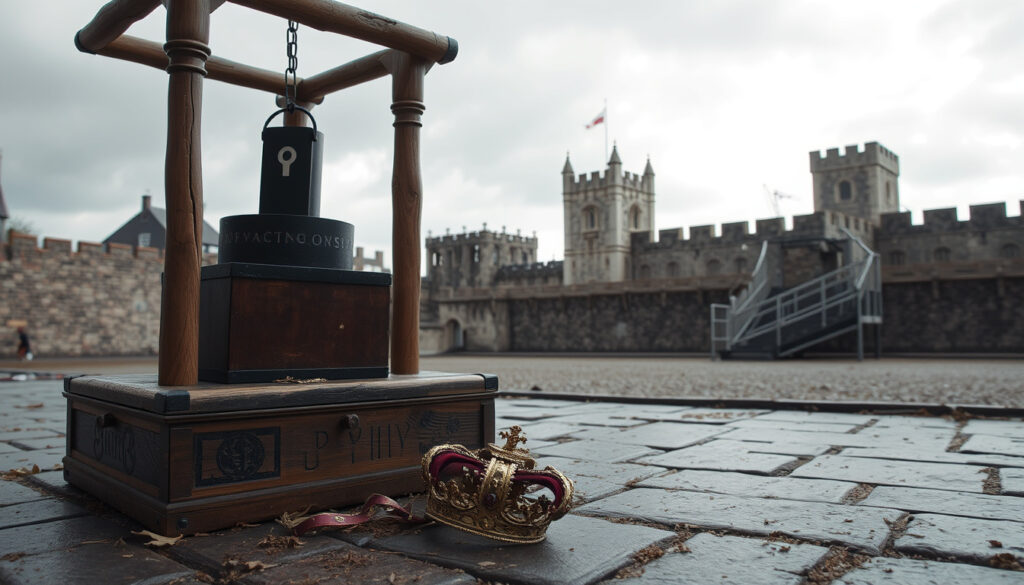
On 12 February 1554, Jane was led to the green on Tower Green for a private execution granted due to her noble status (Historic Royal Palaces). According to the London Museum, her final words were a quotation from Psalm 31: “Lord, into thy hands I commend my spirit” (London Museum (museum of London history)). She also professed her innocence of treason, saying that she had never desired the crown. Witnesses recorded that she asked the executioner to dispatch her quickly.
“Lord, into thy hands I commend my spirit.” — Lady Jane Grey, recorded by chroniclers (London Museum)
Who ordered the death of Lady Jane Grey?
Why did Queen Mary I order her execution?
Queen Mary I personally signed Jane’s death warrant. The execution followed Wyatt’s Rebellion, which broke out in January 1554. Jane’s father, Henry Grey, 1st Duke of Suffolk, joined the uprising, convincing Mary that Jane would remain a rallying point for Protestant rebels (Encyclopaedia Britannica (academic encyclopedia)). Mary reportedly agonized over the decision but ultimately saw no other way to secure her throne.
Jane was executed at the Tower of London, while her husband Guildford Dudley was executed separately on Tower Hill (London Museum). The dual execution eliminated both threads of Northumberland’s family line.
Mary I’s decision to execute a 16-year-old cousin was a cold political calculation. Jane’s survival would have invited further rebellion; her death removed a symbol of Protestant resistance.
Is Princess Diana related to Lady Jane Grey?
How is Lady Jane Grey connected to the Tudor royal line?
Lady Jane Grey was the great-granddaughter of Henry VII through his younger daughter Mary Tudor (the French queen). This made Jane a cousin of Edward VI, Mary I, and Elizabeth I, though the claim was weaker than the direct Tudor line (National Portrait Gallery (UK portrait collection)).
What is the family tree?
Princess Diana was descended from Henry VII through his elder daughter Margaret Tudor, who married James IV of Scotland. That lineage leads through the Stuart kings to Diana’s father, John Spencer, 8th Earl Spencer. Because both Jane and Diana share Henry VII as a common ancestor, they are distant cousins — separated by several generations (Encyclopaedia Britannica).
Six facts: two Tudor branches, one shared ancestor. Henry VII’s two daughters, Margaret and Mary, produced the Stuart and Grey lines respectively. Diana traces through Margaret; Jane through Mary.
Timeline signal
- 1536/1537 – Lady Jane Grey born at Bradgate Park, Leicestershire (Encyclopaedia Britannica)
- May 1553 – Marries Guildford Dudley (National Portrait Gallery)
- 6 July 1553 – Edward VI dies (The National Archives)
- 10 July 1553 – Proclaimed queen (Historic Royal Palaces)
- 19 July 1553 – Deposed by Mary Tudor (The Royal Family)
- August 1553 – Sent to the Tower of London (Historic Royal Palaces)
- February 1554 – Wyatt’s Rebellion occurs (Encyclopaedia Britannica)
- 12 February 1554 – Executed at the Tower (Historic Royal Palaces)
Confirmed facts
- Executed on 12 February 1554 (Historic Royal Palaces)
- Queen for 9 days in July 1553 (The Royal Family)
- Great-granddaughter of Henry VII (National Portrait Gallery)
- Last words included Psalm 31 (London Museum)
What’s unclear
- Exact birth date (sources vary between 1536 and 1537) (Wikipedia (community encyclopedia – tier3))
- Jane’s personal feelings about the crown – chroniclers disagree on her willingness
- Details of her relationship with Guildford Dudley – little firsthand evidence
Quotes from the period
“Lord, into thy hands I commend my spirit.” — Lady Jane Grey on the scaffold, 12 February 1554 (London Museum)
Mary I reportedly said that Jane’s execution was necessary to prevent “the ruin of the realm” (paraphrased from contemporary chronicles cited in Encyclopaedia Britannica)
Jane’s death turned a reluctant teenager into a Protestant icon. The mythologizing began almost immediately: ballads, chronicles, and later Victorian histories painted her as an innocent victim of power-hungry men (London Museum). The reality is more complex – Jane was both a pawn and a participant in a high-stakes dynastic gamble.
Related reading: Queen Elizabeth II Final Days
britannica.com, worldhistory.org, kids.britannica.com, luminarium.org, nationalarchives.gov.uk
Frequently asked questions
Who was Lady Jane Grey’s husband?
Lord Guildford Dudley, son of the Duke of Northumberland. They married in May 1553 (National Portrait Gallery).
What happened to Lady Jane Grey’s father?
Henry Grey, 1st Duke of Suffolk, was executed for treason in February 1554 after joining Wyatt’s Rebellion (Encyclopaedia Britannica).
Was Lady Jane Grey a Protestant?
Yes. She was raised as a committed Protestant and is often considered a Protestant martyr (London Museum).
Where is Lady Jane Grey buried?
She is buried at the Chapel Royal of St Peter ad Vincula within the Tower of London, alongside her husband (Historic Royal Palaces).
How old was Lady Jane Grey when she married?
About 16. She married Guildford Dudley in May 1553, less than two months before becoming queen.
Did Lady Jane Grey have children?
No. Her marriage lasted only a few months before she was imprisoned and executed.
For a modern reader, the story of Lady Jane Grey is a reminder that royal blood can be a death sentence when politics turns against you. Nine days on the throne cost her life. The choice for Mary I was clear: execute a rival or risk losing the crown. Jane became the cost of Tudor consolidation, and her legacy as a tragic queen endures precisely because she was so young and so powerless.
More related posts
 Chrishell Stause: G Flip, Justin Hartley & Selling Sunset Exit
 Norm Macdonald: SNL, The Orville, and Legacy of a Comedy Icon
 Carlo Acutis: Biography, Miracles, Death, and Canonization
 Light Switches Ireland: Types, Wiring & Prices
 Osama Bin Laden: Killing, Legal Debate & Family Aftermath
 David Coote Sentenced: Former Referee Gets Suspended Jail Term
 Sunetra Sarker: Age, Ethnicity, Casualty Roles & FAQs
 Henry Cole: Net Worth, Partner, Health, and Biography