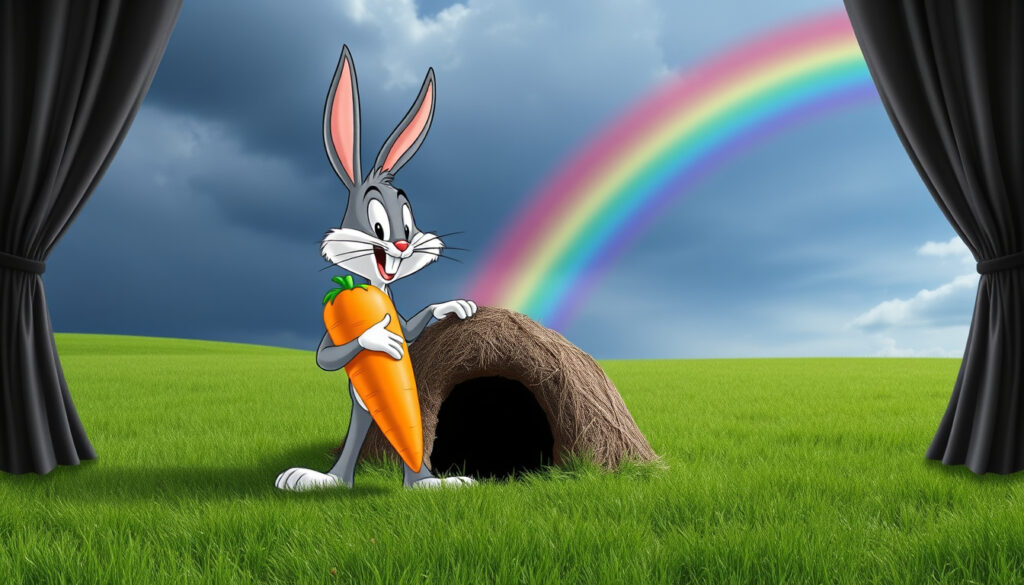
Bugs Bunny: Facts, LGBTQ Rumors, and Guide
Chances are you’ve heard Bugs Bunny’s signature “What’s up, Doc?” even if you’ve never sat through a classic Looney Tunes short. But beyond the catchphrase lies a character with a surprising history—one that touches on gender identity, rivalry, and decades of cultural evolution.
First appearance: 1938 (Porky’s Hare Hunt) · Primary creators: Tex Avery, Chuck Jones, Bob Clampett · Number of theatrical shorts: Over 175 · Catchphrase: “What’s up, Doc?”
Quick snapshot
- Bugs Bunny is a male anthropomorphic rabbit (Wikipedia entry)
- First appeared in 1938 in “Porky’s Hare Hunt” (Wikipedia entry)
- Primary voice actor was Mel Blanc (Britannica encyclopedia)
- Catchphrase: “What’s up, Doc?” (Wikipedia entry)
- Whether Bugs Bunny’s cross-dressing implies LGBTQ+ identity (no official statement from Warner Bros.)
- Whether Lola Bunny has autism (speculative, no confirmation)
- Whether Daffy Duck’s lisp qualifies as a disability
- Whether Bugs’ cross-dressing was intended for adult humor or children’s comedy
- 1938: First appearance in “Porky’s Hare Hunt” (Wikipedia entry)
- 1940: Official debut as “Bugs Bunny” in “A Wild Hare” (Wikipedia entry)
- 1950s: Peak of Looney Tunes shorts; Bugs becomes Warner Bros. mascot (Britannica encyclopedia)
- 1996: Starred in “Space Jam” alongside Michael Jordan (Britannica encyclopedia)
- Continues to appear in streaming series (HBO Max) and merchandise (Britannica encyclopedia)
- Ongoing debates about queer coding in classic cartoons (TheWrap article)
Six key reference points offer a quick spine for understanding the character.
| Label | Value |
|---|---|
| First appearance | 1938 (Porky’s Hare Hunt) |
| Primary creators | Tex Avery, Chuck Jones, Bob Clampett |
| Number of theatrical shorts | Over 175 |
| Catchphrase | “What’s up, Doc?” |
| Gender | Male |
| Species | Rabbit |
Why is Bugs Bunny so famous?
Origins and creation of Bugs Bunny
Bugs Bunny first appeared in 1938 in Porky’s Hare Hunt, a cartoon directed by Ben “Bugs” Hardaway — the source of the character’s nickname (Wikipedia entry). The design was refined over the next two years, and the official debut of the character as “Bugs Bunny” came in the 1940 short A Wild Hare, directed by Tex Avery (Wikipedia entry). His primary voice actor, Mel Blanc, famously described his approach: “I took the voice of a wise guy from Brooklyn and added a touch of rural farmer” (Encyclopedia.com biography).
Bugs quickly became the mascot of Warner Bros. Cartoons, starring in over 175 theatrical shorts (Britannica encyclopedia). Animator Chuck Jones said Bugs was “a cross between Dorothy Parker and Errol Flynn” (The Guardian article).
Catchphrases and personality traits
- “What’s up, Doc?” — first used in A Wild Hare (1940) and became his trademark (Wikipedia entry).
- Polite but combative: uses his wits to outsmart hunters (Elmer Fudd, Yosemite Sam) and rivals (Daffy Duck).
- Famous for nonchalant carrot chewing — originally a parody of Clark Gable’s carrot-eating in It Happened One Night (BBC Culture article).
Cultural impact and legacy
Bugs Bunny appears in everything from Space Jam (1996) to modern streaming series, and his image is used on merchandise worldwide (Britannica encyclopedia). He influenced generations of animators and comedians. The character also became a lightning rod for discussions about gender identity, as we’ll explore later. But first, let’s look at his romantic life and supporting cast.
Bugs Bunny’s fame rests on a perfect storm: impeccable comic timing, a memorable voice, and a mischievous personality that appealed across ages. He became the face of Warner Bros. and remains one of the most recognizable cartoon characters on Earth.
Bugs Bunny’s lasting appeal is no accident—it is a carefully crafted persona that resonates across generations.
Who is Bugs Bunny’s girlfriend?
Lola Bunny: introduction and character
Lola Bunny was introduced in the 1996 film Space Jam as a skilled basketball player and Bugs’ love interest (Wikipedia entry). She was voiced by Kath Soucie. The character was redesigned for the 2021 sequel Space Jam: A New Legacy to be less hyper-sexualized, reflecting changing social norms. There is no official information about Lola having autism; some fans have speculated based on her behavior, but no confirmation exists from Warner Bros. (CBR article).
Does Lola Bunny have autism?
As of 2025, no canonical source has labeled Lola Bunny as autistic. The speculation stems from a 2021 CBR article that noted certain social cues in her portrayal, but the author clearly labeled it as fan interpretation. The claim remains in the “unconfirmed” category.
What are the names of the Bugs Bunny characters?
Main characters in the Looney Tunes universe
The core cast includes Daffy Duck, Porky Pig, Elmer Fudd, Yosemite Sam, Tweety Bird, Sylvester, Marvin the Martian, and of course Bugs Bunny himself (Wikipedia entry). Each has distinct traits: Daffy is jealous and greedy, Porky is stuttering and kind, Elmer is a bumbling hunter.
Bugs Bunny’s closest friends and allies
- Daffy Duck — his frenemy; they share a competitive rivalry but occasionally team up (CBR article).
- Porky Pig — a friend and often a straight man to Bugs’ antics.
- Henery Hawk — a young chicken hunter who sometimes aids Bugs.
For readers interested in another iconic animated duck, check out our guide on Donald Duck Facts: Real Name, Twin Sister, and Richest Duck.
Is Bugs Bunny LGBTQ?
This question has gained renewed attention in the 2020s. Let’s look at the evidence.
Evidence and interpretations of Bugs Bunny’s gender fluidity
Bugs Bunny frequently cross-dressed in shorts from the 1940s and 1950s to outsmart opponents — dressing as a woman to distract Elmer Fudd, for example. Literary scholar Eric Savoy in 1995 called Bugs a “queer cultural icon” and a “parodie diva” in an essay published in Queer For Fear (JSTOR Daily article). A 2023 piece in Little White Lies described Bugs as “the most famous gender-nonconforming character in the world” (Little White Lies article).
Note: There is no official statement from Warner Bros. confirming Bugs Bunny as LGBTQ. The cross-dressing was done for comedic effect, not as an explicit identity statement. However, the coding is strong enough that a 2025 TheWrap article reported social-media users arguing Bugs was “canonically trans” in response to political comments about children’s media (TheWrap article). The character’s queerness is best understood as a cultural interpretation, not an official label.
Comparisons with Daffy Duck and Tweety Bird
Daffy Duck also engages in gender-bending humor, and Tweety Bird’s androgyny has led to similar questions. Tweety is officially male, as confirmed by Warner Bros. (Univision article). This pattern of queer coding across the Looney Tunes roster is well documented by animation historians.
Bugs Bunny’s gender play occurred under the strict Hays Code (1934–1968), making it a subversive act that now reads as a form of resistance. For a parallel in queer cultural history, see our profile of Marlene Dietrich: Life, Controversies, Lovers, and Iconic Quotes, another gender-bending icon.
The debate reflects how audiences project identity onto characters that were never explicitly labeled, making Bugs a canvas for cultural interpretation.
Why is Daffy such a jerk?
Daffy Duck’s character traits and personality
Daffy Duck is characterized as jealous, greedy, and selfish, often trying to steal the spotlight from Bugs (Wikipedia entry). His rivalry with Bugs is the engine of many classic shorts. Animators used his lisp — originally a speech impediment — to make him sound less heroic and more comical. Some fans have speculated that Daffy has a disability, but no official diagnosis exists.
Alleged disabilities and the jail episode
In the 1946 short The Big Snooze, Daffy tricks Bugs into quitting show business, leading to a madcap sequence where both end up in jail (Wikipedia entry). The plot involves Daffy sabotaging Bugs’ dream, showcasing Daffy’s petty jealousy. Daffy’s lisp is a consistent trait, but beyond that, no other disability has been verified.
The catch: Daffy’s “jerk” persona is a deliberate foil. Without him, Bugs wouldn’t be as cool. The rivalry is the heart of the Looney Tunes humour.
Timeline
- 1938 – First appearance in “Porky’s Hare Hunt” (Wikipedia entry)
- 1940 – Official debut as “Bugs Bunny” in “A Wild Hare” (Wikipedia entry)
- 1950s – Peak of Looney Tunes shorts; Bugs becomes Warner Bros. mascot (Britannica encyclopedia)
- 1996 – Stars in “Space Jam” (Wikipedia entry)
- 2020s – Appears in streaming series and merchandise; LGBTQ+ debate continues (TheWrap article)
Clarity section
Confirmed facts
- Bugs Bunny is a male anthropomorphic rabbit.
- He first appeared in 1938.
- Primary voice actor was Mel Blanc.
- His catchphrase is “What’s up, Doc?”
- He is a fictional character owned by Warner Bros.
- His cross-dressing was a comedic device, not an official identity statement.
What remains unclear
- Whether Bugs Bunny’s cross‑dressing implies LGBTQ+ identity (not official).
- Whether Lola Bunny has autism (speculative).
- Whether Daffy Duck’s lisp is a disability (not clinically diagnosed).
- The exact nature of Bugs and Daffy’s friendship (rivalry vs. camaraderie).
- Whether Bugs’ cross‑dressing was aimed at adult humor or children’s comedy.
Quotes from the creators
“Bugs is a cross between Dorothy Parker and Errol Flynn.”
— Chuck Jones, animator
“I took the voice of a wise guy from Brooklyn and added a touch of rural farmer.”
— Mel Blanc, voice actor
Bugs Bunny is more than a cartoon rabbit. He’s a cultural touchstone that has sparked discussions about gender, comedy, and the power of animation. For parents introducing their kids to classic cartoons, the challenge is separating historical context from modern sensibilities. For fans of queer media history, Bugs represents a fascinating case of subtext slipping past censors. Either way, the wascally wabbit has left an indelible mark.
messynessychic.com, cbr.com, thehardtimes.net, highsnobiety.com, buzztrend.uk, southernmonitor.org, lwlies.com, transreads.org
Frequently asked questions
How many Looney Tunes shorts feature Bugs Bunny?
Over 175 theatrical shorts were made during the Golden Age of Animation (Britannica encyclopedia).
Who voiced Bugs Bunny after Mel Blanc?
After Mel Blanc died in 1989, the role was taken over by Jeff Bergman, then others including Joe Alaskey and Eric Bauza (Wikipedia entry).
What is the name of Bugs Bunny’s best friend?
Bugs’ closest friend is often considered Porky Pig, though Daffy Duck is a frequent companion (with rivalry).
Why does Bugs Bunny say “What’s up, Doc?”
The phrase was inspired by a running gag in Tex Avery’s earlier cartoons; it became his signature line after A Wild Hare (BBC Culture article).
Has Bugs Bunny ever won an Oscar?
No, but Looney Tunes shorts won several Academy Awards; Bugs appeared in one Oscar-winning short, “Knighty Knight Bugs” (1958) (Oscars.org).
What is the origin of the name “Bugs”?
The nickname came from animator Ben “Bugs” Hardaway, who developed the early design (Wikipedia entry).
Is Bugs Bunny related to other cartoon rabbits?
No, he is a distinct Warner Bros. character; other famous rabbits include Roger Rabbit (Disney/Amblin) and the Easter Bunny.
More related posts
 What Is the UK Minimum Wage? 2025 Rates & 2026 Projections
 Howard Stern’s Net Worth, Controversies, and Broadcasting Career
 Vicky McClure: Biography, Net Worth, Relationships, and Career
 How Long Does Sunburn Last? Duration, Stages, and Healing Tips
 Stefan Salvatore: Character Profile and Death Explained
 Lacey Chabert: Biography, Career, Net Worth, and Personal Life
 What Happened to Julie Ming? The Murder That Changed UK Law
 Rio Ngumoha: Parents, Transfer Fee, Salary & Career