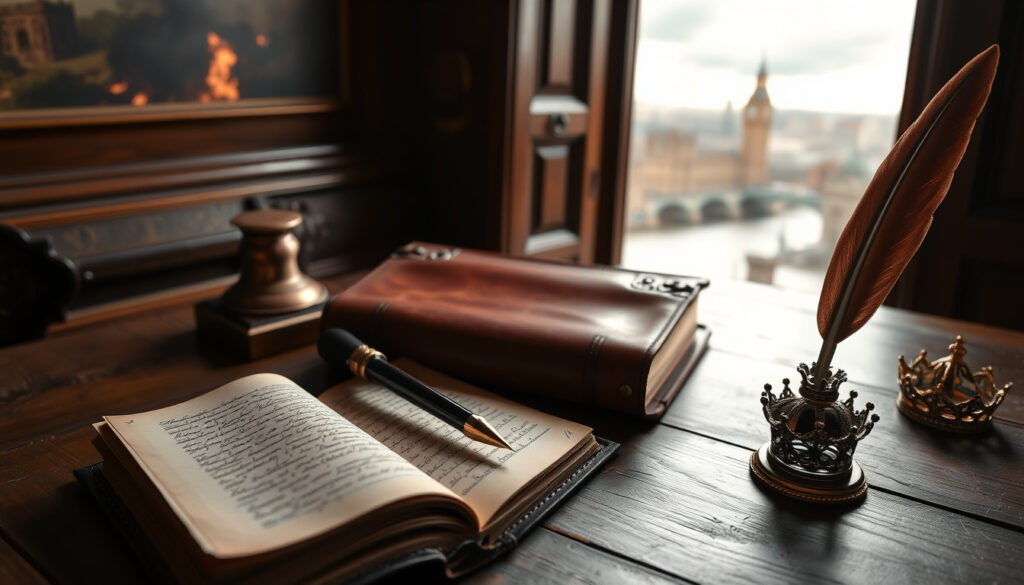
Samuel Pepys: His Diary, Great Fire, and Queen Kiss
Anyone who has ever wondered what it was really like to live through the Great Fire of London or the Plague has Samuel Pepys to thank. His diary, written between 1660 and 1669, captures daily life in Restoration England with an honesty that still feels fresh today.
Born: 23 February 1633, London, England · Died: 26 May 1703, London, England · Occupation: Diarist, naval administrator, Tory politician · Famous work: The Diary of Samuel Pepys (1660–1669) · Role in Great Fire of London: Advised the King and Navy on firefighting · Kissed a queen: Queen Catherine of Braganza
Quick snapshot
- Pepys wrote a daily diary from 1 January 1660 to 31 May 1669 (History Hit)
- He served as Secretary to the Admiralty and reformed naval administration (The National Archives)
- He witnessed and documented the Great Fire of London in September 1666 (The Diary of Samuel Pepys)
- The exact number of diary volumes originally written (six survive) (Wikipedia)
- Whether Pepys intended his diary for publication or kept it as a private record (Historic UK)
- Diary began: 1 January 1660 (Wikipedia)
- Great Fire of London: 2–6 September 1666 (BBC World Service)
- Last diary entry: 31 May 1669 (EyeWitness to History)
- Death: 26 May 1703 (History Hit)
- Pepys’ diary is being fully digitised and annotated by scholars (The Diary of Samuel Pepys)
- New research continues to explore his role in naval reform and Restoration politics (Historic UK)
The details of Pepys’ life form a consistent pattern: he was a man whose career in government placed him at the heart of the century’s defining crises.
| Label | Value |
|---|---|
| Full name | Samuel Pepys |
| Born | 23 February 1633, London, England |
| Died | 26 May 1703, London, England |
| Occupation | Diarist, naval administrator, politician |
| Famous for | Diary of Samuel Pepys (1660–1669) |
| Key event witnessed | Great Fire of London (1666) |
| Queen he kissed | Catherine of Braganza (1669) |
| Cause of death | Complications from kidney stones |
What is Samuel Pepys most famous for?
His role as a diarist
- Pepys began his diary on 1 January 1660, recording daily life in Restoration London (Wikipedia)
- The diary covers nearly a decade of his life, ending in 1669 when failing eyesight made writing impossible (History Hit)
- It is widely regarded as one of the most celebrated diaries in British literature (Wikipedia)
Pepys’ diary is the reason we know his name today. He wrote it in shorthand, a mix of Thomas Shelton’s system and his own abbreviations, which meant that even if someone found the six bound volumes, they could not read them without the key. The diary was not fully transcribed and published until the 19th century, when the Rev. John Smith spent three years decoding it. What emerged was a record of more than one million words that mentions over 3,000 people by name (Wikipedia).
Pepys turned the mundane—what he ate, who he argued with, which plays he saw—into a national treasure. His diary is not a polished memoir but a raw, daily pulse of a city in flux.
His work as a naval administrator
- Pepys served as a clerk of the Navy Board and later rose to become Chief Secretary of the Admiralty (History Hit)
- He reformed naval procurement, pay systems, and shipbuilding standards (The National Archives)
- His administrative work helped professionalise the Royal Navy in the late 17th century (Historic UK)
Pepys was not just a writer—he was a career civil servant who worked his way up from a modest London upbringing. His father was a tailor, but Pepys secured a place at Cambridge and, through family connections, landed a job at the Navy Board. By the time he became Secretary to the Admiralty, he had overhauled the way the navy bought supplies, paid its sailors, and built its ships. His diary often records the frustrations of this work: corrupt contractors, leaky vessels, and captains who padded their crew lists to pocket extra pay. His reforms were not always popular, but they were effective (Historic UK).
What did Samuel Pepys do in The Great Fire of London?
Advising the King and Duke of York
- Pepys was awakened in the early hours of 2 September 1666 by his maid Jane, who had spotted a fire in the Billingsgate area (Wikipedia)
- He went by boat to Whitehall to report what he had seen to King Charles II and the Duke of York (EyeWitness to History)
- He recommended demolishing houses in the fire’s path to create firebreaks (EyeWitness to History)
Pepys’ diary entry for 2 September 1666 is one of the most famous eyewitness accounts of the Great Fire. He wrote that from Barking Church he saw “the saddest sight of desolation that I ever saw” (The Diary of Samuel Pepys). The fire destroyed more than 13,000 houses and 87 churches, including St Paul’s Cathedral (History Hit). Pepys described St Paul’s on 7 September as “a miserable sight … with the roofs fallen” (History Hit). The National Archives notes that Pepys is one of only two eyewitnesses whose accounts of the fire survive (The National Archives).
Pepys advised the King to use gunpowder to blow up houses and create firebreaks—a drastic measure that saved parts of the city. But the same diary shows him worrying about his own belongings before the public good.
Ordering the creation of firebreaks
- Pepys returned to the city with orders from the King to pull down houses (EyeWitness to History)
- The firebreak strategy was eventually adopted, though delays meant the fire spread further than necessary (The National Archives)
- His diary records the confusion and panic of those days with visceral detail (The Diary of Samuel Pepys)
Pepys’ account is not just a dry report—it is full of human moments. He notes that the fire moved faster than anyone expected, that the wind shifted at the worst possible time, and that many people simply fled with whatever they could carry. His own house, office, and diary survived the fire, but he worried they might not (Historic UK).
Burying his Parmesan cheese and wine
- Pepys buried his wine and Parmesan cheese in his garden for safekeeping as the fire approached (Historic UK)
- This anecdote has become one of the most repeated stories about Pepys’ character (History Hit)
- It illustrates the mix of pragmatism and anxiety that defines his diary voice (The Diary of Samuel Pepys)
The cheese-burying episode is often cited as proof that Pepys was hilariously, humanly concerned with his creature comforts even as the city burned. But it also reveals something else: Pepys was a planner. He did not just panic—he took action, whether that meant saving his dinner or advising the King. The cheese survived, by the way, and Pepys mentions eating it later.
Which queen did Samuel Pepys kiss?
The occasion in Westminster Abbey
- Pepys kissed Queen Catherine of Braganza, wife of King Charles II, in Westminster Abbey in 1669 (History Hit)
- The event occurred during a ceremony at the Abbey, and Pepys described it in his diary as a “bold action” (Wikipedia)
- He recorded the queen’s reaction and his own nerves in characteristic detail (Historic UK)
Pepys’ diary entry for 1669 records that he kissed the queen “on the lips” as she passed through the Abbey. He notes that it was a breach of protocol—he was not supposed to touch the queen—but that she received it with good grace. The kiss became a talking point at court, and Pepys, ever the social climber, was both proud and embarrassed by it. The queen was Catherine of Braganza, a Portuguese princess who had married Charles II in 1662 as part of a political alliance that brought Bombay and Tangier to England (History Hit).
Context of the kiss
- Pepys was a known admirer of the queen, and his diary records several occasions when he saw her at court events (Wikipedia)
- The kiss was unusual because Pepys was not a nobleman—he was a civil servant who had risen through merit and connections (Historic UK)
- His detailed account of the kiss reflects his constant awareness of social status and his delight at crossing a boundary (The Diary of Samuel Pepys)
The kiss is a small moment in a long diary, but it reveals a lot about Pepys: his ambition, his charm, and his willingness to push the limits of his station. He was not a revolutionary, but he was a man who knew how to seize an opportunity.
What is Samuel Pepys most famous work?
The diary itself
- Pepys’ diary is his most famous work, covering the period from 1660 to 1669 (History Hit)
- It is considered one of the most important primary sources for understanding Restoration England (The National Archives)
- The diary offers a unique window into daily life, politics, culture, and disaster in 17th-century London (Historic UK)
The diary is not a single bound book but six volumes of tightly packed handwriting. Pepys wrote in shorthand, using a system that allowed him to write quickly and privately. He recorded everything: the plays he saw, the books he read, the meals he ate, the arguments he had with his wife Elizabeth, the affairs he pursued, and the political gossip he heard at court. He also recorded the big events—the Restoration of the monarchy in 1660, the Great Plague of 1665, and the Great Fire of 1666 (History Hit).
Most historical records from the 17th century are official documents—letters, ledgers, treaties. Pepys’ diary is the opposite: unguarded, personal, and sometimes embarrassing. It is the closest thing we have to a time machine.
Its publication history
- The diary was written in shorthand and was not deciphered until the 19th century (Wikipedia)
- The Rev. John Smith spent three years decoding the shorthand, completing the first transcription in 1825 (Wikipedia)
- Since then, the diary has been published in multiple editions, with the most complete edition running to 11 volumes (Historic UK)
Pepys left his library to Magdalene College, Cambridge, where the diary remained largely unread for over a century. The shorthand was the main barrier, but so was Pepys’ own discretion—he had encoded his most intimate passages, including his extramarital affairs, in a cipher that even the shorthand system could not decode directly. It was not until the 1970s that a full, unexpurgated edition was published (Wikipedia).
Why is Samuel Pepys so important?
Historical significance of the diary
- Pepys’ diary provides unique insight into daily life and major events of 17th-century London (Historic UK)
- It is a primary source for the Restoration, the Great Plague, and the Great Fire of London (The National Archives)
- The diary is used by historians, literature scholars, and social scientists as a cross-disciplinary resource (BBC World Service)
Pepys’ diary is important because it fills a gap that official records leave empty. We know when the King signed a treaty, but we do not know how people talked about it in the street. Pepys tells us. He records the mood of the city, the price of bread, the spread of rumours, the fear of the plague, and the relief of the fire’s end. The BBC describes Pepys as one of the diarists who witnessed the Great Fire of London firsthand, and his account is taught in schools as a model of eyewitness reporting (BBC World Service).
Administrative reforms in the Royal Navy
- Pepys reformed naval administration and procurement, making the navy more efficient (History Hit)
- He served as a member of Parliament and as President of the Royal Society from 1684 to 1686 (Wikipedia)
- His administrative legacy outlasted his political career and influenced British naval policy for decades (Historic UK)
Pepys was not just a diarist—he was a reformer. He standardised naval contracts, introduced better accounting practices, and pushed for ships that could outrun and outfight their French and Dutch counterparts. His work at the Admiralty is often overshadowed by the diary, but naval historians consider him one of the most effective administrators of the 17th century (Historic UK).
How is Samuel Pepys pronounced?
Standard pronunciation
- The standard English pronunciation is /piːps/ — like “peeps” (Wikipedia)
- Historical records and modern dictionaries confirm the single-syllable pronunciation (History Hit)
- The name is often mispronounced with two syllables (PEP-iss) by those who have only read it (Wikipedia)
Common mispronunciations
- Many people say “PEP-iss” (two syllables) because the spelling suggests a longer vowel (Wikipedia)
- In Pepys’ own time, the name was pronounced “peeps” — the same as the modern standard (Historic UK)
- The pronunciation is confirmed by contemporary records and by the diary itself, which uses wordplay that only works with “peeps” (The Diary of Samuel Pepys)
Pepys himself spelled his name consistently, and the pronunciation is not in serious doubt. The confusion arises because English spelling and pronunciation diverged in the centuries after his death. If you meet a historian who says “PEP-iss,” you can gently correct them—or just nod and enjoy the irony that Pepys himself would have found it amusing.
The catch: The mispronunciation is so common that even some well-educated readers get it wrong. But the correct pronunciation is “peeps” — short, sharp, and one syllable, just like the man himself.
Timeline of Samuel Pepys’ life
Ten key dates, one pattern: Pepys’ life was a series of intersections with the major events of his century, from the Restoration to the Fire to the rise of the Royal Society.
- 23 February 1633 — Samuel Pepys born in London (History Hit)
- 1655 — Married Elizabeth St Michel (Wikipedia)
- 1 January 1660 — Began writing his diary (Wikipedia)
- 1660–1669 — Worked as clerk of the Navy Board (History Hit)
- 1665 — Witnessed the Great Plague of London (History Hit)
- September 1666 — Witnessed and documented the Great Fire of London (The Diary of Samuel Pepys)
- 1669 — Kissed Queen Catherine of Braganza at Westminster Abbey (History Hit)
- 31 May 1669 — Last diary entry due to failing eyesight (EyeWitness to History)
- 1684–1686 — President of the Royal Society (Wikipedia)
- 26 May 1703 — Died in London (History Hit)
What is confirmed and what remains unclear
Confirmed facts
- Pepys wrote a diary from 1660 to 1669 (History Hit)
- He served as Secretary to the Admiralty (The National Archives)
- He witnessed and wrote about the Great Fire of London (The Diary of Samuel Pepys)
- He kissed Queen Catherine of Braganza in Westminster Abbey (History Hit)
- He died on 26 May 1703 (History Hit)
What’s unclear
- The exact number of volumes of his diary originally written (though six survive) (Wikipedia)
- Whether he intended his diary for publication or private record (Historic UK)
Quotes from and about Samuel Pepys
“I saw the saddest sight of desolation that I ever saw.”Samuel Pepys, diary entry describing the Great Fire of London from Barking Church, 2 September 1666 (The Diary of Samuel Pepys)
“I did kiss the Queen’s lips, which was a bold thing, and she did not take it ill.”Samuel Pepys, diary entry from 1669 describing the kiss of Queen Catherine of Braganza (History Hit)
“Blessed be God, a good day. I did walk to the Tower and saw the King’s barge go by with the King and the Duke of York, and the people did shout with great joy.”Samuel Pepys, diary entry from 1660 reflecting on the Restoration of the monarchy (The Diary of Samuel Pepys)
“Pepys is one of the most celebrated diarists in British history, and his account of the Great Fire is the most vivid we have.”The National Archives, describing the significance of Pepys’ eyewitness testimony (The National Archives)
For someone who lived nearly 400 years ago, Samuel Pepys still has a direct line to the present. His diary is not a dusty relic—it is a living document that continues to be read, studied, and quoted. The reason is not just the events he witnessed, but the way he wrote about them: with curiosity, honesty, and a complete lack of self-censorship. For anyone trying to understand what it actually felt like to be alive in 17th-century London, the choice is clear: read Pepys, or settle for second-hand accounts.
howtopronounce.com, pepysdiary.com, graceelliot-author.blogspot.com, journals.psu.edu, hotellradarn.se
Frequently asked questions
Where did Samuel Pepys bury his cheese during the Great Fire?
Pepys buried his Parmesan cheese and a bottle of wine in his garden on 4 September 1666, as the fire threatened his home in Seething Lane. He later retrieved them, and the cheese survived (Historic UK).
What other food did Samuel Pepys mention in his diary?
Pepys mentioned a wide range of foods, including oysters, venison, mutton, turkey, and wine. He often recorded what he ate for dinner and how much it cost (The Diary of Samuel Pepys).
Did Samuel Pepys have children?
Pepys and his wife Elizabeth did not have any surviving children. Elizabeth had a miscarriage in 1666, and Pepys fathered at least one illegitimate child, a son named John, who died in infancy (Wikipedia).
How long did Samuel Pepys write his diary?
Pepys wrote his diary for almost ten years, from 1 January 1660 to 31 May 1669, when he stopped because his eyesight was failing (EyeWitness to History).
What happened to Elizabeth Pepys?
Elizabeth Pepys, Samuel’s wife, died in 1669 at the age of 29, likely from a fever. Samuel was devastated and wrote about his grief in his diary. He never remarried (Wikipedia).
Is Samuel Pepys’ diary still in print?
Yes, the diary is still in print in multiple editions. The most complete scholarly edition is the 11-volume set published by the University of California Press. Abridged versions are widely available (Historic UK).
What was Pepys’ role in the Royal Society?
Pepys served as President of the Royal Society from 1684 to 1686. He was elected a Fellow in 1665 and was an active member who attended meetings and corresponded with scientists. His library, now at Cambridge, includes many scientific works (Wikipedia).
More related posts
 Alex Belfield: Stalking Conviction and 2026 Prison Recall
 Ian Lavender: Dad’s Army star dies aged 77
 Jason Bateman Movies and TV Shows – 40-Year Career Highlights
 Jeffrey Dean Morgan: Biography, Wife, Kids, Weight Loss, and Facts
 The Conjuring Last Rites – Release Date, Cast, True Story and Where to Watch
 Jessica Gunning: Biography, Age, Accent, Net Worth
 Daniel Gillies: Marriage, Net Worth, Accent, and Current Projects
 Erika Kirk Biography: Age, Family, and Turning Point USA CEO Role