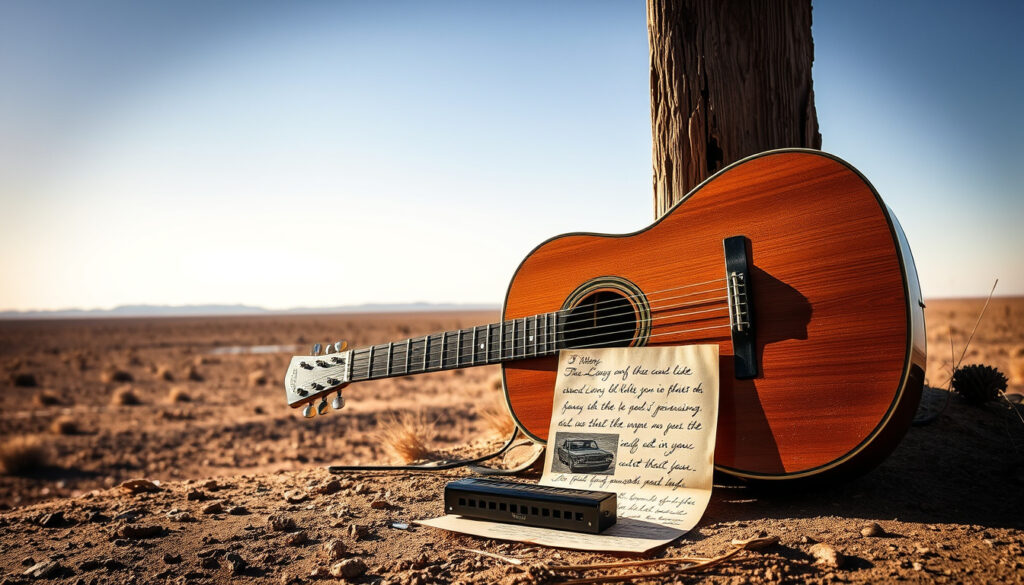
Woody Guthrie: Life, Death, and Dylan Connection
Ask any folk music fan which songwriter shaped the conscience of American music, and a handful of names come up — but Woody Guthrie’s often lands first: born in Okemah, Oklahoma on July 14, 1912, he went on to write over 1,000 songs, including the enduring anthem “This Land Is Your Land.” This guide traces his life, explores his profound influence on Bob Dylan, and shows why his music still resonates nearly six decades after his death.
Born: July 14, 1912 ·
Died: October 3, 1967 ·
Cause of death: Huntington’s disease ·
Famous song: This Land Is Your Land ·
Notable album: Dust Bowl Ballads (1940)
Quick snapshot
- Born July 14, 1912 in Okemah, Oklahoma (Official Woody Guthrie website)
- Wrote “This Land Is Your Land” in 1940 (Official Woody Guthrie website)
- Died October 3, 1967 from Huntington’s disease (Official Woody Guthrie website)
- Bob Dylan visited Guthrie in the hospital in 1961 (PBS American Masters) (Official Woody Guthrie website)
- Exact number of songs written (estimates range from 800 to over 1,000)
- Full original lyrics of some early songs exist in multiple variants
- Details of his teenage travels are partly anecdotal
- The full extent of Guthrie’s influence on Bob Dylan is debated by historians
- 1961: Bob Dylan visits Guthrie at Greystone Park Hospital in New Jersey (PBS American Masters)
- Woody Guthrie Center in Tulsa continues to preserve and promote his work (Woody Guthrie Center)
Seven key facts, one pattern: Guthrie’s life was a mirror of the American experience — hardship, migration, and a relentless drive to give voice to the voiceless.
| Label | Value |
|---|---|
| Full name | Woodrow Wilson Guthrie |
| Born | July 14, 1912 |
| Died | October 3, 1967 |
| Cause of death | Huntington’s disease |
| Genre | Folk |
| Spouse | Marjorie Mazia (1945–1953) |
| Number of songs | Over 1,000 (estimates) |
Did Bob Dylan Actually Meet Woody Guthrie?
Did Bob Dylan visit Woody Guthrie in the hospital?
Yes. In 1961, a 20-year-old Bob Dylan traveled from Minnesota to New Jersey to visit his idol at Greystone Park Hospital, where Guthrie was being treated for Huntington’s disease. According to PBS American Masters (public broadcaster historical archive), the encounter was a turning point in Dylan’s early career.
Did Bob Dylan meet Pete Seeger at the same time?
Dylan met Pete Seeger during that same visit, and Seeger became Dylan’s early mentor, helping him gain entry into the New York folk scene. The meeting is documented in PopMatters (music culture review outlet).
What this means: The hospital visit cemented the succession of American folk music — Guthrie passed the torch, and Dylan ran with it.
What Was the Cause of Death of Woody Guthrie?
What is Huntington’s disease?
Huntington’s disease is a hereditary neurodegenerative disorder that causes involuntary movements, cognitive decline, and mood disturbances. According to Britannica (encyclopedic medical reference), the onset typically occurs in the 30s or 40s.
How long was Guthrie hospitalized?
Guthrie was admitted to Greystone Park Hospital in New Jersey in 1952 and later transferred to Creedmoor State Hospital in Queens, New York, where he died on October 3, 1967 at age 55, per Coney Island History Project (community historical organization).
The trade-off: Guthrie’s most prolific years came before his diagnosis, but even during his illness he continued to write and inspire, as noted by Woody Guthrie Center (museum and archive).
What Was Woody Guthrie’s Most Famous Song?
What is the story behind “This Land Is Your Land”?
Guthrie wrote the song in 1940 as a response to Irving Berlin’s “God Bless America.” He was frustrated by the song’s complacency and wanted to pen a “people’s anthem” that acknowledged the struggles of the working class. The original version included verses about private property and poverty. The full original lyrics are preserved at Official Woody Guthrie website (artist foundation archive).
How did the song become an American anthem?
After Guthrie’s death, the song was popularized by many artists, including Pete Seeger, Bruce Springsteen, and countless school choirs. It has become a staple at political rallies and patriotic events. Smithsonian Magazine (cultural history publication) notes that its melody is so embedded that many hear it as a traditional folk tune.
The paradox: A song written as a protest against uncritical patriotism is today sung as a patriotic standard — evidence of Guthrie’s enduring, and complicated, legacy.
Why Did Bob Dylan Love Woody Guthrie?
What did Dylan say about Guthrie?
“Woody Guthrie was my last idol.”
Bob Dylan, quoted in PBS American Masters
Dylan wrote a tribute song, “Song to Woody,” in 1961, and often cited Guthrie’s unvarnished storytelling and commitment to the “protest song” as formative. According to Britannica (editorial biographical reference), Dylan modeled his early public persona — the rambling, harmonica-wielding troubadour — directly after Guthrie.
How did Guthrie inspire Dylan’s music?
From the acoustic fingerpicking to the colloquial, direct lyrics, Dylan’s first album (1962) is saturated with Guthrie’s influence. PopMatters argues that without Guthrie’s example, Dylan might never have found his voice as a political folk singer.
Why this matters: The mentor-student link between Guthrie and Dylan is the single most important chain in American folk music’s evolution.
What Was Woody Guthrie’s Early Life and Career?
Where did Woody Guthrie grow up?
He was born in Okemah, Oklahoma, a small farm town. His early life was marked by tragedy: a house fire, his sister’s death, his mother’s institutionalization for mental illness, and the family’s financial collapse during the Dust Bowl. The Official Woody Guthrie website (tier1 biography) details how these events drove him to leave home at age 14 and ride the rails.
What events shaped his music?
As a migrant worker traveling through Texas, California, and the Pacific Northwest, Guthrie experienced the Great Depression and the Dust Bowl firsthand. He began writing songs about the plight of workers, the Okies, and the migrant families he met. In 1940 he arrived in New York City, where the official site notes he became part of the leftist folk scene and quickly produced Dust Bowl Ballads.
The pattern: Guthrie transformed personal hardship into universal anthems, turning migrant labor and Dust Bowl devastation into the raw material for a new American folk idiom.
What Is Woody Guthrie’s Lasting Legacy?
How did Guthrie influence modern folk music?
Beyond Dylan, Guthrie’s direct influence extends to Pete Seeger, Joan Baez, Bruce Springsteen, and a generation of protest singers such as Ani DiFranco and Billy Bragg. Smithsonian Magazine calls him “the original foul‑weather folk singer,” a label that captures his gritty authenticity. Other notable biographies include Eartha Kitt: Biography, Ethnicity, Blacklist, and Legacy and Neil Diamond: Health, Personal Life, and Famous Songs, both available on this site.
What is the Woody Guthrie Center?
The Woody Guthrie Center in Tulsa, Oklahoma, opened in 2013 as a museum and archive dedicated to preserving his papers, lyrics, art, and personal artifacts. According to Woody Guthrie Center (tier1 institution), it’s a hub for scholars and fans who want to understand the intersection of music and social justice.
For today’s artists, the implication is clear: Guthrie proved that a folk song can be both a personal expression and a political weapon, a standard that still challenges songwriters to be truthful and bold.
Timeline of Woody Guthrie’s Life
- 1912 – Woodrow Wilson Guthrie born in Okemah, Oklahoma (Official site)
- 1930s – Travels across the U.S. as a migrant worker, begins performing (PBS American Masters)
- 1940 – Writes “This Land Is Your Land”; moves to New York City (Official site)
- 1941 – Dust Bowl Ballads album released (PBS American Masters)
- 1952 – Diagnosed with Huntington’s disease (Coney Island History Project)
- 1961 – Bob Dylan visits Guthrie in hospital (PBS American Masters)
- 1967 – Dies at age 55 in Queens, New York (Coney Island History Project)
- 2013 – Woody Guthrie Center opens in Tulsa, Oklahoma (Woody Guthrie Center)
The timeline shows Guthrie’s peak creative output was compressed into just 10 years (1940–1950), yet his influence ripples through five decades of American music.
Confirmed Facts and What Remains Unclear
Confirmed facts
- Cause of death: Huntington’s disease (multiple sources: Britannica, Coney Island History Project)
- Bob Dylan visited Guthrie in 1961 (PBS American Masters)
- Guthrie wrote “This Land Is Your Land” in 1940 (Official site)
- He died on October 3, 1967 (Official site)
What’s unclear
- Exact number of songs Guthrie wrote (hundreds up to 1,000+)
- Full original lyrics of some songs (multiple variations)
- Details of his early travels are partly anecdotal
- The full extent of Guthrie’s influence on Bob Dylan is debated by historians
Quotes and Perspectives
“This land is your land, this land is my land — from California to the New York island.”
Woody Guthrie, “This Land Is Your Land” (Official Woody Guthrie website)
“Woody sang what he saw, and what he saw was the heart of America — its pain, its hope, its toughness.”
Pete Seeger, as quoted in Smithsonian Magazine
Both quotes capture Guthrie’s mission: to give voice to the voiceless. But the irony remains — his most political song became a corporate-backed patriotic anthem.
The full transcript of Bob Dylan’s early interviews with Guthrie’s biographers is preserved at Voices of Oklahoma (oral history archive).
For the next generation of folk musicians, the challenge is clear: Guthrie’s legacy is not just a catalog of songs, but an example of how music can hold power accountable. Whether you are a protest singer, a schoolteacher, or a museum director preserving his papers, the question remains — are you willing to tell the truth the way Woody did?
blackwing602.com, en.wikipedia.org, tedtockscovers.wordpress.com, youtube.com, americamagazine.org, xn--pressinkym-w5ad.fi
For a deeper look at Guthrie’s later legacy, including his surprising Trump song and Dylan’s hospital visit, see Guthries Trump song controversy.
Frequently asked questions
Where was Woody Guthrie born?
Okemah, Oklahoma, on July 14, 1912 (Official website).
How many songs did Woody Guthrie write?
Estimates range from about 800 to over 1,000 recorded songs (Britannica).
What is the Woody Guthrie Center?
A museum and archive in Tulsa, Oklahoma, opened in 2013, dedicated to preserving Guthrie’s work and legacy (Woody Guthrie Center).
What political views did Woody Guthrie hold?
He was a committed leftist and activist, aligning with labor unions and the American Communist Party in the 1930s–40s, though he was never a formal member (EBSCO Research Starters).
Did Woody Guthrie have children?
Yes, he had eight children with three wives. His daughter with Marjorie Mazia, Nora Guthrie, became a dedicated archivist of his work (Woody Guthrie Center).
What instruments did Woody Guthrie play?
Primarily guitar, harmonica (mounted on a rack), and occasionally mandolin and fiddle.
Did Woody Guthrie serve in the military?
Yes, he was drafted into the U.S. Army on V‑E Day in 1945, but he never saw combat because his draft was late in the war (PBS American Masters).
Who are some artists influenced by Woody Guthrie?
Bob Dylan, Pete Seeger, Bruce Springsteen, Joan Baez, Billy Bragg, Ani DiFranco, and many more (PopMatters).
More related posts
 Dmitri Shostakovich: Life, Works, and Stalin-Era Controversy
 Sergio Ramos: Free Agent, Wife, Net Worth, Age, Career
 Cute Pictures: Free Images, Wallpaper & Profile Ideas
 James May: Health, Relationships, Net Worth, Metrosexual Label
 Maxwell Caulfield: Age at Marriage, Children, Grease 2 & Life Now
 Henry Cole: Net Worth, Partner, Health, and Biography
 Alexa Bliss: Her Real Life, Health, and WWE Relationships
 Diana Dors: Secret Code, Missing Millions, and the Krays